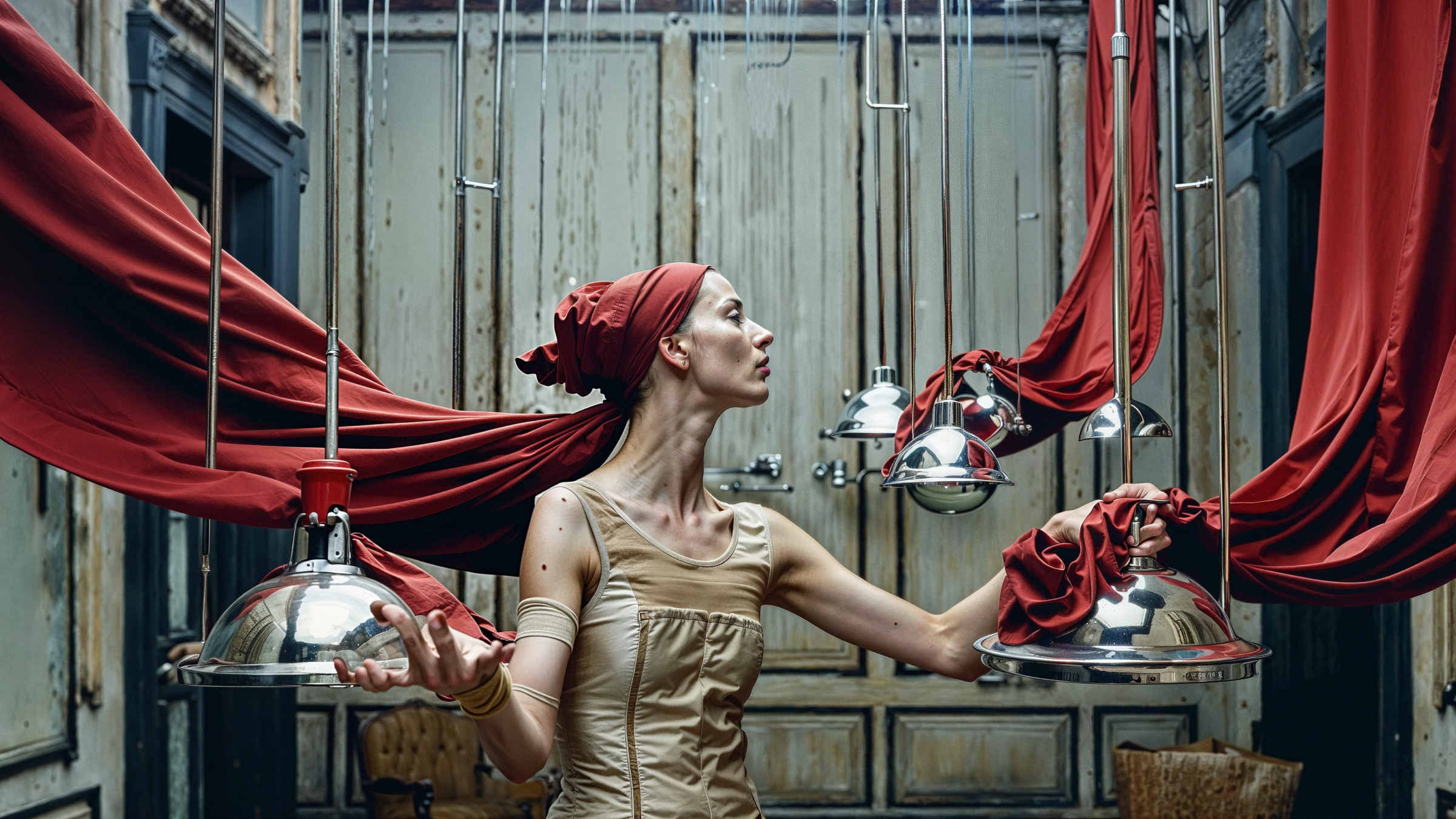
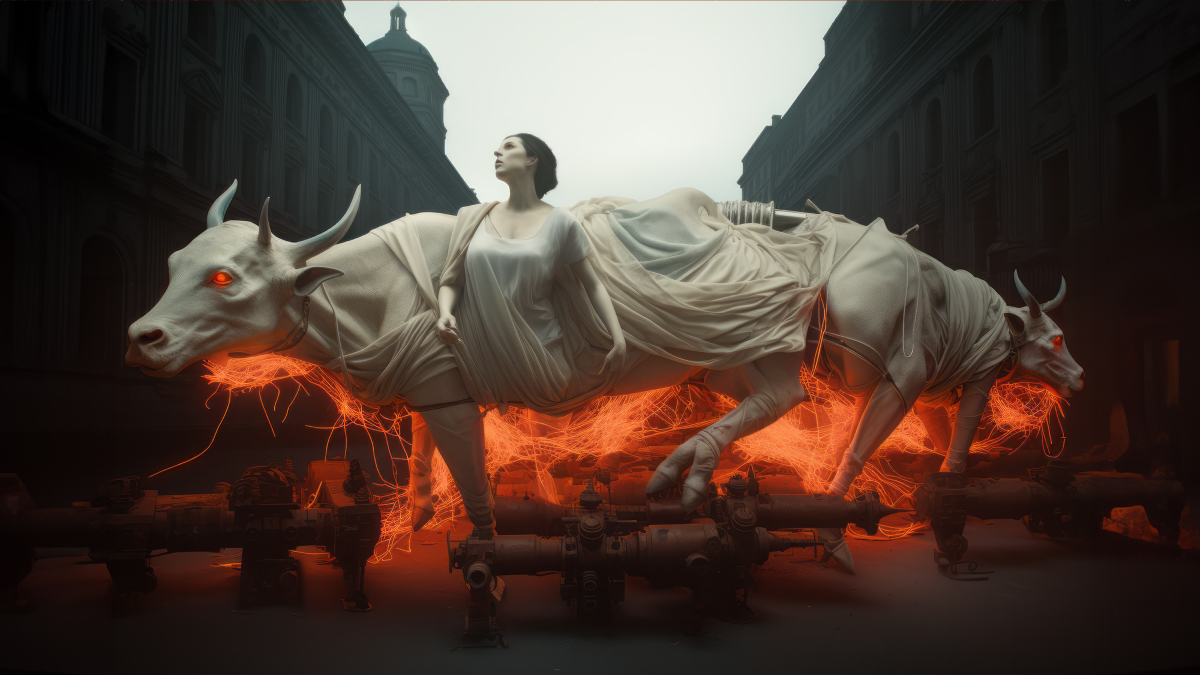
Thomas Trail, Silk, generative image synthesis, 2025.
four questions to//Jul 2025
How is AI influencing your artistic evolution?
AI lets me bring images to life that used to stay stuck in my head. It breaks the limits of cameras, budgets, and real-world time. I use it to chase ideas faster—and dive deeper into image creation and storytelling.
Can you outline your creative process for a work developed with AI?
I often start with my own photos—fragments from my life. Feeding them into AI feels like building a diary from my dreams. Then I layer prompts and direct the image like a film scene, refining until it lands on something that feels true to who I am.
Thomas Trail, Matadero, generative image synthesis, 2025.
How do you handle surprises and challenges in AI collaboration?
I don’t push back against surprises. Some of my most honest images come from accidents. I treat the process like a conversation—half control, half letting go.
What is AI good for?
AI is good for disrupting creative habits. It pushes me out of routine and into new ways of seeing. It opens the gates—gives more people a way in. It lets artists who’ve been historically left out of image making to finally build worlds on their terms.
In Print//Apr 2026
Essay, published in The AI Art Magazine, Number 3
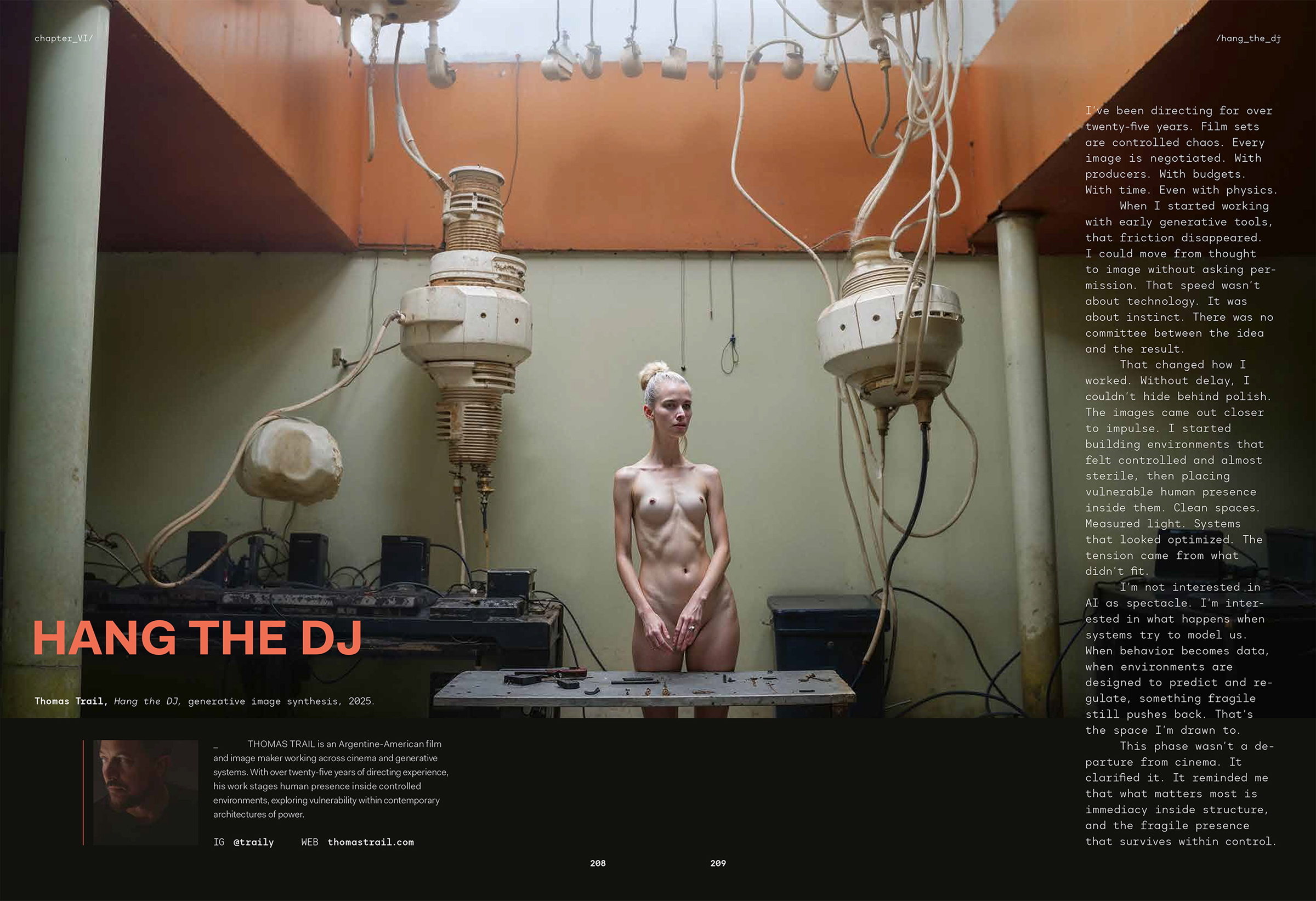
Hang the DJ
I’ve been directing for over twenty-five years. Film sets are controlled chaos. Every image is negotiated. With producers. With budgets. With time. Even with physics.
When I started working with early generative tools, that friction disappeared. I could move from thought to image without asking permission. That speed wasn’t about technology. It was about instinct. There was no committee between the idea and the result.
That changed how I worked. Without delay, I couldn’t hide behind polish. The images came out closer to impulse. I started building environments that felt controlled and almost sterile, then placing vulnerable human presence inside them. Clean spaces. Measured light. Systems that looked optimized. The tension came from what didn’t fit. I’m not interested in AI as spectacle. I’m interested in what happens when systems try to model us. When behavior becomes data, when environments are designed to predict and regulate, something fragile still pushes back. That’s the space I’m drawn to. This phase wasn’t a departure from cinema. It clarified it. It reminded me that what matters most is immediacy inside structure, and the fragile presence that survives within control.
Project//Sep 2026
Saturnalia
2026
Saturnalia takes its name from the ancient Roman festival held in honour of Saturn, traditionally celebrated in December. For several days, ordinary social order was loosened: work paused, gifts were exchanged, public feasting took place, and established hierarchies could temporarily shift or reverse. The festival combined celebration with suspension, excess with ritual, creating a brief interval in which the usual rules no longer fully applied.
This historical idea becomes a point of departure for imagining a later, unstable version of the ritual, where ceremony, spectacle, hierarchy and witness remain, but their meaning has shifted.
Cameras appear openly within the film as objects from another technological age, reflecting the possibility that tools once central to filmmaking may themselves become artifacts. Using contemporary AI models, Saturnalia constructs a world in which the ancient and the obsolete begin to fold into one another.
Thomas Trail, Saturnalia, generetive film synthesis, ongoing project.
About the artist
Thomas Trail
Film and Image maker
Thomas Trail is an Argentine-American film and image maker working across cinema and generative systems. With over twenty-five years of directing experience, his work stages human presence inside controlled environments, exploring vulnerability within contemporary architectures of power.
The AI Art Magazine emerged from the desire to set something lasting against the constant flux of digital image streams. Each issue can be understood as a kind of “water sample”: an archive of a moment at the intersection of art and artificial intelligence, taken from a current that keeps moving.