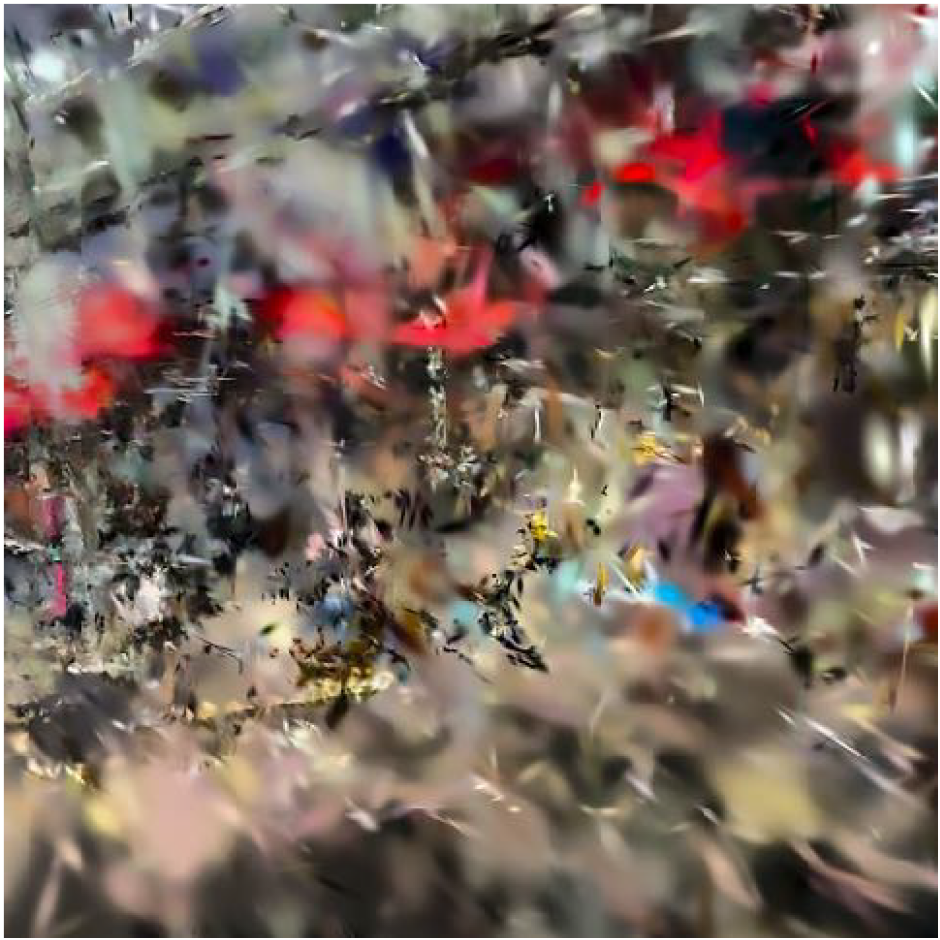
Critical Zones emerges from a deviation. Although I have been working with AI since 2017, I had never used Suno AI. The initial impulse was simple: to test whether I could recreate the sound of one of the vignettes from my audiovisual performance Zonas Críticas, a project that had already incorporated synthetic voices generated with early AI systems.
As I began exploring Suno, I introduced a constraint. I asked ChatGPT to generate lyrics based on the conceptual universe of Critical Zones. This was not meant as an end in itself, but as a fixed element, a baseline against which the system could be tested. I expected something unstable, slightly off, perhaps even nonsensical — a form of tension that could push the algorithm away from its default solutions. And that is precisely what emerged.
From there, I began to iterate. The same lyrics were submitted through different prompts, emulating multiple genres and stylistic conditions. What followed was a process of observation: patterns, repetitions, limits, and biases gradually became visible, alongside small deviations and unexpected variations. The system revealed itself not only through what it produced, but through what it insisted on repeating.
More than thirty tracks were generated in a short span of time. At a certain point, the
experiment shifted. It was no longer about testing the system, but about following its
implications. The idea of an album emerged.
The project became an “artist album” in which all tracks share the same lyrics. Rather than
functioning as remixes, the pieces operate as reenactments: the same textual structure
unfolding under different technical and aesthetic conditions. Each track exposes a slightly
different configuration of the system’s internal logic.
A key condition was established early on: nothing would be edited. The lyrics remained
untouched. The generated audio was not modified. Only minimal adjustments were made at the level of prompts. The process remains visible in its raw state, including its redundancies, clichés, and inconsistencies.
What surfaces are the biases of the system: standardized solutions, familiar structures,
predictable gestures. But also fissures — moments in which something slips, where
coherence falters and another kind of signal appears. These moments are not necessarily
superior, but they destabilize the expected.
In this mirror, an unavoidable question arises: to what extent does human creativity also operate through repetition, repertoire, and automatism?
Since the early twentieth century, artistic practices have continuously challenged the
boundaries between object, process, and context. When Marcel Duchamp repositioned an
everyday object as art, the gesture was not about the object itself, but about shifting the
conditions under which meaning is produced.
AI enters this lineage not as a rupture, but as an intensification. It amplifies processes that
were already present: iteration, recombination, pattern recognition. At the same time, it
introduces new layers of opacity, speed, and scale. This work does not try to resolve anything. It insists on looking at all of this as it unfolds.