< Artists
INTERVIEW by Simone Brauner
SEP 22, 2026

john gerrard: SPIRITS

SPIRITS by Irish artist John Gerrard is a year-long commission for the Art + Technology Lab at the Los Angeles County Museum of Art (LACMA). Running from the Winter Solstice of 2025 to the Winter Solstice of 2026, this digital solo exhibition is presented permanently directly on LACMA’s homepage. The release of the 96 virtual sculptures unfolds in four stages timed to the year's primary astronomical events: the solstices and equinoxes.
john_gerrard, SPIRITS, Screenshot 2026-08-27 at 18.20.36
Simone Brauner. SPIRITS is structured through numbers and cycles: 96 objects, 24 hours, four bodies of water, four astronomical moments. Why does your work submit itself to such rigorous logic
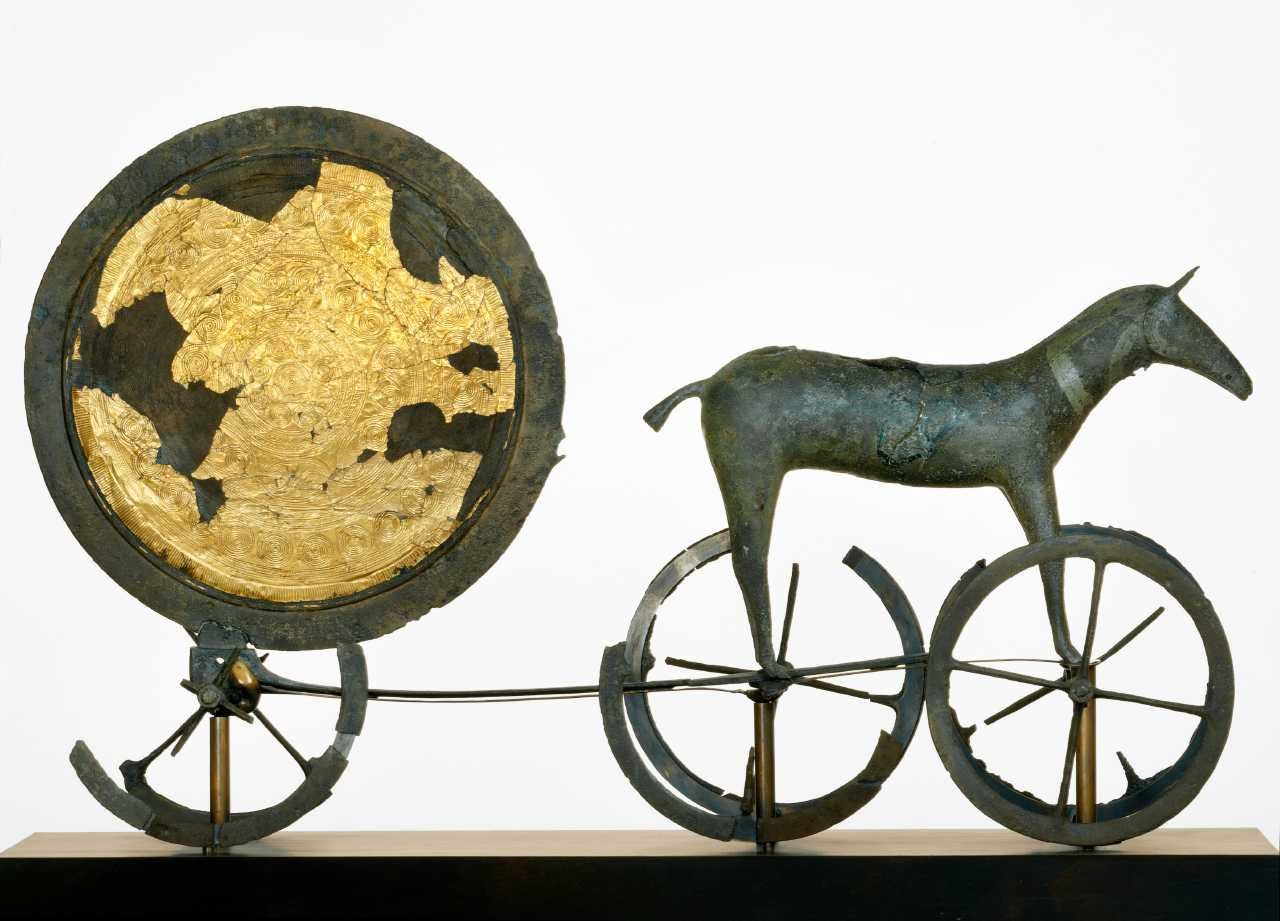
SPIRITS is structured by the energy and power of the sun and in particular the early representation of it as a solar wheel, a circle bisected by a cross into four quadrants. This can be seen within the wheels of a favorite object of mine such as the Trundholm Sun Chariot of circa 1400BC found in what is now Denmark.
Sun Chariot of Trundholm, Early Bronze Age, c. 1400 BCE. Photo: John Lee / National Museum of Denmark, CC BY-SA 4.0.
Taking these quadrants and mapping them in place of seasons onto four oceans and filling each one with plastic in the form of lost sandals is the core model as such. Plastic here is a persistent metaphor for the 20th century transformed by petroleum, whose legacies and remnants profoundly shape the present.
Working backwards from plastic one gets to petroleum and backwards again via compressed life one gets to sunlight so in effect this is a temporal map back across aeons. 24 works are then released as individual front page takeovers on LACMA.org on the great solar days of Summer and Winter solstice alongside the Autumnal and Spring equinox to create a total series of 96.
This is thus a light language and so is the delivery system. 99% of the world's intercontinental data crosses roughly 1.4 million kilometres of submarine fibre-optic cable, carrying a light signal upon ultra-pure silica glass: information prismatics. I was drawn to call these complex interconnected stories up and to do so through this network and through the touch screen - itself a deeply complex play between the electrical charge of life in the body and a conductive layer.
Thus SPIRITS, before we speak of the production itself or its relation to the gaussian splat is a diagram of a relationship: between human society, locked sunlight, the lost object, the turning year, the network. If one listens deeply to these signals a story may emerge and the story that emerged for me is titled SPIRITS.
john gerrard, This is key 1 x moving image of the shoes changing across the 3 seasons Winter, Spring, Summer:
Simone Brauner. Digital comes from the Latin digitus, finger. The same root that gives “digit” its numerical sense, from counting on fingers. In SPIRITS, this order meets a finger that sets the work in motion. The press release calls the finger the “central cultural actor.” Yet the finger can only act within a system whose possibilities have already been defined. How does this square with its role as the central cultural actor?
You have certainly found a hinge to the work. Digitus is a finger and a number at once - we probably counted on our hands before we counted on anything else, so number and body were never separate. And one is correct that the finger acts only within a system already defined in SPIRITS. In that light the hand that knapped a flint also worked within the grain of the stone. The finger on a piano key works within twelve notes and a tuning it did not choose.
Agency has never necessarily meant unlimited possibility - it can mean a real effect within a given world. But this is also an artwork - thus the finger on SPIRITS calls forth iridescence I have designed, holds it and depending on the season may move through other algorithmic languages both visual and sonic: oceanic, cultural, ecological. Threads of fire and soot and damage run through the piece. However the digit cannot make the shoe do anything to its core; it can make the shoe reveal what it already is or is part of. That is not a lesser agency. That is the only kind there is in the work.
What I resist is the opposite condition - the finger on the infinite scroll, which acts constantly and changes little, whose every motion is captured and sold back to it. The SPIRITS finger is the same finger given something to perform, to call forth with endless variation. Constraint is what makes the gesture legible. A cultural actor is not someone with infinite options. It is someone whose specific, bounded act may carry meaning.
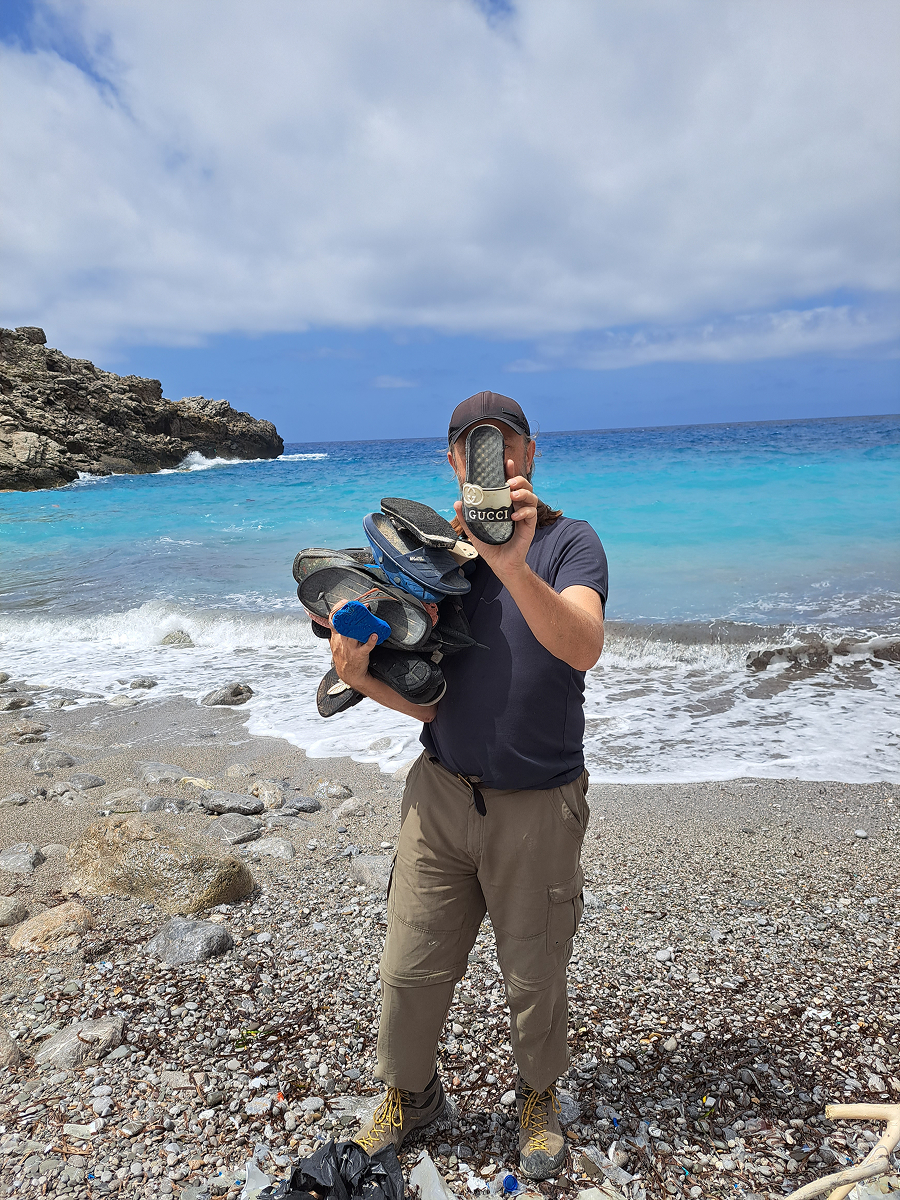
john gerrard, Shots from the original beach in Greece where the project began. Karpatos Beach
Simone Brauner. You describe Reza Negarestani's idea of petroleum as "a demonic, planetary intelligence using humanity as a vector to reach the surface and burn." If humanity is the vector, what does that make the artist?
The artists I admire the most and I am in particular thinking of Pierre Huyghe here - operate a little like wizards. But the magic they produce does not change the real necessarily - rather the perception of it. I have come away from a Huyghe work or installation profoundly changed and moved both intellectually and emotionally.
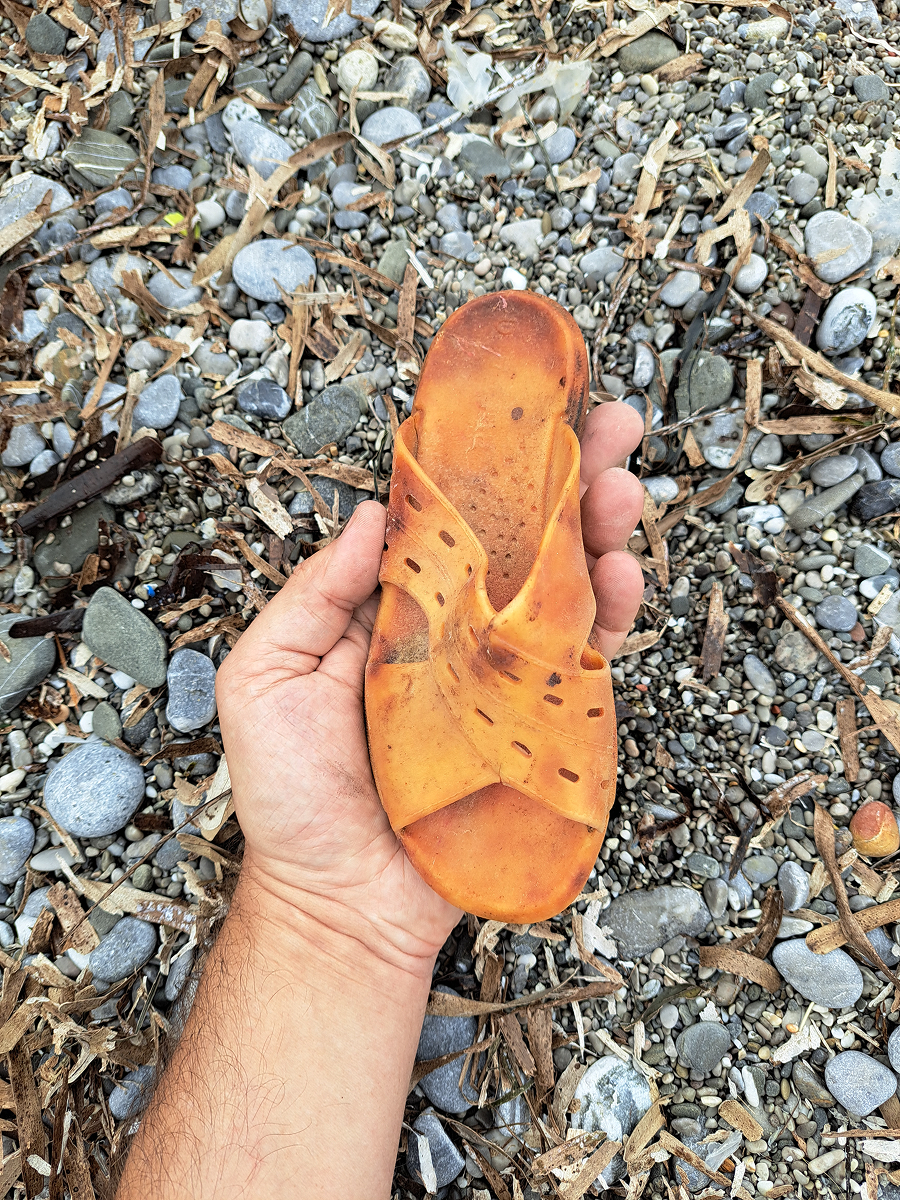
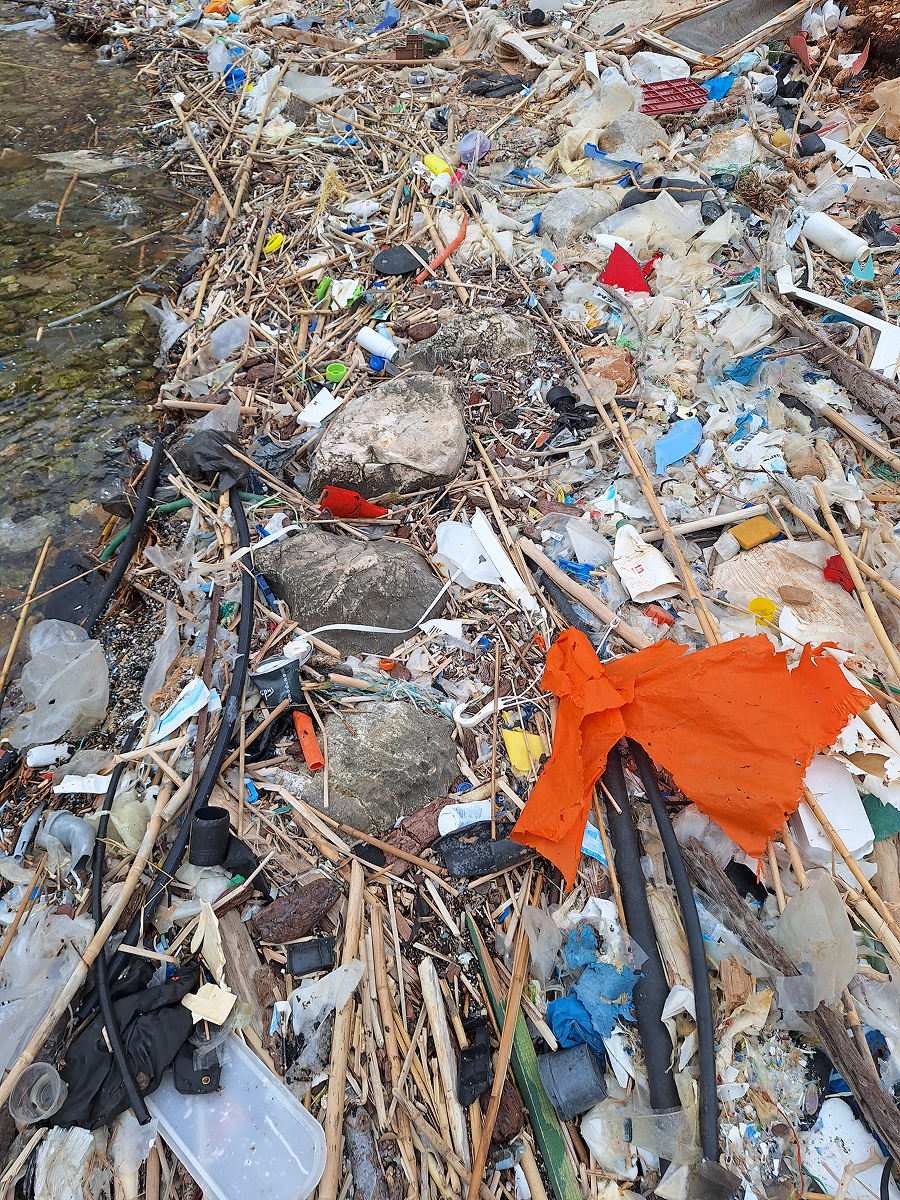
For me, try as I might I cannot escape this subject of power and transformation embedded in gasoline. Whilst I walk on the island of Karpathos in Greece - where SPIRITS emerged - I am surrounded by old abandoned wheat terraces which emptied out as both hyper mobility and hyper US led grain production emerged from petroleum in the early 20th century. One passes through these landscapes and languages and gets to the sea shore where these strange ghosts reside - many hundreds of lost plastic shoes - some really old, from the 60’s maybe, or 70’s.
The older shoes are amusing as they try to pass themselves off as other materials - rattan, leather, fabric. It was only later that plastic embraced its core qualities to be itself - injection moulded into any shape and colour - a kaleidoscope of the 20th Century.
In the end - getting back to Reza - petroleum does not just burn now, it also is infernal as it becomes smaller and smaller in the tumbling waves. There is a rising tide of awareness of the microplastic which attacks its maker on the micro level - as CO2 attacks on the macro. In SPIRITS and in effect through this potential poetry of technology one calls these different registers at once. As it happens the sound for the last Autumnal section uses a technology called granular synthesis, which chimes with a tiny, deadly ecological fragment.
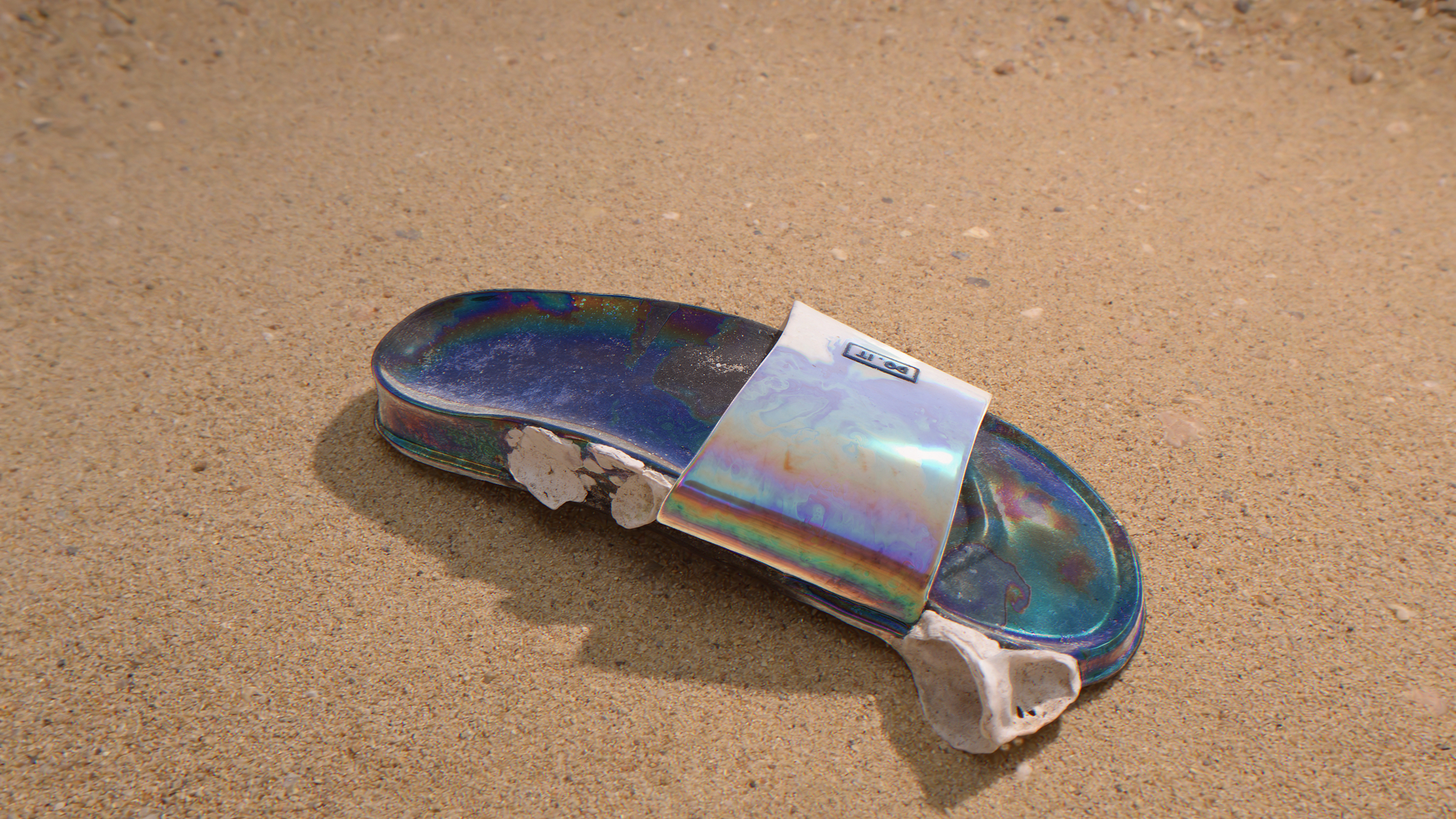
john gerrard, SPIRITS, Pacific #3.
Simone Brauner. Through Gaussian splatting, the spatial appearance of the found shoe continues to exist as data and light, while the material shoe is left behind. As the shoe becomes a spirit, does it lose its history, its aura, through digitization?
To begin - the gaussian splat - derived from neural-network research and a radiance-field lineage - is entirely built from our photographs of the real found shoe. The machine reconstructs and subsequently renders this new data thing live in the browser. The object is computed on the fly by the engine, forming as the viewer's device draws it - it exists only as it streams into the screen, which is why the finger, completing the circuit, becomes the central actor.
Then it is this cloud of points, not a solid - a thing composed of thousands of soft luminous specks rather than a fixed object. The form itself is a swarm, which suits a spirit better than a sculpture might. The shoe as cloud of light.
Extending this I imagine the shoe as spirit before I reached it. It was made by no one hand and thrown in some unknown manner into the sea, where it drifted for years or for decades before it washed up anonymous on a beach. Whatever history it had was already lost by the time I found it. I do not know whose foot it held, on what shore, in what life of labour or leisure or flight. That loss, that anonymity, is its history. It is a ghost of a person I will never meet and a story I cannot know.
The digitisation does not strip that aura away. What the gaussian splat does is give the ghost a second body and to distribute it - one made of data and light rather than petroleum - and let it go on existing in the way its real material already insists on existing. The plastic shoe does not rot. It persists, zombie like in the ocean for decades and more as both beached things and also microplastics, haunting the water and the body. The splat is an image of that condition: the object that will no longer pass away, continuing now as light on a screen, as data in a server, as the related objects continue as poison in the sea. Two afterlives of the same imperishable things.
Walter Benjamin feared that mechanical reproduction would wither the aura of the original. But SPIRITS is not a reproduction of a shoe. There is no aura-bearing original artwork standing behind it in a museum. It is the shoe's spirit, in the precise weird sense - the part that outlives the body and cannot rest. And a ghost, I think, carries more aura than a body, not less. That is why the works are called SPIRITS. The digitisation is not a loss of the sacred. It is the moment the object becomes visible as what it already was: something that refuses to die, lifted into the light so that we might finally see it, understand it (perhaps) and say goodbye.
john gerrard, SPIRITS, key 1 x moving image of the shoes changing across the 3 seasons Winter, Spring, Summer:
Simone Brauner. Oil is seduction. Oil is beautiful. Thin films of oil produce iridescent colors; black oil can act like a mirror. The surface draws me in, even though I know the history this material carries. SPIRITS, too, is beautiful to me, almost perfect in its form and order. The shoe comes from a landscape of waste and pollution, yet appears in digital space like a precious, singular object. What role does beauty play for you within this “petroleum reality”³?
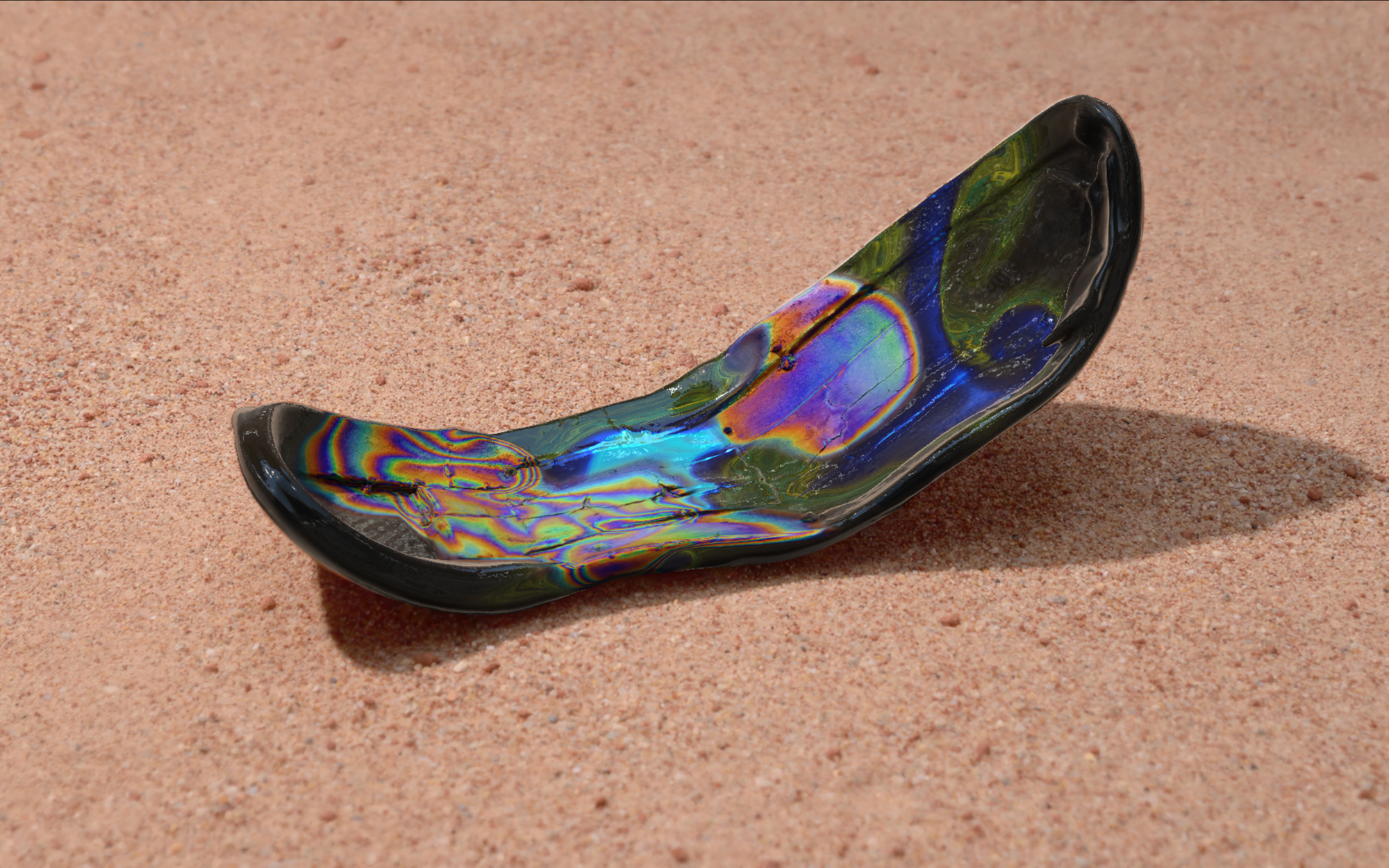
Oh thats the crux really. The dance and intersection between the deep toxic allure of petro realities and the immense potential of the algorithm to represent them, to call them up. There is no better medium to speak of the now to my mind. Should you wish to take the time - perhaps begin with Mediterranean Summer - call up both the realtime generative techno score titled PEAK OIL but in particular - pull up the oil. We built a virtual studio for the shoe - so that the petroleum would reflect the space exactly as a Prada shoot might - a sort of garage space - quite gallery like - with lights all around to create hot spots and a sort of highly polished allure.
On top we put a fast moving iridescent layer - which is another spirit in a way - which operates as a sort of sprite, a magical dancing apparition of these times. Somehow this engine based space allows a sort of collapse of languages of painting into performance, where the public get to somehow perform the language of the work which over time becomes more beautiful and more troubled at the same time.