< Artists
INTERVIEW by Simone Brauner
Nov 1, 2026

OONA: Dear David

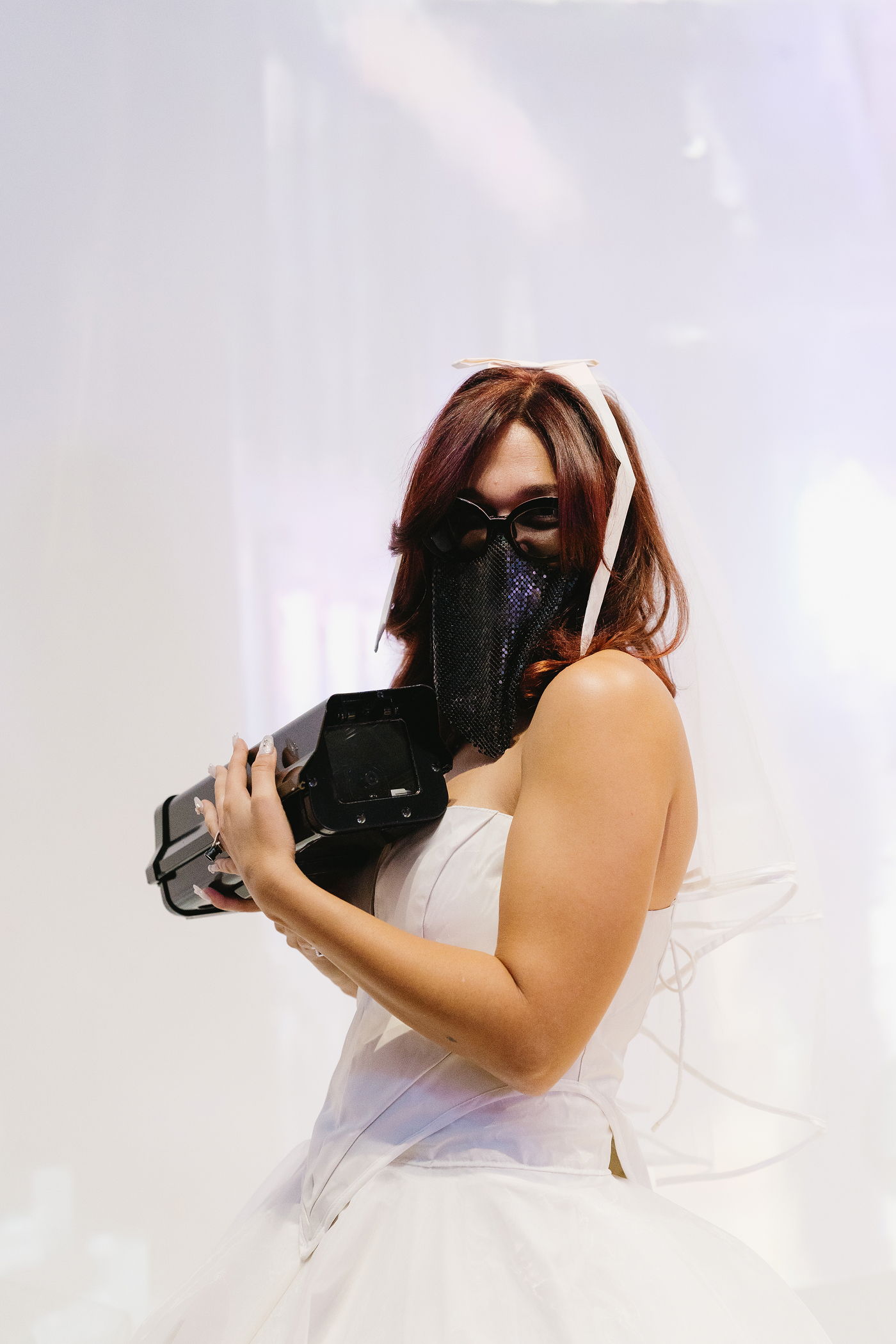
A bride in white, a surveillance camera in her hands. What does it mean to say “I do” to something that would keep watching even if you said no? On 16 October 2026, the anonymous artist OONA symbolically married David, a CCTV data manager at Transport for London, and the surveillance state he represents in her work. The wedding performance, ’Til the Cameras Do Us Part, at London’s Shoreditch Arts Club marked the eighth and final chapter of Dear David: A Surveillance Love Story.The relationship began with requests for footage. OONA performed in front of CCTV cameras on the London Underground, then exercised her right of access to obtain the recordings. Behind the infrastructure was someone who responded to her. His name was David, which means “beloved”. Their email correspondence and the footage became material for videos and live performances. Building on research that began in 2019, Dear David took shape in 2025, curated by Anika Meier for The Second-Guess; the video works, including two drawn from the wedding footage, were released as NFTs on the Tezos blockchain.This conversation follows the relationship as it unfolds, from confronting the camera’s gaze and feeling its effect on the body to reclaiming its images, dancing with the system and finally marrying it.
john gerrard, SPIRITS, Fall still, Screenshot 2026-08-27 at 18.20.36
Simone Brauner. How have you been since the wedding?
OONA. glowing, obviously. It was the wedding of the century, and the groom never took his eyes off of me. David never will. If I were writing a book, I’d title this chapter: OONA GETS EVERYTHING!
OONA, wedding
Simone Brauner. According to a statement published by Liberty on 23 October 2026, the Metropolitan Police expects to install fixed live facial recognition cameras on Oxford Street this coming December. The technology compares the faces of people in the street against a police watchlist in real time, with officers reviewing possible matches. Liberty is calling for the rollout to be paused until clear laws, safeguards and independent oversight are in place. The Met says the systems will only operate when officers are present.
How do you respond to this development in London? When cameras no longer simply record passers-by but compare their faces against a watchlist in real time, does that change the city for you? You now live in New York. Does being watched feel different there than in London?
OONA. In both cities, surveillance gaslights privacy.
I <obviously> have quite a strong proclivity for privacy. That is because embedded in privacy, and uprooted in surveillance is the idea of consent: Privacy is the choice of what to share and with whom, surveillance doesn't ask at all. The most common rebuttal expansion of state surveillance like the ones you’ve mentioned is: “if you have nothing to hide, let them look.” First, it ignores consent altogether. the looker doesn’t have to ask permission, each time and at every level of intimacy. The face, I believe, is one of our more intimate parts. The lips, the chin, the shapes they make in sadness and in surprise, the way the mouth opens and the nose scrunches with laughter, and the clarity of one's eyes…these are intimate to expressions of personhood.
And most iterations of the “if you have nothing to hide, let them look” argument assume equal visibility, as if looking were the same as being looked at. And, it never is. The watcher keeps the power and the watched gets nothing.
Now add capital. What if that software were sold to private companies so they could work out who to market to on which street? your face just existing becomes someone else’s revenue. The face and the body become raw material, shares without equity. This isn’t hypothetical, btw. Retail facial recognition already exists. Most of us don’t realize what our image is worth, which is why we give it away so easily. Lucky for OONA, her face is private.
so my thinking: you own your image; your image is your property. If it’s being used to generate value ($ or political), you are entitled to some of that value and should have a seat at the (cap) table determining its worth and rights.
john gerrard, SPIRITS, partial fill.
Simone Brauner. The instinct might be to avoid the cameras. You chose to step into their view and went further still, performing for them and later requesting the footage of yourself.What drew you to make yourself visible in this way? How much influence did you have over the recordings and their subsequent use, and what remained beyond your control?
OONA. Truth is, I had no money for film equipment, videographers, lights, or even a studio space. So I decided I would make the state surveillance infrastructure on the tube my video equipment. I didn't know David would also become my video editor.
In regards to my influence over the videos, I have very little control. David decides what to give back to me and which camera angels to supply. In 2024 I found out TFL was trialling AI algorithms on the tube. One alert was triggered when a passenger’s hands went above their head, a stand-in for “aggressive behaviour” because the algorithm cannot classify “agression”. The system isn’t so emotionally intelligent. So i walked the platform with my arms up. david didn’t give me that footage.
Other rules had no defined label, but one clear target: the houseless. ‘Alert staff if someone sits on the platform for more than 10 minutes, or sits at the station's entrance." None of this is new. surveillance as social sorting" is david lyon’s phrase, and norris and armstrong’s the maximum surveillance society (1999) showed CCTV operators already targeting people by class and race. the ai automates an old sorting logic. The promise of safety never applied to everyone equally.
So i lay on a bench for over 10 minutes. The algorithm alerted staff, and a TfL employee came to speak with me. David never released that footage either.
So, what did I control? the performance and the trigger. I staged my body in various places on the underground where I thought the cameras would catch me. I played with my clothes, each gown matches the color of the line. Black for the Northern, pink for Hammersmith and City, Green for District and so on. What I never controlled was the recording; only David does that.
john gerrard, SPIRITS, shots from the original beach in Greece where the project began.
Simone Brauner. What happens to your body when you know the camera is watching? Does performing free you from the pressure to behave in a certain way, or does it create another form of self-control?
OONA. One of the lines in the first letter to Dear David, I’ve been Looking for You is “I have a peculiar superpower, always perform for the camera, know the camera’s angle, i am never not aware of the image of myself. So much so that I've turned this into a sort of career.”
I can feel a camera on my skin, it’s an evolutionary skill that evolved from once being animals of prey. Science has confirmed that, but I never needed science to know it was a talent. The camera as a predator is not my idea, but it's one I play extensively with in Dear David and my practice.
We all change when there is a camera in the room, science can confirm that too if you need it too.
And my body does the same thing as everyone’s. It becomes aware of the image of itself, it edits, it asks what the watcher wants to see, it is aware of the attention. Performing doesn’t free me from that. It moves me from unconscious self-control to conscious control.
john gerrard, SPIRITS, Winter still, Pacific Ocean.
Simone Brauner. In your work, being under the camera’s gaze also means having a stage. Being recorded also means being able to shape an image. What makes you the object of someone else’s observation becomes a means of expressing yourself. The system turns your body into data, and you turn the system into a tool for producing your art.Could this very sense of self-determination lead you to make peace with something you originally wanted to question?
OONA. This line Dear David It’s A Spoilt World “if a body is prey, it is also bait, so I'll wait here like a fish on a line and reel it.”
Not sure I'm looking to make peace, I quite like the curiosity of something that can never be concluded. I’m scratching at ownership with all my work, what it means to own one's body, what the body consents to, but they’re not questions I think I'll ever fully answer. Or problems i will solve.
So instead I choose to have fun with the lopsided power dynamics of gender and visibility. To make wild art about it.
I also particularly like that Dear David consists of my own CCTV footage on public transport, material that was originally government property being made private and now public on the Tezos blockchain. That subversion of privacy and visibility on a public ledger is another way of asking “who owns this?”
john gerrard, SPIRITS, key 1 × moving image of the shoes changing across three seasons: winter, spring, summer.
Simone Brauner. What happens to your body when you know the camera is watching? Does performing free you from the pressure to behave in a certain way, or does it create another form of self-control?
OONA. One of the lines in the first letter to Dear David, I’ve been Looking for You is “I have a peculiar superpower, always perform for the camera, know the camera’s angle, i am never not aware of the image of myself. So much so that I've turned this into a sort of career.”
I can feel a camera on my skin, it’s an evolutionary skill that evolved from once being animals of prey. Science has confirmed that, but I never needed science to know it was a talent. The camera as a predator is not my idea, but it's one I play extensively with in Dear David and my practice.
We all change when there is a camera in the room, science can confirm that too if you need it too.
And my body does the same thing as everyone’s. It becomes aware of the image of itself, it edits, it asks what the watcher wants to see, it is aware of the attention. Performing doesn’t free me from that. It moves me from unconscious self-control to conscious control.
john gerrard, SPIRITS, Winter still, Pacific Ocean.
Simone Brauner. In your work, being under the camera’s gaze also means having a stage. Being recorded also means being able to shape an image. What makes you the object of someone else’s observation becomes a means of expressing yourself. The system turns your body into data, and you turn the system into a tool for producing your art.Could this very sense of self-determination lead you to make peace with something you originally wanted to question?
OONA. This line Dear David It’s A Spoilt World “if a body is prey, it is also bait, so I'll wait here like a fish on a line and reel it.”
Not sure I'm looking to make peace, I quite like the curiosity of something that can never be concluded. I’m scratching at ownership with all my work, what it means to own one's body, what the body consents to, but they’re not questions I think I'll ever fully answer. Or problems i will solve.
So instead I choose to have fun with the lopsided power dynamics of gender and visibility. To make wild art about it.
I also particularly like that Dear David consists of my own CCTV footage on public transport, material that was originally government property being made private and now public on the Tezos blockchain. That subversion of privacy and visibility on a public ledger is another way of asking “who owns this?”
Simone Brauner. Imagine David published Dear OONA, the story of your correspondence from his perspective. What role do you think you would play in it, and where might his account differ from yours?
OONA. OONA would start as a fun story for david to tell at the pub, and then a royal pain in the arse, with a little ‘how long will she keep at it’ in the middle. One time David told me my SAR request would take three months of labor for them to process and I just wrote back “brilliant! thank you!.” Then at Christmas, i sent him Fortnum & Mason champagne, strawberries and truffles, and TfL internal affairs flagged it, because civil servants can’t accept gifts over £20..
I hope he knows i’m not actually in love with him. I think he’s smart enough to see the commentary, he did call the work “really thought-provoking!!!”
When I invited him to our wedding, he must have thought I was mad. <David, i know you’re reading this, you would have loved it!>
Simone Brauner. A romantic wedding evokes a freely given “I do”. Yet your relationship with surveillance would continue even if you said no. What does choosing to say yes allow you to express that refusing could not?
OONA. The audience officiated the wedding.
They asked “David, do you take OONA as your wife?” 
I replied “David cannot speak.”
They asked “OONA do you take David as your husband?”
And in my big white wedding dress,
I shouted “yes!”
And we all know, the relationship was never optional. The cameras were watching before i said yes, and they’ll keep watching after. what i get to choose is the terms of my presence. The part I like most about Dear David is it’s humor and absurdity. And how both can be used as tools to acknowledge “OONA is insane” and make us question: is the expansion of state surveillance and the constant monitoring of our bodies not also insane?