< Artists
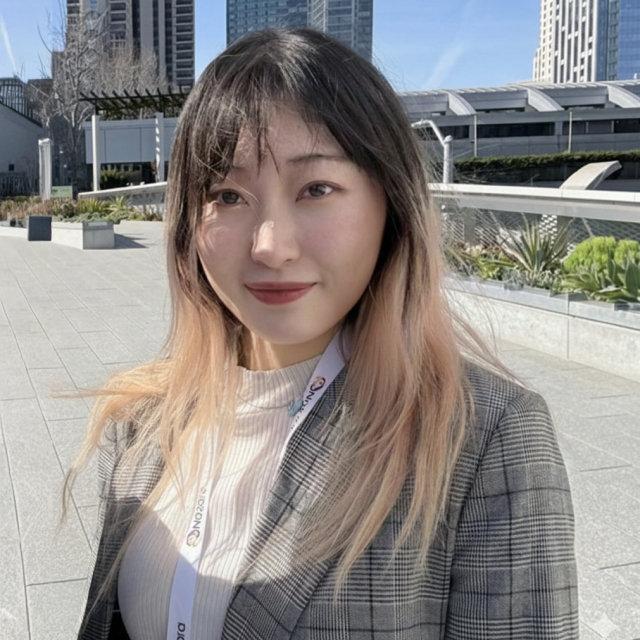
Zeo Zhang
_Jun x, 2026

Emotional Planet: When Emotions Become a Shared Landscape

In Zeo Zhang’s installation Emotional Planet, participants externalize a felt state by giving it to language, after which an AI system interprets the written input and returns it as an organic form that can be modified and placed within a collective landscape. Each blob functions as an affective trace, a mediated imprint of an inner state that has acquired a visible position outside the body. The feeling remains abstract, yet it becomes available as an object of attention and alteration. The work examines how emotion changes once it passes through a technical system and reappears as something participants can encounter from the outside.
Collective emotional matrix generated from audience-created emotional planets during Emotional Planet, Hachinohe, Japan, 2026.
When I first started developing Emotional Planet, I wasn't trying to build a visualization of emotions. I was trying to understand them.
Language is an unstable interface for feeling. The same emotion shifts depending on the tongue you use to name it, and some feelings resist naming altogether. What interested me was not the emotion itself but the gap between what we feel and what we can express, and what happens when something else does the interpreting for us.
Audience interaction interface photo taken at Art Space Neo Ippei, Hachinohe, Japan, 2026.
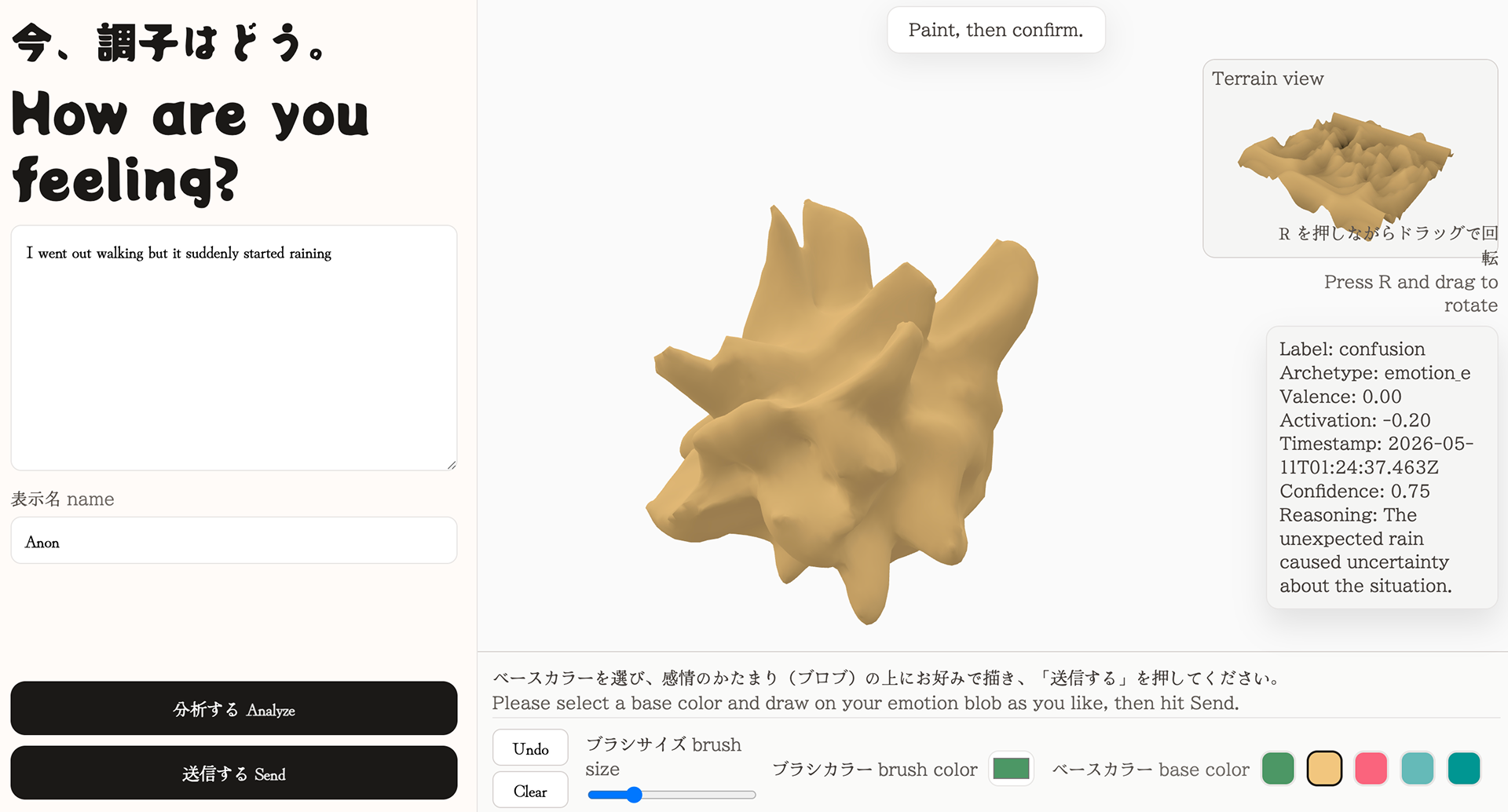
The installation invites visitors to type whatever is on their mind, freely and in any language. An AI system then reads the input and classifies the emotion behind it into one of 24 types, drawing on a taxonomy of emotional states developed by researcher Mikiko Takasago. The participant does not choose their emotion. They simply write, and the AI interprets. That act of displacement is where the work begins.
We all know how biased human emotional reading can be. AI, as an aggregate of human expression accumulated at scale, carries its own kind of bias: inherited, statistical, shaped by everything it has ever been trained on. The question the installation keeps asking is not whether AI reads correctly, but what it reveals about collective human interpretation when it reads at all.
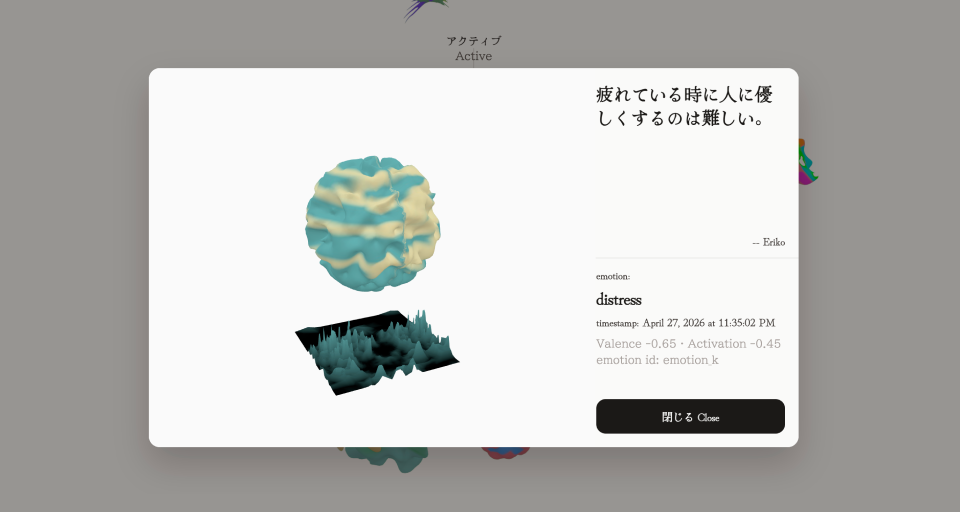
Individual participant-generated “emotional planet” created from audience emotional input during Emotional Planet, 2026.
But classification is only the first half of the experience.
Once the AI assigns an emotional type, it surfaces a blob, an organic shape associated with that emotion. Each of the 24 types has its own form. Rather than presenting this as a fixed output, the installation hands it back to the visitor: they can paint on it, push the color, alter the surface, make it theirs.
What begins as text passes through machine interpretation and becomes something visual and personal. The emotion moves from language into image, from AI reading into human mark-making.
This is the translation chain the installation traces. Not a pipeline, but a sequence of interpretive displacements: the feeling becomes a word, the word becomes a classification, the classification becomes a shape, and the shape becomes something only that person could have made. Meaning does not accumulate cleanly at each step. It shifts, and those shifts are the work.
Every completed blob joins a larger shared landscape. The full picture is a matrix organized along two axes, negative to positive and active to inactive, extending across time. Each individual expression holds its position within the whole, so you can see where your emotion sits in relation to everyone else's and observe what forms when many people's feelings are placed together.
Entrance view of Emotional Planet at Art Space Neo Ippei, Hachinohe, Japan, 2026.
Painting is the second part of the conversation.
Before the exhibition opened, I spent a lot of time imagining how people might interact with it. What actually happened was different, and more interesting.
I did not expect the range of how people chose to contribute. Some inputs were immediate and sensory, like "I feel cold right now." Hachinohe, wherethe exhibition was held, was bitterly cold at the time. Others carried something heavier, like "I am worried about my daughter's future." There was no prescribed length, no right format. People wrote one word or a full paragraph, in Japanese, in Chinese, in English. The variety said something about how differently each person holds language in relation to what they feel.
Then came the moment of AI classification, and often, a moment of surprise. Not always because the result felt wrong, but because seeing their words read back through a system made the act of emotional interpretation visible in a way it usually is not. We read each other's emotions constantly, unconsciously and imperfectly. The installation just made that act legible. And then it asked: now that you have been read this way, what do you do with it?
The answer was painting. What people did with their blobs was as varied as what they had written. Some approached it deliberately, choosing colors with clear intention. Others moved quickly and almost impulsively. Some seemed to extend what they had already expressed in words, while others seemed to be correcting the AI's interpretation with their own hands, pushing back against the shape they had been given. That negotiation felt alive. The painting was not just a decoration. It was the second part of the conversation.
Visualization generated in progress from a participant’s written emotional reflection using the installation’s AI-assisted emotional classification system.
As more people participated, patterns began to appear across the collective landscape.
Certain emotions clustered together while others remained sparse. What stood out was how much of what people expressed carried weight: worry, grief, unease. A strong thread of negativity ran through the archive. Maybe it reflects the ambient anxiety of global political and economic instability. Or maybe it is simply how human memory works, tending to record what troubles us more readily than what brings ease. The pattern felt like a mood portrait of the people who passed through that space at that particular time.
The role of AI in all of this was never about objectivity. I used an unaltered, not specifically trained large language model, and I was fully aware of what that means. Where a human reader brings personal bias, the model brings statistical bias: vast, averaged, and shaped by the accumulated texture of human expression. Neither is neutral.
What became interesting was not which reading was more accurate, but where the discrepancy between what someone felt and what the system decided sat, and what the person chose to do with that gap.
This is what I find most compelling about the installation in retrospect. It is neither fully human nor fully algorithmic. The AI contributes a reading no single person could produce, drawn from an accumulation too large for any individual to hold. But the human hand comes back in through the painting, and neither half completes the other so much as each one complicates it.
K. Danse, ETERNITY. Photo Credits: Jean-Marc Matos + deep AI.
Emotional meaning does not live in the classification.
Looking ahead, I think of Emotional Planet as something still unfinished, in the best sense. What interests me most now is how the emotional landscape might differ across different cities and cultures. The same installation in different locations could reveal how collective emotional tendencies shift depending on where people are and what they are living through, whether the matrix tilts toward different territories, whether the blobs get painted differently. I believe they would. Those differences might tell us something real about how people in different places are perceiving the world right now.
What I want to keep resisting is the reduction of emotion to data. The installation uses classification and structure, but emotional meaning does not live in the classification outcome. It lives in the gaps between what was felt, what was written, how the machine read it, and what the person made with their hands afterward. That chain never resolves cleanly, and perhaps it should not. The work exists precisely in that instability.