
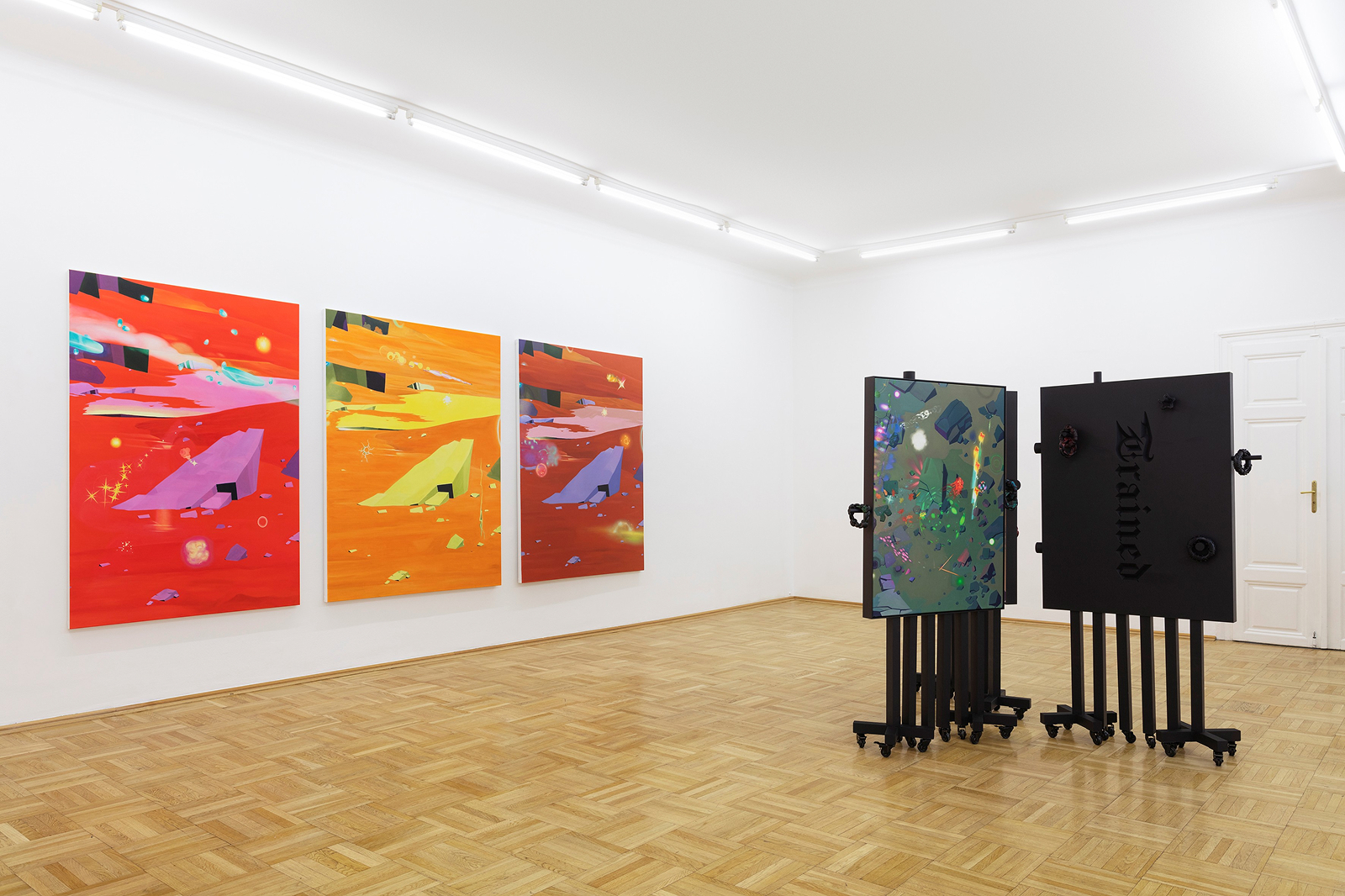
In her first solo museum exhibition in Europe, Chinese artist Miao Ying transforms Belvedere 21 into a post‑human office landscape quietly overtaken by generative AI. Projections, sound works, videos and oil paintings populate an abandoned workplace where algorithmic systems keep running even after people have left, inviting visitors to reconsider their own entanglement with opaque technologies.
Following artistic training in both China and the United States, Miao Ying has developed a critical and often ironic practice that probes the intersections of technology, ideology and digital image culture. Her installations, videos and paintings dissect mechanisms of digital surveillance, government control and media manipulation, frequently drawing on the specific conditions of the Chinese internet behind the “Great Firewall”. In “Come, Sit, Stay”, she explicitly links dog commands and human‑led AI training: clearly defined instructions guide learning and control in both animals and machines, revealing how obedience, authority and behavioural shaping are embedded in technical systems. The exhibition stages AI as something that can be instructed, negotiated and occasionally resisted, using humour to open up complex questions about agency and responsibility.
In her recent works, Miao Ying generates digital images with neural networks operating under predefined parameters and subsequently translates these compositions into analog, painterly formats. This movement from data to material form makes abstract computational processes tangible and sensorial, prompting reflection on reality, authorship and control in AI‑assisted image‑making. Allusions to medieval magic, alchemy and incantations underscore that every technological innovation is accompanied by projections, irrational fears and utopian hopes, connecting today’s AI fantasies to much older imaginaries of power.
Miao Ying was born in Shanghai in 1985 and belongs to the first generation of Chinese artists to grow up with the internet, the one‑child policy and tightening digital censorship. She studied New Media Arts in Hangzhou and Electronic Integrated Arts in New York, and now lives and works between Shanghai and New York. Her work has been presented internationally, including at the Venice Biennale, New Museum in New York, Art Museum at the University of Toronto and institutions across Europe and Asia, cementing her position as a leading voice in the discourse around AI, censorship and visual culture.
_2026.png)
