< Artist Directory
Interview by Olena Yara
_DEC, 2025

Ana María Caballero: The Linguistic Implications of Generative AI

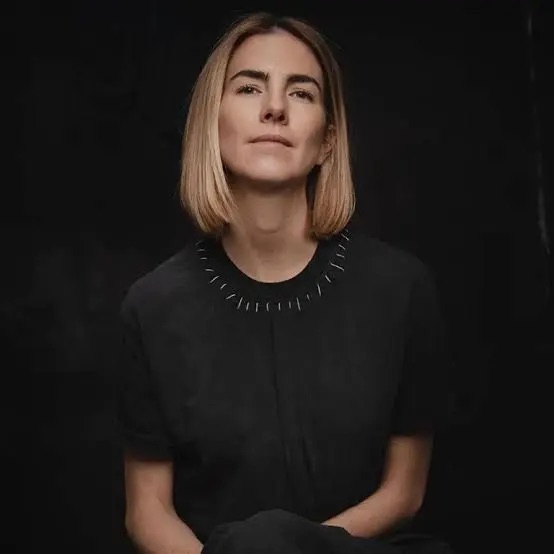
Ana María Caballero is a multiple award-winning, transdisciplinary artist whose work interrogates the slippery boundaries between physicality and selfhood, language and perception, biological processes and their cultural narratives. Widely recognized across contemporary literature and digital art, she’s the first living poet sold at Sotheby’s and the first artist to receive a triple finalist nomination for the Lumen Prize.

Her practice has been featured by outlets such as ArtNews, Monopol, artnet, Poetry International, and BOMB, and her works reside in institutional collections including the Reina Sofía, MACBA, the Ashmolean, HEK Basel, Spalter Digital, and the Francisco Carolinum. A graduate of Harvard and the author of eight books, she’s also the co-founder of the digital poetry gallery theVERSEverse. She’s performed at the Venice Biennale, Art Basel, Gray Area, Fundación Telefónica, and Fundación March. Forbes named her one of 50 Latin Women to Follow in 2025.

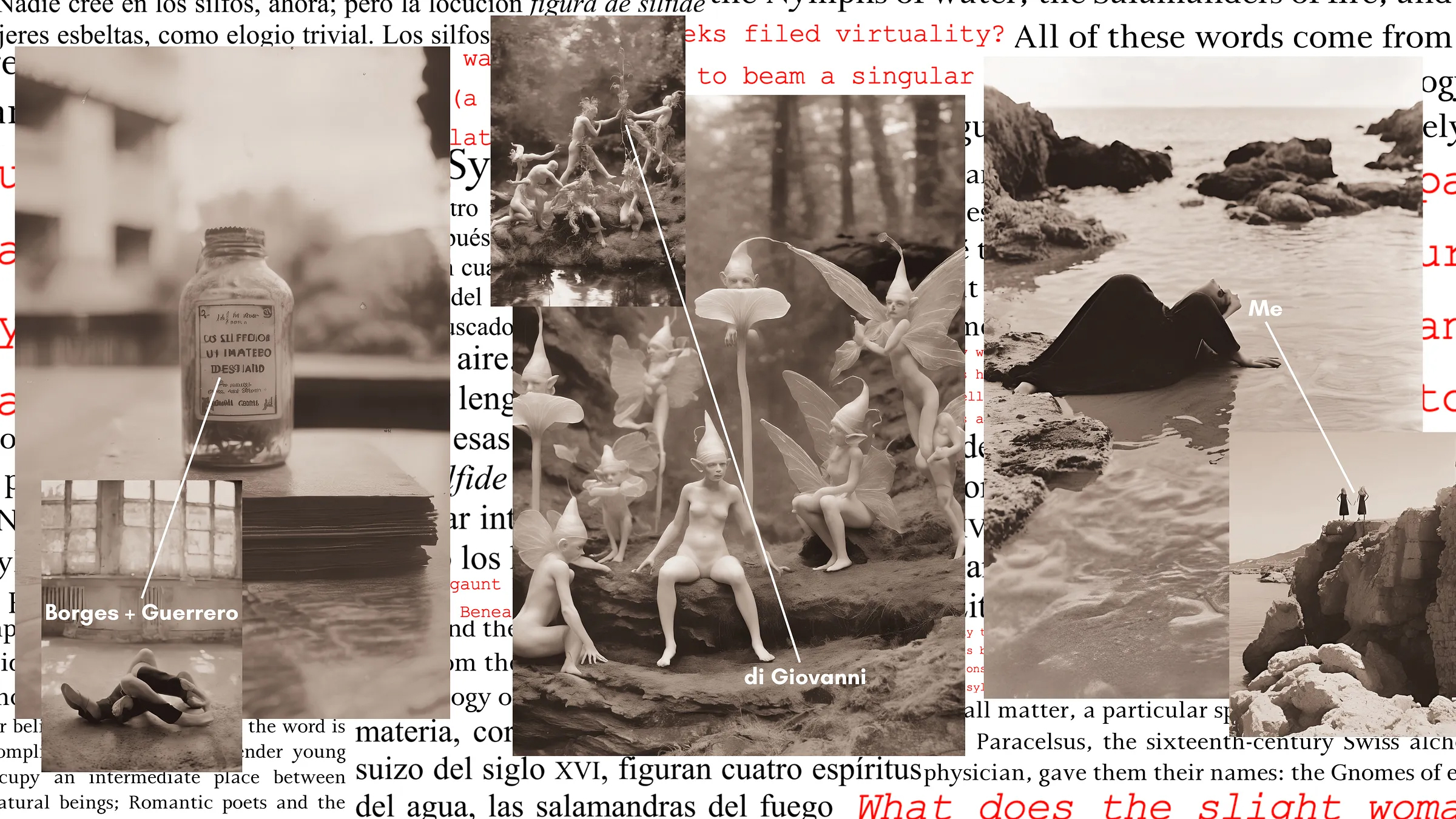
In her award-winning series Being Borges, Ana María Caballero reimagines The Book of Imaginary Beings by Jorge Luis Borges and Margarita Guerrero, probing the bounds of translation and the biases embedded within machine interpretation. Her work from the series, The Sylphs, winner of the 2025 Lumen Prize in Still Image, asks a deceptively simple question: What happens when language becomes literal through the visual?
Ana María Caballero, The Sylphs: Collage from Being Borges, 2025.
The Sylphs
Olena Yara. To begin with The Sylphs, what drew you to Borges & Guerrero’s Book of Imaginary Beings as the foundation for the project? And for readers unfamiliar with it, what makes this book significant?
Ana María Caballero. Borges and Guerrero’s Book of Imaginary Beings is a foundational work of Spanish literature, a recipient of the Cervantes Prize and one that deserves more readers. The book is a fantastic “way in” to Borges’ work. Also, the visual radiance of its language plays well with AI.
At the root of consciousness is the ability to imagine, to invent that which doesn’t exist. I wanted to use AI to visualize these imaginary creatures because AI is a summary of centuries of invention. 
I love that the Book of Imaginary Beings is structured like an encyclopedia. But, of course, it's fictional. That very thin line between fact and fiction is brought to bear in Borges’ work and in generative AI.
Screenshot from Ana María Caballero’s film showing Jorge Luis Borges’ The Book of Imaginary Beings and Julio Cortázar’s Rayuela.
"At the root of consciousness is the ability to imagine, to invent that which doesn’t exist. I wanted to use AI to visualize these imaginary creatures because AI is a summary of centuries of invention."
Olena Yara. In Being Borges, you translate Spanish and English descriptions into images using AI. You’ve said this reveals the “impossibility of translation.” Where does that impossibility lie for you, in language, culture, the algorithm, or expectations?
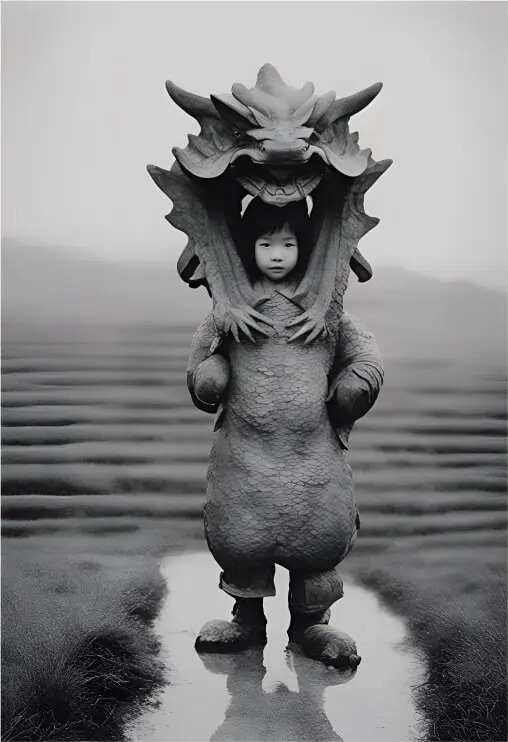
Ana María Caballero. On a broad scale, the visual translations resulting from Spanish prompts are pastoral, as if shot from distant vantage points. The images that result from English texts are narrative, with central human figures. The images rooted in poetry tend to be abstract, which I think is interesting as poetry is a condensed, metaphorical form of expression.Yet, the three texts describe the same thing.
Spanish, English, prose, poetry—each is a different system of signification, with meanings that extend beyond their signifiers, their words. 
The impossibility of translation lies in our inability to fully convey lived experience. In literature as in life, the unsaid is as evocative as the said. How do you translate the unsaid?
Ana María Caballero, Shang Yang: The Rain Bird: Image Generated by Caballero's Poem from Being Borges, 2025.
Olena Yara. Your practice spans poetry, image-making, and multiple media. What does AI allow you to do that traditional methods cannot?
Ana María Caballero. Interacting with AI allows me to reveal the intimate, personal nature of meaning-creation. When I translate a body of language into an image, the experience—for me personally—is limiting. Whereas the text remains an open-ended, porous space of possibility, the image cages me inside a narrower interpretation. Of course, this doesn’t apply to everyone. That’s the point.
Olena Yara. What role should artists, or even everyday users, play in shaping how AI understands language and meaning?
Ana María Caballero. AI models are evolving quickly. But as they get better, they get worse. The outputs are becoming homogenous, precise, clean. Great for a hospital catalog.
Early AI images were compelling because they expressed notions of error, bringing us face-to-face with the presence of the uncanny in everyday life. Bland outputs poke at nothing, say little.
This is why I worked with a company called Titles XYZ to create my own Being Borges model, assuring that the aesthetic essence of the project, one curated over three years, remains intact.
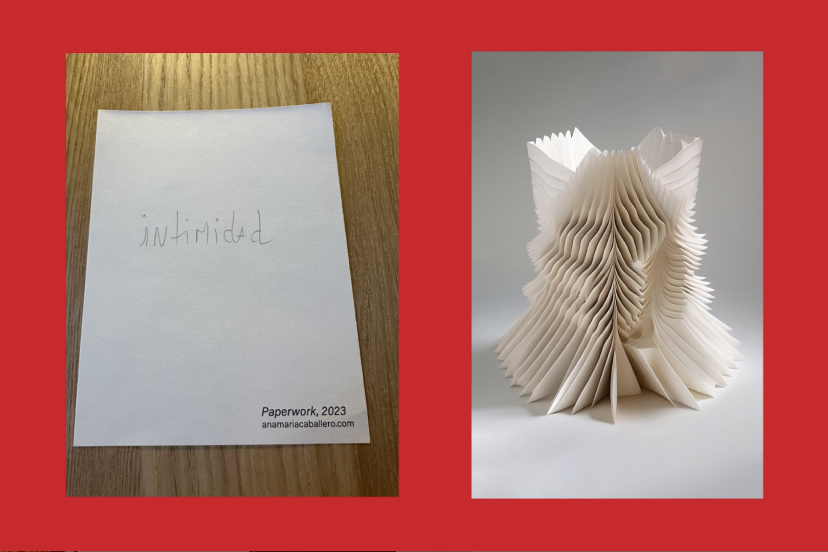
From left to right: Still from Ana María Caballero’s Paperwork video (2023) and photograph of Ana María Caballero at Art Basel Miami 2025.
Radical Repair
Olena Yara. Your new work Radical Repair, from the Speech Patterns series, debuted during Art Basel Miami at Untitled Art Fair. What inspired you to turn a performance script into sculpture? And could you share more about the series overall?
Ana María Caballero. What’s interesting to me about generative AI is the new ways we're using language. Via text-to-image prompting we engage in novel linguistic exercises, ones we’ve yet to fully acknowledge. We need to bend language, increasingly so, to obtain desired results from AI models. My explorations with generative AI ask us to observe this linguistic evolution. 
In my Paperwork series, I used an algorithm to visualize attendee responses to my performed poetry. I felt this investigation had more to give, so I created an evolution called Speech Patterns, where I visualize the texts I prepare for my performances. 
Paperwork translated reactions; Speech Patterns manifests intent. Both materialize emotion via generative AI.
Ana María Caballero’s sculptural wall piece at Art Basel Miami Beach, Instagram documentation, December 2025.
Olena Yara. What aspects of performance do you feel sculpture captures, or fails to capture?
Ana María Caballero. The sculptural form creates an immersive experience of viewership, forcing you to think about all the decisions taken to produce the work and design how it occupies space. The sculptural form is one of expansion, not of limitations. There is implicit intimacy to sculpture, because it invites the viewer to approach.
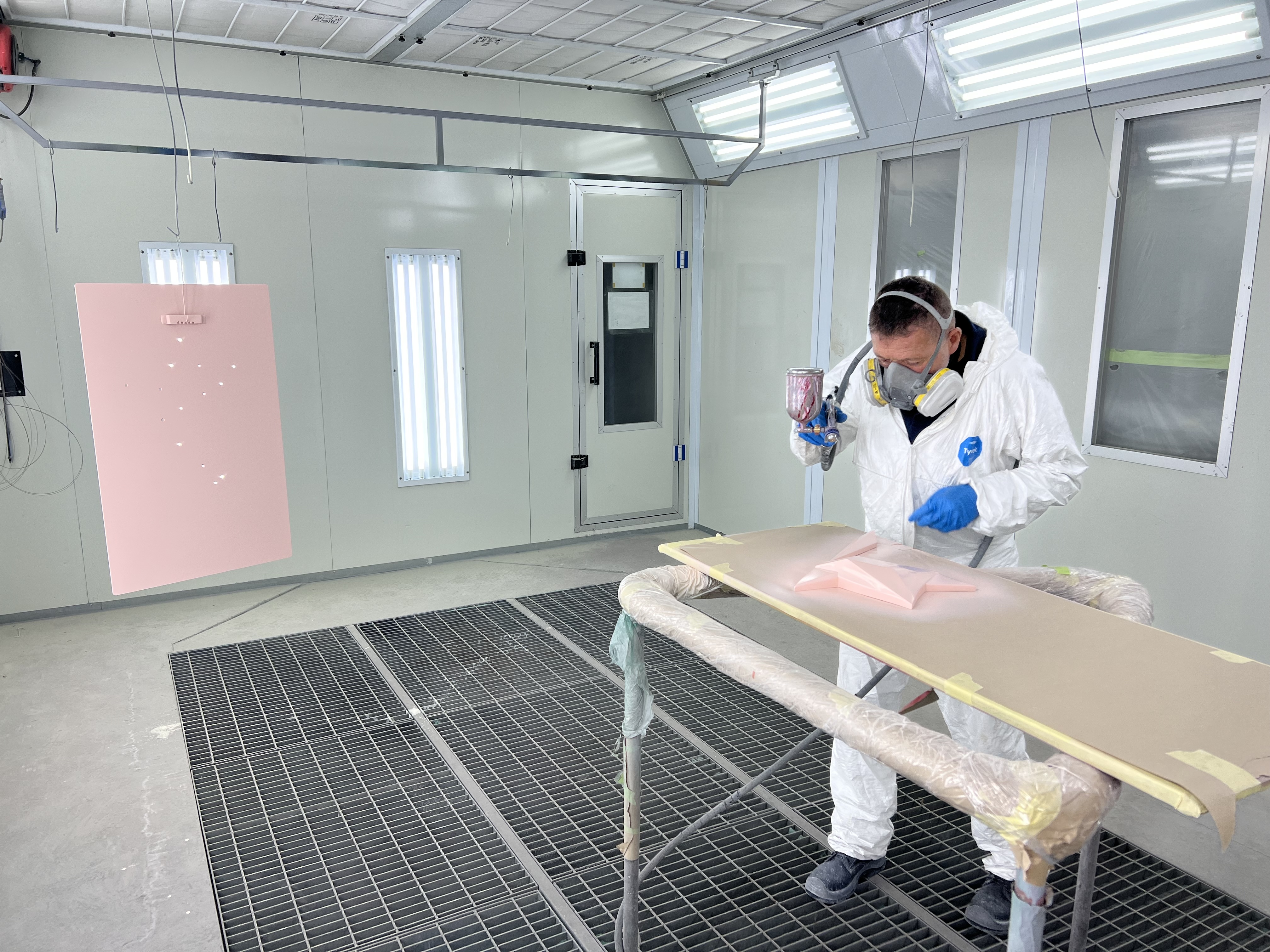
Ana María Caballero’s sculptural wall piece in production, Colombia, 2025.
Olena Yara. These sculptures were produced by artisans in Colombia. I absolutely adored photos from the production. Could you talk about the process and why this location matters to you?
Ana María Caballero. I’m from Colombia and am very proud to work with top local artisans to create these pieces. I explored other workshops and none were able to recreate the level of quality found in Bogotá, Colombia—my homeland.
Olena Yara. Both Being Borges and Speech Patterns involve translation, one between languages through AI, the other between performance and sculpture. Do these two modes feel connected?
Ana María Caballero. One way of recording emotion, such as is summoned during a poetry reading, is through language. If this language is then visualized via generative AI, the image becomes a translation of our emotional response to the reading.
In both Being Borges and Speech Patterns, language becomes literal via the visual, materializing lived experience via digital and physical forms.
Olena Yara. What’s next for you? Will you continue exploring AI and text, or move toward other hybrid forms?
Ana María Caballero. I’ll debut an installation in January with my new Madrid gallery, Max Estrella, rooted in Entre domingo y domingo, my book of Spanish poetry. I'm very excited to launch a series of explorations, rooted in Spanish verse. This installation will lean into the iconography of the weekend versus the workday, a theme taken from my book.