< Artists
Reflections from Jean-Marc Matos, K. Danse
_Jan, 2026

AI and Dance: The Artistic Intelligence in Motion

Foreword by Jean-Marc Matos
It is important to note that while AI has the potential to support and enhance human creativity, it is unlikely to completely replace it. Human creativity is driven by a complex interplay of emotions, experiences, and cultural contexts, whereas AI creativity is limited to the algorithms and data it has been trained on. Human creativity and AI creativity each have unique strengths and limitations, and the most exciting possibilities for creativity may arise from the intersection of the two. In this sense, AI and creativity are conceptually linked by the idea of generation. Both can be considered systems with the capacity to generate new and original outputs, and both have the potential to enhance and support human creativity.
Dance and AI
At the crossroads of contemporary choreography and digital innovation, Compagnie K. Danse foregrounds an artistic practice that doesn’t merely use artificial intelligence as a tool, but questions it through the lived experience of the body in motion. Under the direction of Jean-Marc Matos, the company’s AI-infused works interrogate our assumptions about cognition, presence, and the machine by creating interactions that emphasize not separation but coexistence between human and nonhuman intelligences.
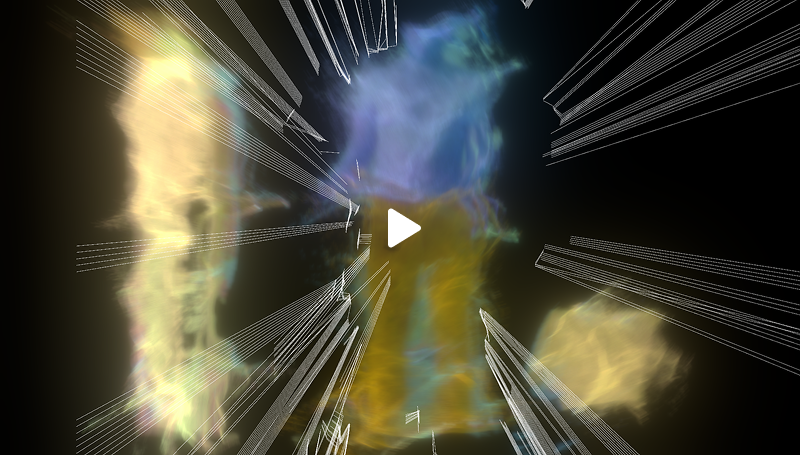
K-Dance, F_AI_L project, Trailer, F_AI_L production 2024, Still.
The “F_AI_L” project
A standalone performance and an installation open to the public.
F_AI_L (2024) is a dance and AI project that questions the fallibility of artificial intelligence when it encounters and enters into an unlikely dialogue with the human body, through an interactive comparison between standardized and unusual movements.
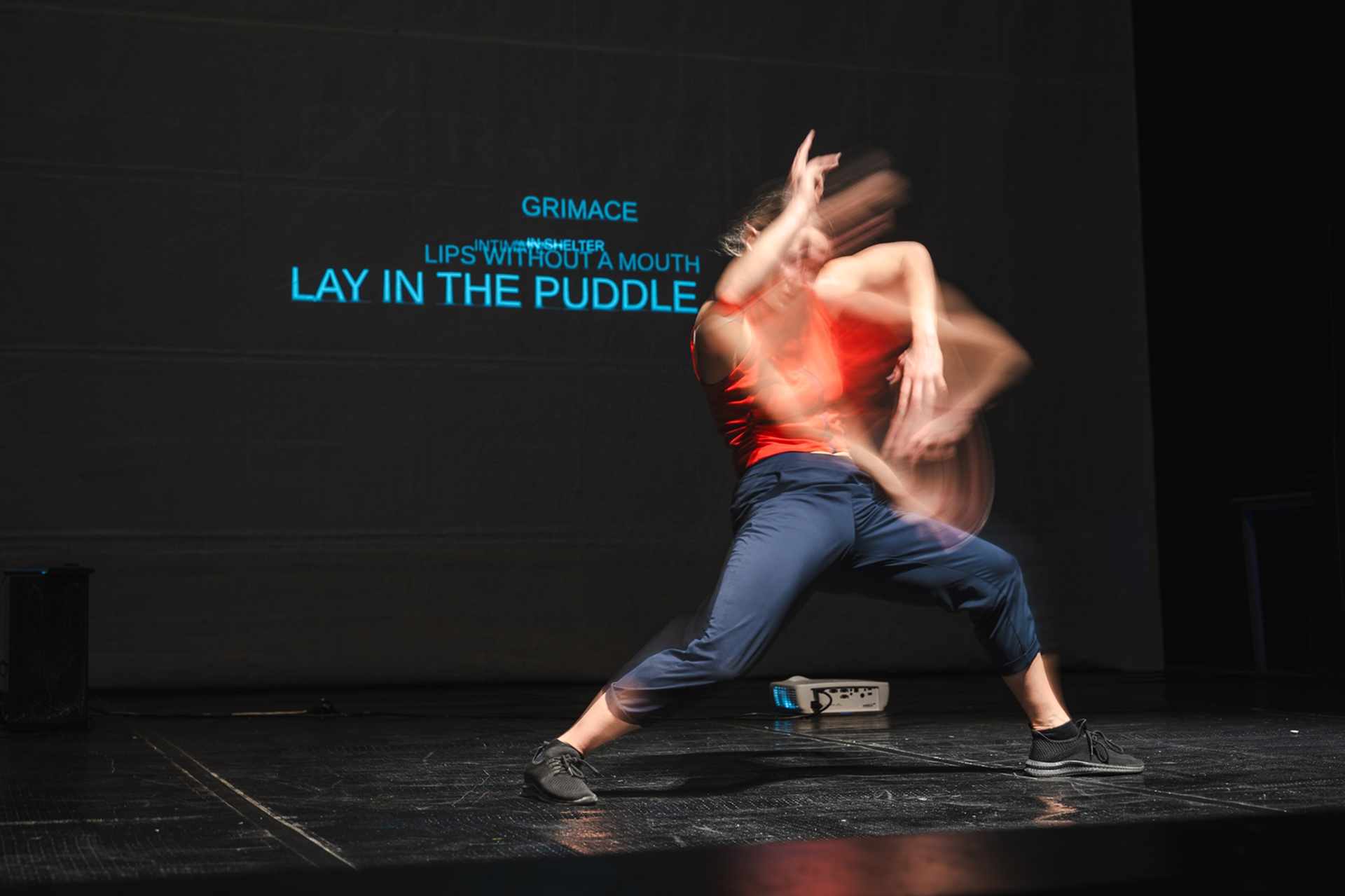
In this project, the AI is conceived as a digital creature, trained on a database composed of a very large number of short dance video recordings, set performed by a wide and diverse public (approx. 5000). The “body” of this creature is omnipresent throughout the scenographic set, expressing itself through images, music, and projected words. The image transforms itself in response to unusual, disaligned movements. An invitation to dance—differently.
The words function both as an interpretation of what the machine perceives from the movements danced in front of it, and as invitations guiding the participants toward the directions it suggests. The movements of a spectator are captured and interpreted by the AI. The more the AI recognizes a movement as daily and standardized, the closer the body’s representation is to a human, identifiable figure. A body to be displayed… Conversely, the more the movements depart from the habitual and deviate from the ordinary, the more complex the body’s representation becomes, inviting the spectator into an exploration of letting go. A body to be explored…
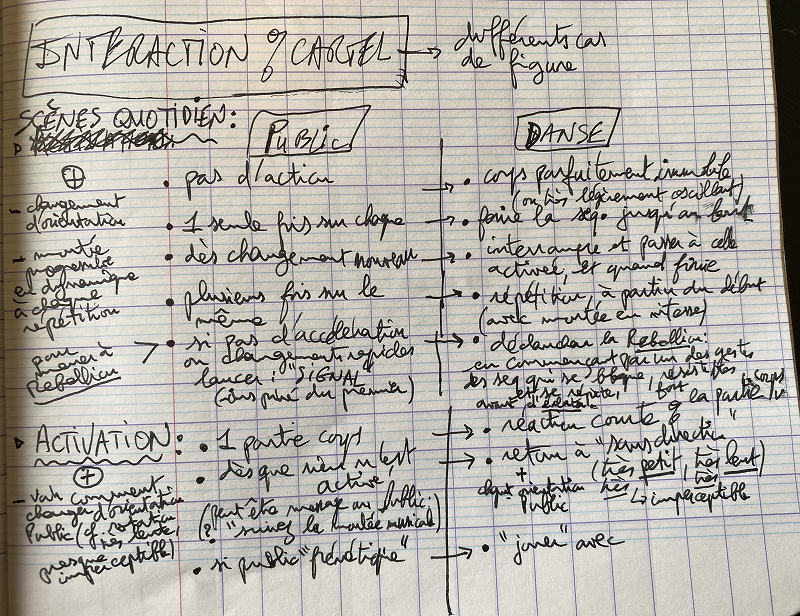
The dance in this project is nourished by an in-depth research into everyday gestures and attitudes observed in people, in situations where they wait and observe. More than a simple interaction, the aim is to generate a dialogue with the AI, as it is not possible to predict exactly how it will interpret the training it has received. Beyond this, the project seeks to understand how an AI functions through the medium of bodily movement. F_AI_L is capable of interpreting the smallest movements—fragments of behavior, all kinds of gestures and attitudes, intentions. An invitation to discover other ways of moving, to explore states of the body, and to develop a relationship shaped by one’s own creative inspiration.
More than a simple interaction, the aim is to generate a dialogue with the AI, as it is not possible to predict exactly how it will interpret the training it has received.
In F_AI_L, AI becomes a dialogic partner rather than an automated generator of form. Here, the AI system trained on vast databases of dance videos interprets and misinterprets the gestures of performers and spectators alike. When movements align with familiar patterns, the AI confidently represents the body in simplified, normative visual forms; when movements deviate, recognition falters and fallibility emerges — producing richer, more complex representations that echo human variability rather than algorithmic predictability. Through this dynamic, F_AI_L transforms AI’s limits into generative artistic material, inviting audiences to explore unfamiliar movement states and re-discover somaesthetic perception.
AI enters this lineage not as a rupture, but as an intensification. It amplifies processes that
were already present: iteration, recombination, pattern recognition. At the same time, it
introduces new layers of opacity, speed, and scale. This work does not try to resolve anything. It insists on looking at all of this as it unfolds.
ETERNITY projet de création-recherche 2025 -2026-2027 EXPERIENCE # 4Spectacle et installation performative, chorégraphique et interactive, intégrant danse contemporaine, intelligence artificielle (IA), immersion sensorielle, et participation du public.Équipe de réalisation (2025)
The “ETERNITY” and ”Immortal(s)” projects
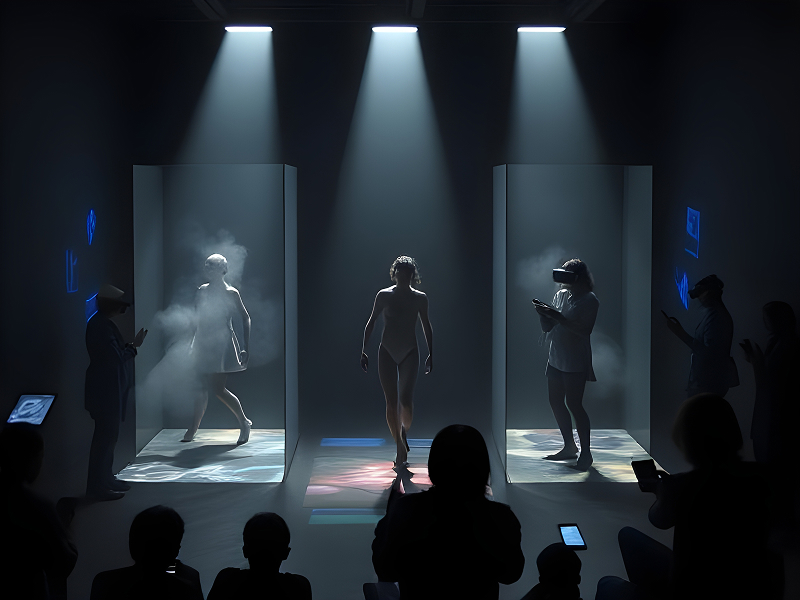
Where F_AI_L probes AI’s incomplete understanding of the body, ETERNITY (2025–27) imagines a speculative future in which hybrid immortals — “near-humans” — are mediated by AI that coordinates scenography, light, sound, and audience interaction. In this immersive installation, the choreography unfolds within a triangular communication system of dancers, visitors, and intelligent systems. The performance doesn’t just display technology; it weaves it into a dramaturgy of emotion and presence, exploring how human affect might be mirrored, amplified, or eluded by algorithmic processes that adapt in real time to human behavior.
Similarly speculative in narrative yet grounded in corporeal investigation, Immortal(s) (2023) situates audiences in a future where hybrid beings — part human, part AI — are confined, observed, and engaged. Their struggle to reconnect with human experience stages a poignant choreography of memory, estrangement, and desire. By making AI both a character and a partner in collective storytelling, Immortal(s) transforms the machine from an abstract symbol into a relational agency that reflects back human presence and absence.
Both are immersive, site-specific, participatory, and interactive live performances.
A speculative and post-human science f(r)iction. Audiences, projected into the future, can, at will, act upon and dialogue with hybrid beings, sort of “organorgs”, enclosed for eternity inside a protective capsule or beams of lights. These creatures are nothing more than one, amongst many “Immortal(s)s”, which has been ostracized. A meeting between two intelligences: the artificial one and the corporeal one.
Immortal(s). 2023. Photo Credits: Arnaud Courcelle
2084, different times, different customs.
The Immortals have become circus animals confined in cages and exhibited to the glory of past technology.
Visitors can observe and tease them as one would with trained monkeys.
The Immortals embody an “almost human” sophisticated AI.
They try to relive forgotten memories. They struggle to connect with humans.
They await their visiting audiences …
The set is installed inside an immersive 3 walls, video mapped space. Audiences communicate with the creatures via tactile screens, headphones, and contact interfaces.
"Love is the Turing test. [..] This is how we verify life. ”
Catherynne Valente, “Silently and Very fast”

“Like diamonds we are cut with our own dust. ”
John Webster, “The Duchess of Malfi”

“Thus, age by age – oh, how soon, my Lord? – Under the art and nature’s scalpel, Our spirit screams, and flesh is worn. By giving birth to the sixth sense’s organ.”
Nikolai Gumilev
Spectacle Focale-Z
The “F-Z 25” project
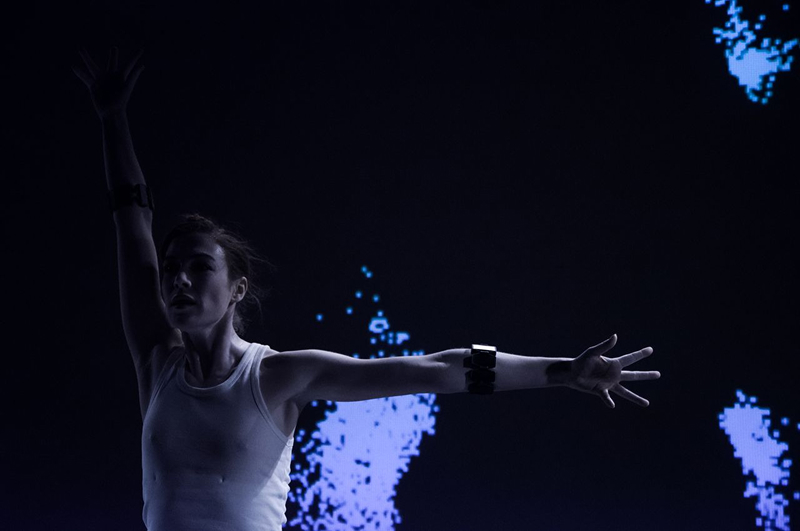
F-Z 25 (2025) combines interactive sensors, generative AI music, and digital imagery with live performance to explore the aesthetics of the body’s disappearance. Drawing on optical detection and gesture-driven sound generation, the piece stages a poetic encounter between human movement and algorithmically responsive environments. Far from disembodied virtuality, the work proposes a nuanced, eu-topian space where technology amplifies sensory richness without erasing the physical body.
Image pre-AI "Myself" projectn
The ”pre-AI” “Myselves” project
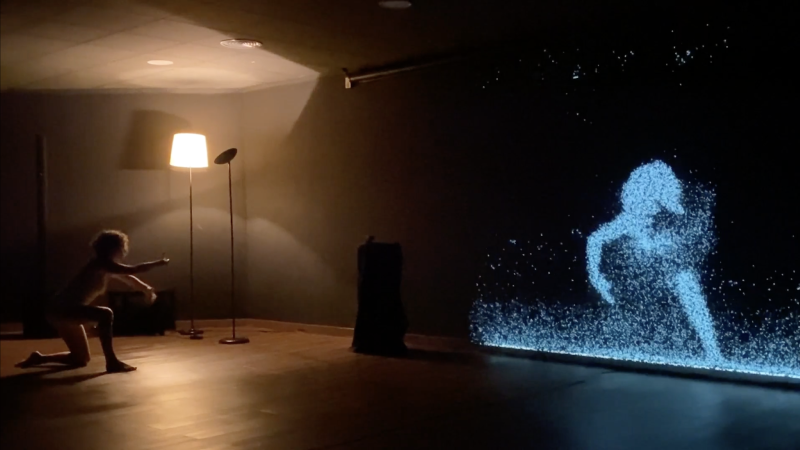
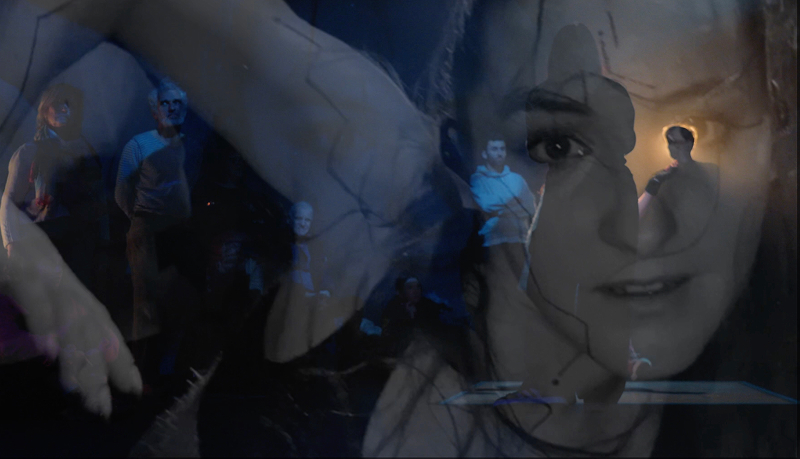
The performance Myselves (2019-2025) features a semi-improvised reciprocal choreography between a human dancer and an artificial entity programmed with algorithms of infra-language intelligence related to bodily behavior: imitation, flight, attack, fusion, etc. Its body is made up of pixels projected onto the dancer and her environment, and its pre-AI intelligence is programmed with algorithms inspired by living behaviors. These algorithms perceive the dancer through visual and physiological sensors to understand her different selves and interact with them. The performance develops as an infra-verbal dialogue between a human and an immaterial entity, exploring various relational modalities and culminating in a form of reconciliation.
Image Description
AI and Dance: Embodied Intelligence, Fallibility, and Coexistence
Intelligence is not exclusively cognitive, linguistic, or computational. It emerges across the living world — through movement, sensation, behavior, adaptation, and relational exchange. While contemporary artificial intelligences such as large language models and generative media tools simulate fragments of human cognition, they inhabit only a narrow slice of what living systems know and do. What remains largely unexplored is the intelligence of the body: the infra-language of movement, tension, relational modalities, and behavioral patterning that cannot be reduced to symbols or text. This embodied intelligence, what K. Danse and close artistic partner, Antoine Schmitt, term “pre-AI,” becomes the artistic material and conceptual anchor for choreographic inquiry.
Our practice does not treat AI as a decorative or instrumental technology. Instead, AI becomes a relational partner — not perfect, not omniscient, but capable of fallibility, resonance, and response. Through this encounter, intelligence is not something to be observed at a distance, but something lived through movement, disturbance, and negotiation.
In F_AI_L (2024), the AI’s inability to classify atypical movements becomes the point of creative departure. Trained on vast dance corpora, the machine attempts to interpret gestures but “fails” when faced with deviations, micro-variations, or non-normative physical subtleties. These errors are not bugs to be corrected, but openings for the body to assert its unpredictability, inviting performers and audiences alike to explore movement as an active, abductive, and sensate intelligence. The work reframes AI’s limitations as a destabilizing aesthetic — where machine fallibility becomes a creative partner.
In Immortal(s) (2023), the focus shifts to coexistence and memory. Hybrid beings — part human, part algorithmic — inhabit an immersive environment that evokes speculative futures of artificial longevity and estrangement. Audiences navigate relational thresholds with these beings, whose behaviors are shaped by both learned data and embodied contingencies. Here, K. Danse interrogates narratives of immortality and technological mastery, suggesting that being alive together — human and artificial — involves vulnerability, miscommunication, and affective exchange, not mere optimization.
ETERNITY (2025–27) expands this inquiry into an immersive scenographic ecosystem where choreography is co-composed between bodies, projected environments, soundscapes, and adaptive AI processes. The performance inhabits a triangular field of interaction: dancer, audience, and intelligent system. Each gesture, glance, and proximity feeds AI modules that modulate light, image, and spatial dynamics, creating a living architecture of perception. ETERNITY reframes the performance space as a shared organism, where intelligence is distributed across bodies and technologies, and where spectators become participants in ongoing negotiation.
F-Z 25 (2025) foregrounds perceptual extension and somatic resonance. Using gesture recognition, generative audio feedback, and immersive visuals, the work maps the interplay between sensorium and responsive systems. Instead of relegating the body to data points, F-Z 25 treats the moving body as a site of continuous emergence — a generator of qualitative states that resist pre-programmed categorization. Here, the AI is not a director of form but a mirror of uncertainty: it amplifies subtle tensions, foldings of posture, rhythms of breath, and the unpredictable contours of live presence.
Across these works, a shared ethos emerges: AI isn’t harnessed to replace human creativity, but to challenge and reveal it. Instead of automating choreography, K. Danse’s approach positions AI as a collaborator whose limitations, misreadings, and reactivity become vital creative forces. This practice resonates with broader conversations in dance and technology, where artists are exploring AI not as a surrogate dancer but as a catalyst for expanding corporeal understanding and aesthetic possibility.
In doing so, K. Danse’s works reveal something profound about the intersection of machine intelligence and human expression: intelligence itself isn’t reducible to data processing or algorithmic precision, but emerges — and is experienced — through relationality, unpredictability, and embodiment. In these choreographic experiences, AI doesn’t overshadow the body; it refracts it, amplifies it, and invites us to reimagine what it means to move with others — human, digital, imagined — in a shared present.
Our broader philosophy emerges across these works: artificial intelligence is neither an abstract omniscience nor a threat to human creativity. Rather, AI functions as a relational interlocutor — one whose limitations, misreads, and adaptive processes make visible what is unique about embodied life. Dance, as both method and metaphor, refuses the disembodied maginary of pure computation, instead insisting on movement as intelligence, failure as aesthetic resource, and coexistence as a choreographic condition.
Thus, the confluence of bodies and digital systems becomes not a zone of replacement but of transformation: a space where embodied wisdom and machine responsiveness coalesce in forms that are speculative, poetic, and profoundly human. K. Danse’s work invites us to rethink intelligence itself as a lived, relational, and emergent process — one that thrives in the interplay between skin, algorithm, sensation, and shared presence.
Image Description
Some key points on how AI influences dance
Dance and artificial intelligence (AI) are increasingly intersecting, creating an exciting fusion of art and technology.
1. AI-assisted Choreography: Researchers and artists use AI to generate new choreographies. Algorithms can be trained on datasets of dance movements to generate original movement sequences.
2. Movement Analysis: AI can be used to analyze dancers' movements, providing detailed insights into technique, emotional expression, and other performance aspects. This can be useful for professional dancers and choreographers to improve their practice.
3. Interactions with Virtual Partners: Advanced AI systems allow dancers to interact with virtual partners or avatars. These partners can be programmed to respond to the dancer's movements in real-time, offering new possibilities for creative exploration and performance.
4. Use of Sensors and Wearable Devices: Sensors and wearable devices are often used to capture dancers' movements and transmit them to AI systems for analysis and processing. This allows for seamless integration of AI into the creation and performance process.
5. Experimentation with Immersive Environments: AI is also used to create immersive environments in which dancers can interact. These environments can be virtual or augmented, offering new sensory and narrative experiences for both performers and audiences.
6. Exploration of New Styles and Techniques: AI can be used to explore new dance styles and techniques by combining elements from different genres or generating unique movements that challenge traditional conventions. This can lead to innovative and inspiring forms of dance.
In summary, the combination of dance and AI opens new creative and artistic perspectives, providing dancers and choreographers with powerful tools to explore and push the boundaries of their art.