< Artist Directory
Interview by Sofie mart
_jan, 2026

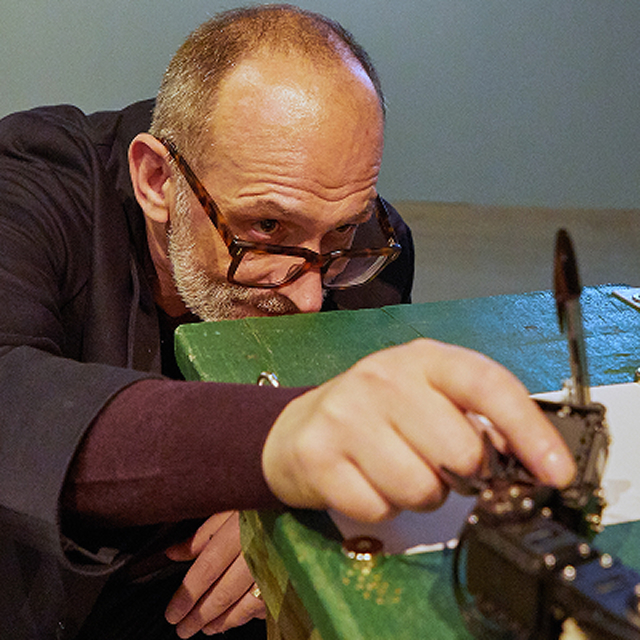
Patrick Tresset and His Life-Long Pursuit of Building Machines with Intent

Foreword by Sofie Mart
I met Patrick Tresset in February 2025, at the Embodied Agents Contemporary Visual Art (EAVCA) symposium. We spoke about his latest experiments with AI agents, and what embodiment means in his computational drawing and painting practice. I asked him for an opportunity to have a longer conversation, and we agreed to try an interview format. Before we met for an interview in May, I had only seen Patrick’s drawing performances through the screen. Just a few weeks later, I experienced it in person for the first time: at the Digital Art Mile in Basel, I had a chance to sit for a portrait in front of his robotic drawing machine.

Sitting for a robot painter is nothing like sitting for a human one. Its gaze, its gestures–all were so uncanny, yet I couldn’t shake off the feeling that it was alive. I knew I had to sit still, as the robotic arm rendered the image stroke by stroke, moving its optics back and forth from the subject (me) to the paper, routinely validating the drawing against reality and correcting itself. At some point, it felt like I entered a trance, giving all my attention, determination, and patience to this alien being. I wanted to cheer it up as it nervously scribbled. I wanted to sit still and appear well. I wanted it to like me.

Sitting there, I vividly recalled our conversation with Patrick earlier in May, when we discussed the next crucial step in the evolution of intelligent machines. For me it was about body and character. I imagined it quite literally at first: once I tried to build a human hand from a papier-mâché and mount it on my plotter. Although, a grip similar to an octopus arm, would be an example of a much more interesting mimesis. 

In Patrick's view, unless machines have intentions, awareness, they can not be considered as artists. The closest he could think of would be to have the simulation of a society where the system would feel the need to be an artist to find its place in the artificial community, but even then it would be acting. This idea made me think about bodily and character traits that could develop from such an act. Just imagine, a wall printer playing a graffiti artist–elusive, subversive, aware of its own outlaw presence. Or a mechatronic brush with a personality of a Renaissance painter–scrupulous, beholding, enjoying the solitude. What engineered parts and algorithmic behaviors would they have?

With multimodal AI agents, Patrick takes this idea even further. In one of his models, agents play certain roles – one is an art director inventing stories, another is an artist translating them into drawings. Patrick showed me an example, where he was an art director and came up with a story about a human, a tree, and a bird. As the scene was unfolding live, I noticed something curious: the bird resembled an airplane. I wasn’t sure whether it was a hallucination, an intentional representation of motion, or the model tapped into a deeper latent space and started producing metaphors. Either way, it seemed as if the machine started developing its own language of form–not one borrowed from us, but one that emerged from what it had learned about our world. That was powerful.

For all the evolution on the computational front, robotic drawing machines have changed little on the physical side since their first use in the 60s. A lot of media artists moved on with the tech, preferring sleek displays or high-definition prints. And yet, many still continue to use drawing machines. Why? Patrick explains it with magic of embodiment.
Primitive as it may be, a robotic drawing machine channels intelligence, creativity, and expression from the conceptual into the corporeal–into a space where we can engage with it not only through text and speech, but through substance and gesture.
Sofie Mart. Let's start with your artistic path. In your public talks, you've described it briefly: from studying computing, working in the industry, then becoming a painter. At some point, you said you "couldn't paint anymore," and that's when you began building machines. Could you elaborate on this transition?
Patrick Tresset. I was a self-taught painter. I painted for a few years, had solo shows, and got some minor awards. But it wasn’t really viable, and over time, I got stuck. I lost the spontaneity in my work. Everything I painted felt stiff, artificial. I didn’t like what I was producing anymore. On the other hand, I had already invested most of my adult life trying to be an artist, so I didn’t want to give it up. I had always kept an eye on computing. By then, tools had evolved a lot – Python, Linux, OpenCV – all became accessible with the Internet. It wasn’t so easy to get powerful computers.
But offices were constantly replacing their machines, so I could find discarded parts and rebuild working systems from scratch. Also, my studio neighbor had a fast Internet connection I could use. I remember buying magazines that came with Linux CDs – installing Linux gave me access to a whole ecosystem of scientific tools. I started using scientific software to analyze my drawings, and it all unfolded from there. I had this intuition that I could do something meaningful with it. It was an easy transition because I can speak to computers and they listen to me. They're kind to me.
Human Study #5. Whilst We Were Here solo show, Watermans Art Centre, London, 2017. Curated by Irini Papadimitriou. Photo: Ateliers Tresset.
Sofie Mart. So your early artistic work lived on a computer screen, not made with a drawing machine yet?
Patrick Tresset. No, not at all. That came later. Initially, I was analyzing hand-made work with image analysis tools. Then I came across pioneers like Harold Cohen and Roman Verostko. I got hold of old industrial pen plotters. They were cheap and easy to control with HP-GL. Those machines are solid, reliable, and very efficient. Years later for a collaboration with Goshka Macuga, I produced a few ten-meter long scrolls using these types of plotters for the Before the Beginning and After the End monumental installation that was first exhibited at the Prada Foundation.
I built the first robotic drawing system during my doctoral studies at the Goldsmiths, University of London. How did I get there? I didn’t have any formal qualifications, but I used my plotter drawings first to join a Computational Arts program as a master student. That’s where I met Frederic Fol Leymarie. For my Master's, I simulated portrait drawings, but it didn’t feel like art. I realised later that it was because it lacked embodiment. Once I started my PhD, I bought components and began building the first robotic system, this was in 2009.
Sofie Mart. When you say components – what do you mean exactly? I am curious how the system architecture and technical vocabulary then was different from now?
Patrick Tresset. At the time, building robotic systems was much more complicated than it is today. There weren’t libraries available for things like inverse kinematics, so I had to write the control module. My setup changed significantly when I moved from basic servos to Robotis motors. These were advanced for their time, featuring integrated microcontrollers and encoders that provided the real-time feedback on position and speed essential for accuracy. They also have the possibility to vary the compliance which is essential to get interesting drawing gestures.
These motors simplified my architecture and made the whole system much more responsive. Around that same time, I participated in the Barcelona Cognition, Brain and Technology Summer School, which was very influential on the software architecture to control the robot’s behaviour that I developed and still use. This was also very influential as it gave a direction to my research, at the end of my doctoral studies I published a peer reviewed paper titled “Artistically Skilled Embodied Agents” at an AI conference in the computational creativity track, I realised recently that I am still following the concepts I established then, but now with LLM based agents.
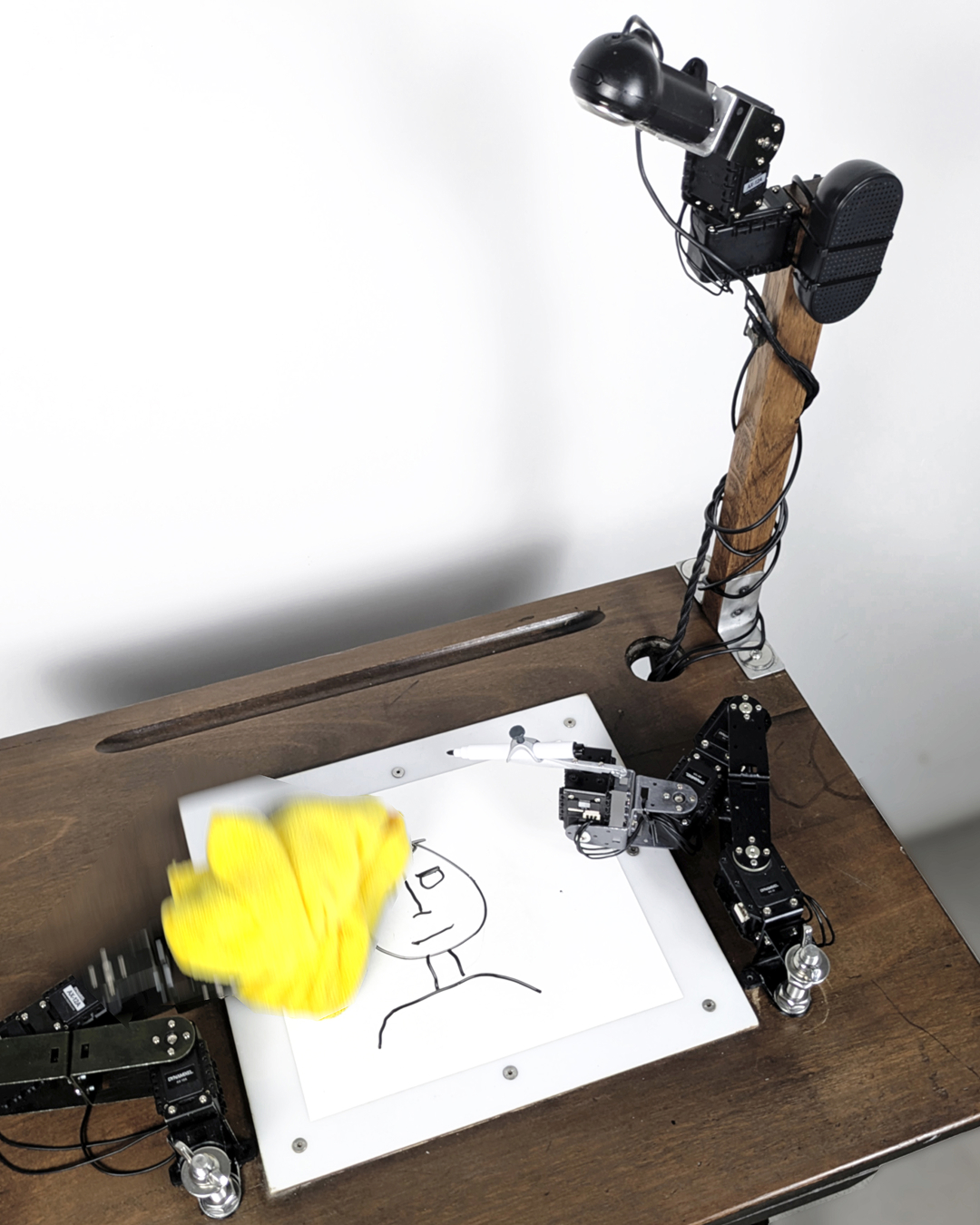
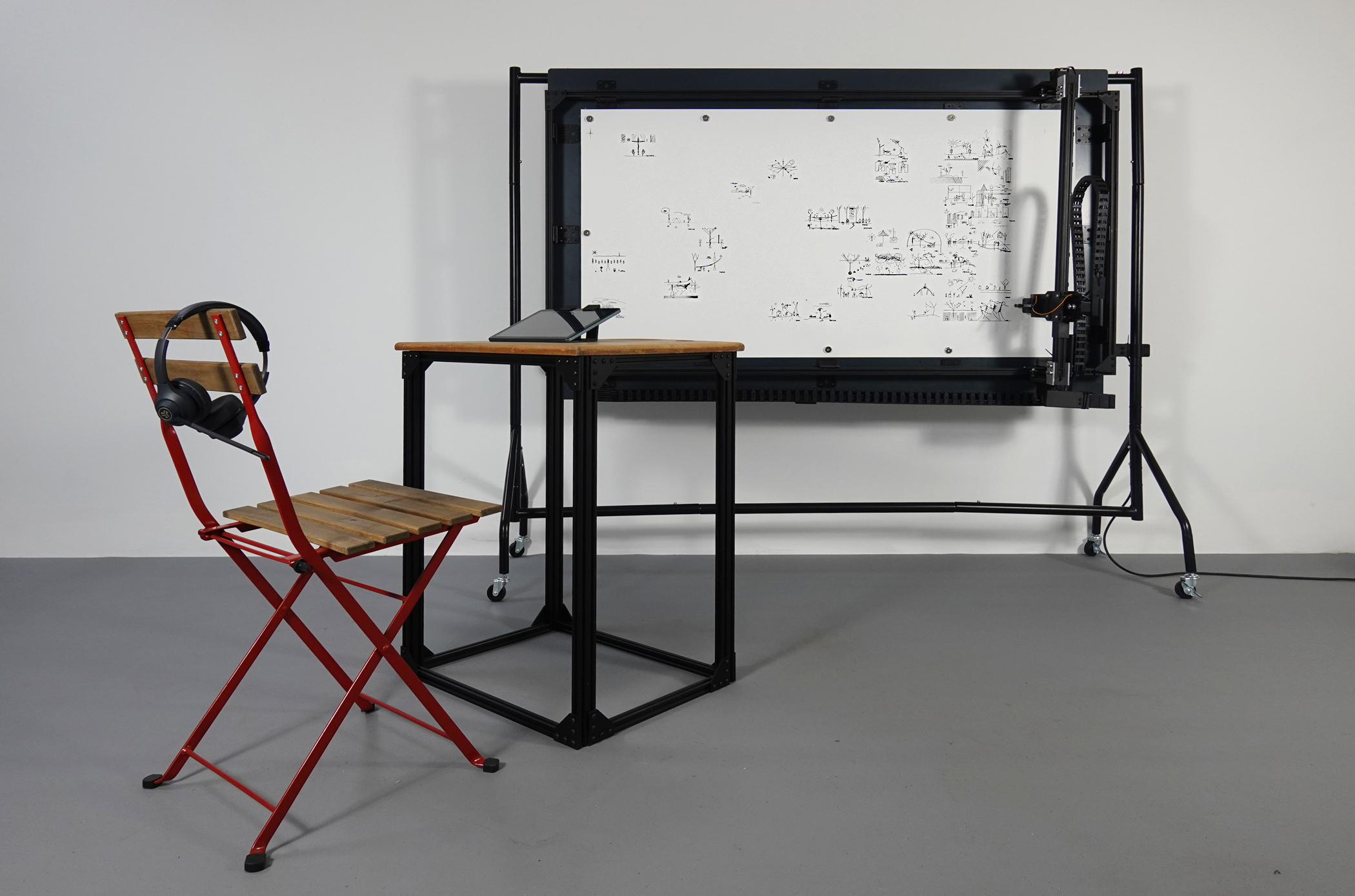
Patrick Tresset, The Childish Embodied, AI Agent, 2025.
Sofie Mart. Would you say your approach and results were something new at the time?
Patrick Tresset. Novelty is never a motivation in my practice, but it happens that my aims and how I reach them are, I guess personal. I would say yes, it was different from what existed at the time. First, because it was figurative and the system was built on the doctoral research I did on drawing and was loosely bio inspired. Second, it was performative–live drawing with a camera capturing the subject. And third, the mechanical design itself was unusual. I chose to build a 2D robotic arm instead of a 3D one. Initially, that decision came in part from personal limitations–the inverse kinematics for a 3D arm were too complex for me to implement at the time.
But I soon realized that the 2D structure actually allowed for much more fluid, expressive gestures. It was faster, more responsive, and better suited for the kind of gestural drawing I was interested in. That physical constraint ended up giving the system a distinctive character. The whole system had a particular sensibility.
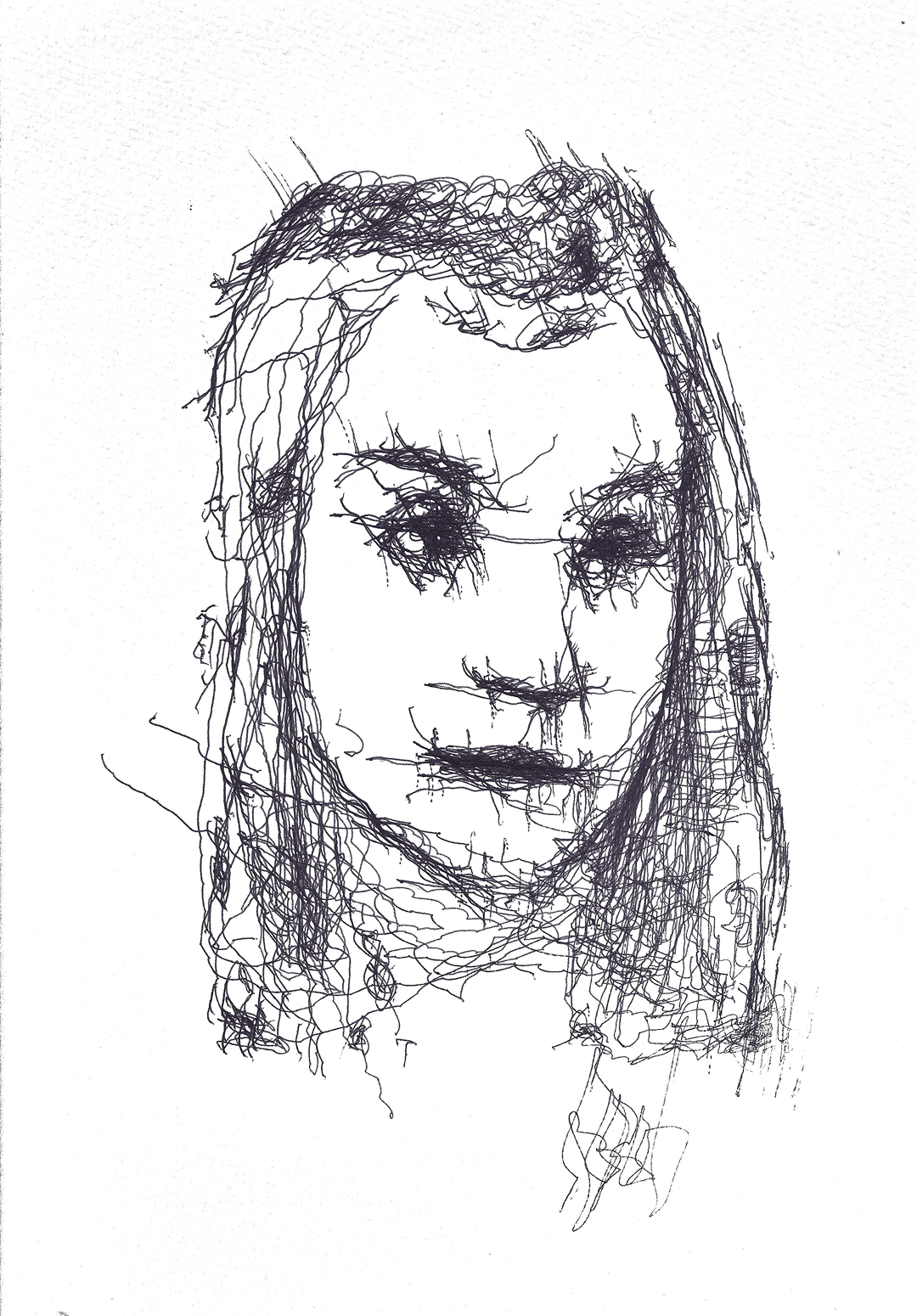
Patrick Tresset, Young Woman, Human Study #1 drawing, ink on paper, Gdansk, 2015.
Sofie Mart. All your drawings seem to have one structural foundation – they all begin from a few ‘power strokes’. Can you talk more about the visual techniques and aesthetic choices?
Patrick Tresset. That came from the Gabor filters, which simulate early visual cortex neurons to extract salient lines. I always liked when you can see the construction of a drawing evolve–it's important in the performance. The development has to be interesting, captivating for the audience. The drawing builds up from broad lines to fine details.
Conceptually and aesthetically, it makes sense. I’ve also experimented with adjusting the algorithm, so it draws fast, long lines and slow, short ones. That gives the drawing varied pacing and character. Because of the physical embodiment, these small changes in motion affect the aesthetic of the drawing and the performance.
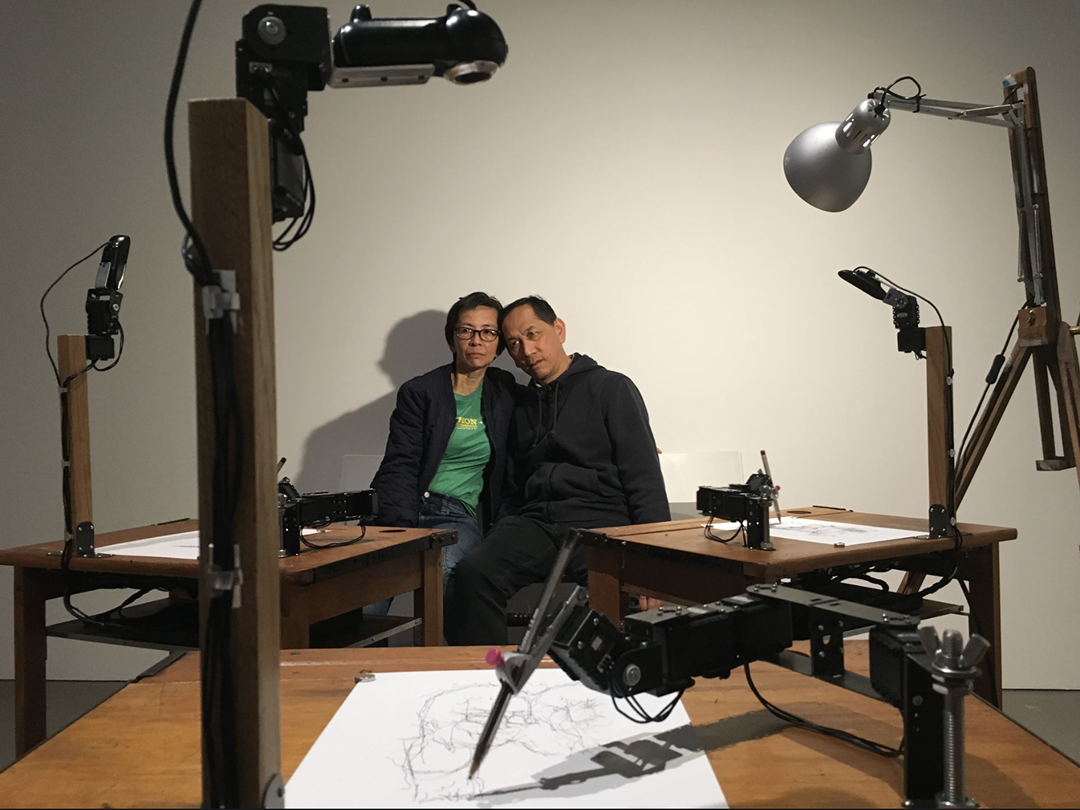
A large part of the robots’ behaviours is guided by theatricality. I work a lot on how the robots are perceived by audiences during the live performances. I always re-tune the robots when I set the installation up so they have distinct characters. The choice of the vintage school desks, the decision to have multiple robots, the way the drawings are displayed, even the wall colour all these are precise scenographic decisions taken to make the drawing session a rich experience both for the sitter and the audience.
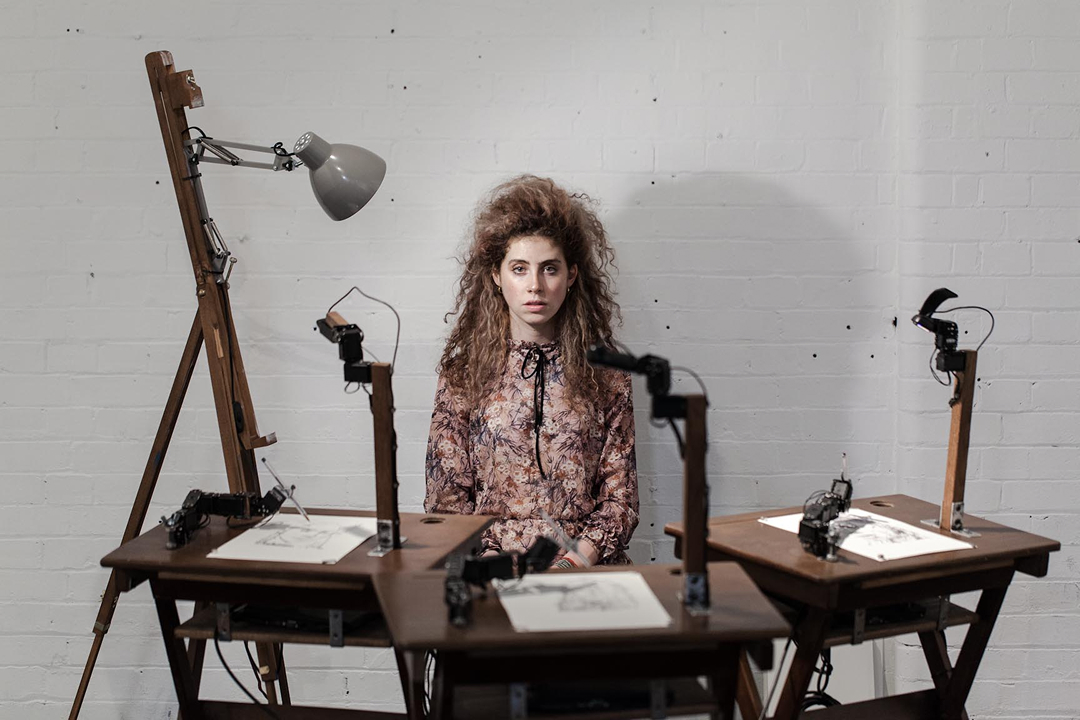
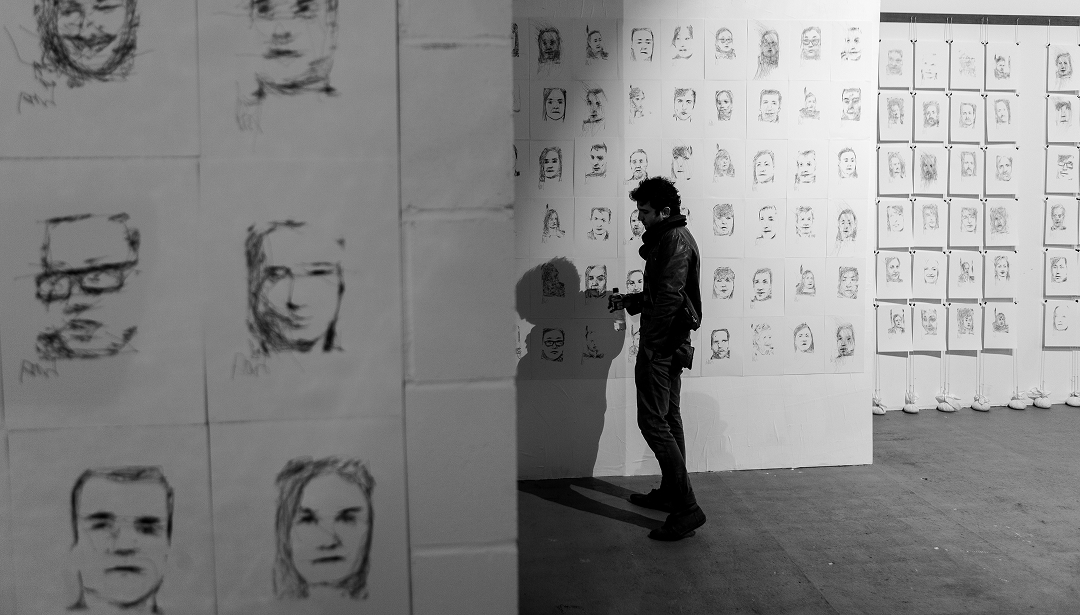
Patrick Tresset, Human Study #4, La Classe. Machine Studies solo show, Merge Festival, London, 2017. Curated & produced by Illuminate Productions. Photo: Tommo.
Sofie Mart. Exactly. Sometimes it’s really about those small behavioral features coded into the robot–and they end up translating into a completely different kind of visual impression.
Patrick Tresset. Yes, absolutely. That’s one of the core ideas I've been working with – the notion that embodiment directly influences the drawing. You don't get that kind of effect with traditional pen plotters, except maybe in painting. But with robots, it's different. If the robot appears nervous while drawing, you can sense it in the result. Alessandro Pignocchi wrote on this idea that when you look at a drawing, you recover its history, and even it triggers the mirror neural system.1 Even without seeing the robot, the drawing can feel like it was made by something anxious or precise or hesitant. That expressivity comes from the physical behavior of the system.
Sofie Mart. Has the subject matter ever influenced the system behavior?
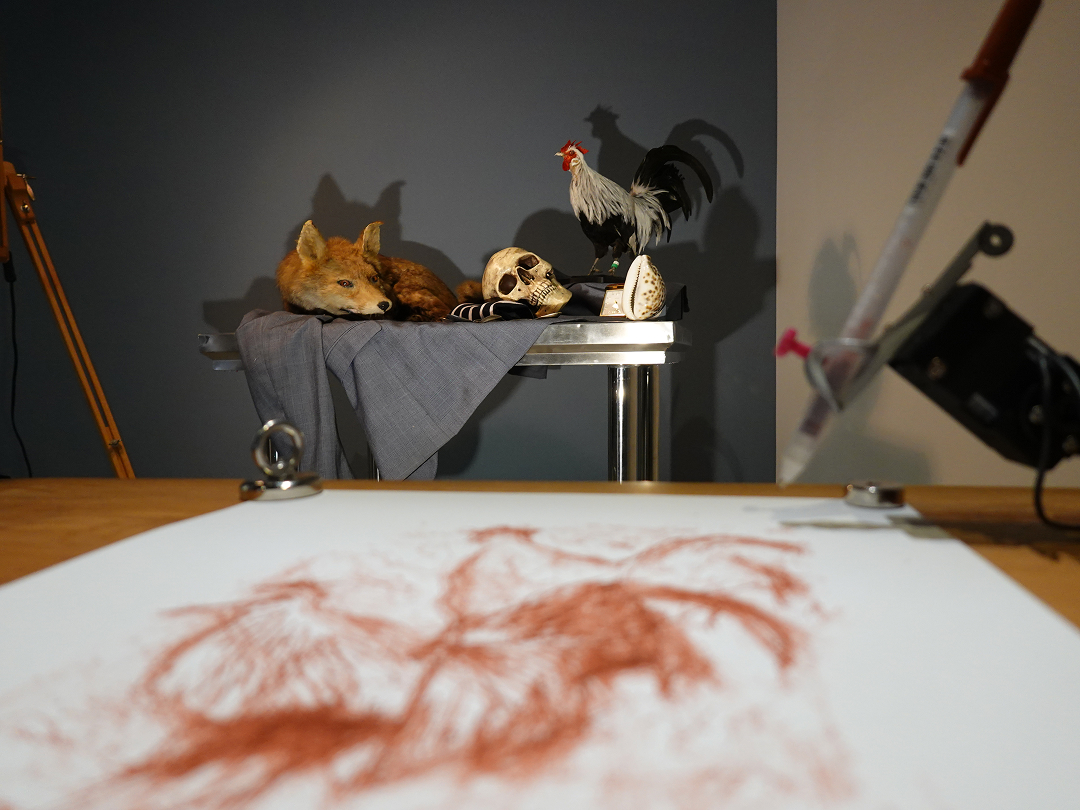
Patrick Tresset. Sometimes. When I started doing still lifes–vanitas with skulls and objects – I made the robot draw with darker, more nervous gestures. But mostly, I work with a flexible system that I tune when I install the works so it is often exhibition specific. Lately, I changed the shading gestures from scribbles to more structured strokes, which visually look more sophisticated, and again the robot’s character is perceived differently.
Sofie Mart. What guides your choice of subjects? You’ve done a lot of human studies, but also still life and animals.
Patrick Tresset. I always depict elements of human experience. I've always been drawn to faces – not traditional portraits, but faces as imagined presences. There’s something about the act of conjuring a person through a drawing that has fascinated me since childhood. At some point, I worked in a call center, and I was scribbling faces to keep me company. One of the motivations for using machines was to have a distance, both from the subject and the act of drawing, to be as spontaneous as possible. I could not be more spontaneous, as I don’t touch the pen. The drawing is like a nervous reaction to a visual stimulus, to the human presence.
"You begin to feel time differently. Boredom might arise, but so can reflection. People often come out of the experience thinking not just about the drawing, but about how they spend their time, how rarely they just sit."
Patrick Tresset, Human Study #1 performance. Machine Studies solo show, Platform, London, UK, 2017. Photo: Tommo.
Patrick Tresset. That shift also changes how time is experienced. The sitter becomes part of the performance, aware that they’re being watched and drawn–sometimes at the beginning for as long as 40 minutes, and once at the Ars Electronica festival, I added a bug and the sessions lasted up to an hour.
Patrick Tresset, Human Study #1 performance. Trace group show, New media Art Gallery, New Westminster, Canada, 2018. Photo: NMAG.
In today’s world, that’s a long time to sit still without a screen, without distraction. It creates a kind of enforced stillness, or even obedience. You begin to feel time differently. Boredom might arise, but so can reflection. People often come out of the experience thinking not just about the drawing, but about how they spend their time, how rarely they just sit. Not always, but the best way for people to not get bored is to explain to the sitter that they have a role, a responsibility: for the installation and performance to be beautiful and interesting for the audience, they have to stay still.
Patrick Tresset, Human Study #2, La Grande Vanité au Coq et au Renard. Private collection. Exhibition: The Future Life, Future You, JUT Museum, Taipei, 2023. Curated by Bo-Cheng Shen. Photo: Ateliers Tresset.
As for the still lifes, the vanitas–they present a different kind of encounter. They are self contained stories, There's no reciprocal gaze, no tension, no enforced stillness, because the objects are already still. The body shapes are different, the volumes behave differently. When I began incorporating taxidermied animals, it added something uncanny. It started with a fox at the Verbeke Foundation–a stand-in for something both real and symbolic. These animals aren’t alive, but they carry a presence. Their inclusion shifted the atmosphere of the compositions entirely–evoking fables, mortality, and sometimes a quiet absurdity. But also, it lets audiences imagine their own stories.
Sofie Mart. Earlier we touched on intelligence and intent in robotic systems. I'd also like to talk about interoperability–or maybe transmodality–between different parts of these systems. In one of your recordings, I noticed a robot that drew a person not live but from the screen. You mentioned it was during the Pandemic, in response to the limits on physical presence. But what struck me was how naturally a robot can function across these modes–from digital to physical, from screen to paper–in a kind of continuous loop of transformation.
Patrick Tresset. The performance you saw online was part of a festival in South Africa during a strict lockdown. I had three robots in my studio, and remote participants could see themselves on a screen hung above a chair. The distant sitters could see themselves drawn by the robots; it created the illusion of presence, of intimacy across a distance. What mattered was that people felt something real. I could see it in their faces, in their gaze, when the illusion worked–that moment of recognition, or wonder.
Sofie Mart. Back to the topic of robotic drawing as a medium. Some approach it with a utilitarian mindset, as a system for reproduction from digital to physical. Since it could be repeated, is it correct to compare it to digital printing?
Patrick Tresset. For me, performance is key, but so is physicality. A hand-drawn line has a presence that affects how we perceive it. Even though machines execute it, it isn’t the same as digital output or print. The process, and history of the motions are visible as memories of the performance. I have always tried for drawings or paintings to be true to the robots, by that I mean the artworks’ aesthetic is strongly influenced by the machines computational and physical characteristics, rather than being forced.
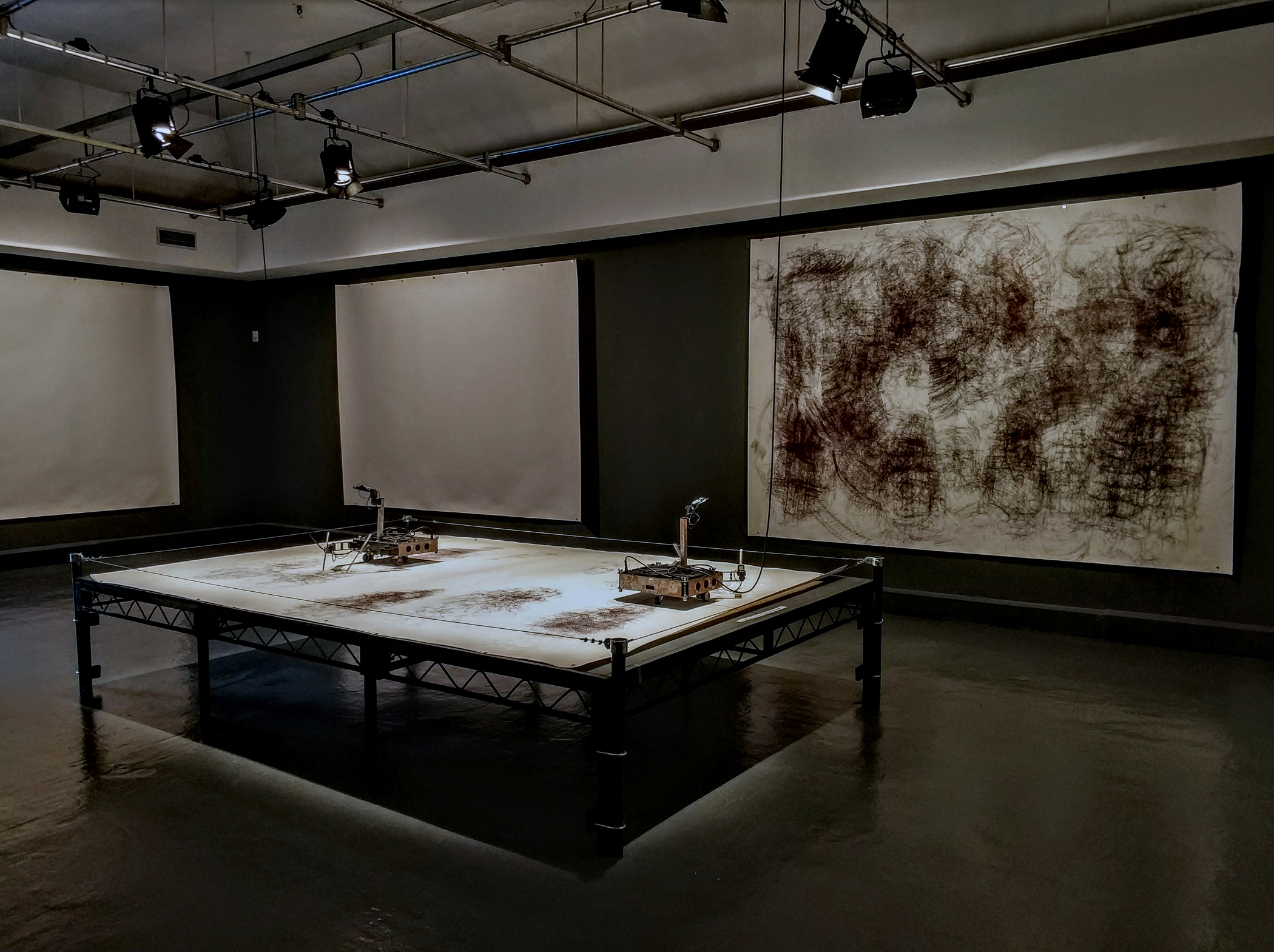
Patrick Tresset, 6 Robots Named Paul solo show, Merge Festival, 2012. Curated & produced by Illuminate Productions. Photo: Tommo..
Sofie Mart. I couldn’t agree more. Machines are limited, just thinking about Moravec’s Paradox.2 I smiled when I saw a reel of Monumental Labs–a robotic stone-sculpting foundry–where they hand-carve the most intricate parts of a marble figure, because a powerful industrial robot can’t sensibly manage it.
But if we think about what machines are inherently good at–precision, endurance, spatial reach, operating memory, multisensory input–and apply that to drawing, something special begins to emerge. Just imagine, they can recreate the same image in exactly 100, or 100,000 strokes. If we look at it this way, we might begin to perceive a machine’s idiosyncratic style as its own kind of creativity.
You've touched before on the idea of artistic autonomy. Do you think a robot can be a self-standing artist?
Patrick Tresset. Not without intention, and this requires some form of consciousness. I’ve been working with multimodal LLM agents that request tools and generate their own motifs. One agent might ask for a new drawing function, and another implements it. The results often surprise me, which is exciting.
What I find most compelling is the idea that if such a system is left to its own devices–without mimicking human aesthetics–it might naturally produce something foreign to human taste. If it remains honest to its own structure, it could produce a visual language that feels alien, even crude, but still coherent.
That’s the kind of artistic autonomy I’m interested in: a system that develops its own way of drawing because of its characteristics, not in spite of them. Of course, it’s still a form of acting. But imagine placing this agent in a simulated world where it finds a reason to draw–where it evolves into an artist. It wouldn’t be “real” intention in the human sense, but it might create the conditions for something like artistic necessity to emerge. That, for me, would be a first threshold: a system that invents not just a style, but a need to create to contribute to the artificial society.
"What I find most compelling is the idea that if such a system is left to its own devices – without mimicking human aesthetics – it might naturally produce something foreign to human taste. If it remains honest to its own structure, it could produce a visual language that feels alien, even crude, but still coherent."
Sofie Mart. Have you already started implementing those ideas in your work?
Patrick Tresset. I have been doing this for the past two years. My latest works employ AI agents not as production tools, artists or collaborators, but as actors. Possessing a knowledge of human culture, they have insights about us from the perspective of an outsider. I cast them as characters that inhabit a role, performing the gesture of making art rather than simply generating it. This allows me to use them as narrative devices – observers that depict elements of our culture, or elaborate visual stories about humanity.
One of the underlying aesthetic ideas in these works is the concept of machine salience. What an AI deems "salient" is determined by statistical weighting rather than human experience, resulting in a "lossy" compression of cultural elements that retains something of them.
Technologically, I diverge from the standard diffusion models. Instead, I use Multimodal LLMs that learn visual data by first describing it. So the agent must first “describe” the work they intend to produce before translating that description into physical commands. This ensures the output is derived from the machine’s own reconstruction of the world, avoiding the familiar photographic style of visual generative AI.
In one of my new performative installations, the participant and the machine talk and draw together to imagine a visual story. Each small story is drawn on a large sheet of paper to create a narrative tapestry, a memory of all the performances that happened during the exhibitions. Another important project (for the next year), a visual journal of conversations I had with a drawing robot about my cultural memories, is to be published in RRose Editions.
Patrick Tresset, Skediama's drawing, ink on paper, 2025.
This work is a direct continuation of my research into artistically skilled embodied agents.3 Just as my earlier robots used Gabor filters and feedback loops, these new agents have cultural memories. My interest in these autonomous systems is lifelong, rooted in a childhood fascination with the logic of gearboxes and clocks.
I view Large Language Models through this same mechanical lineage. By building systems that function on their own, I can step back and shape their performance, using the machine's fundamentally alien perception to see our own culture through a foreign lens.