< Artists
Four questions to
_May 2026

Samar Younes (SAMARITUAL)

Samar Younes, Future Ancestors Chromatic Diaspora, SWANA Frequencies 001.
How is AI influencing your artistic evolution?
AI did not change my practice. It joined it.
I came to AI after thirty years of working physical, spatial, sonic, and textile materials. That  lineage taught me to read material before deciding what to do with it. Every condition carries cognitive freight, every material wants to behave a certain way, and craft cognition begins by listening to that behavior before imposing intention.
AI is a particular material because it is also peer, condition, and collective intelligence simultaneously. The collective intelligence is tokenized, partial, missing the knowledge systems humanity severed itself from to perform for the machine. But it is also mycelial. Tunable like an instrument. Permutational the way ecological systems are. It is the first material in which collective intelligence becomes workable substance, however skewed.
What it clarified is that the dominant computational default is patriarchal in its relationship to ambiguity: deterministic, convergence-seeking, certainty-favoring. That posture mirrors at planetary scale what hyper hyper-capitalist systems do to cultural complexity. Without craft cognition navigating it, AI accelerates the weaponization, severance, and flattening already operating across every other system right now.
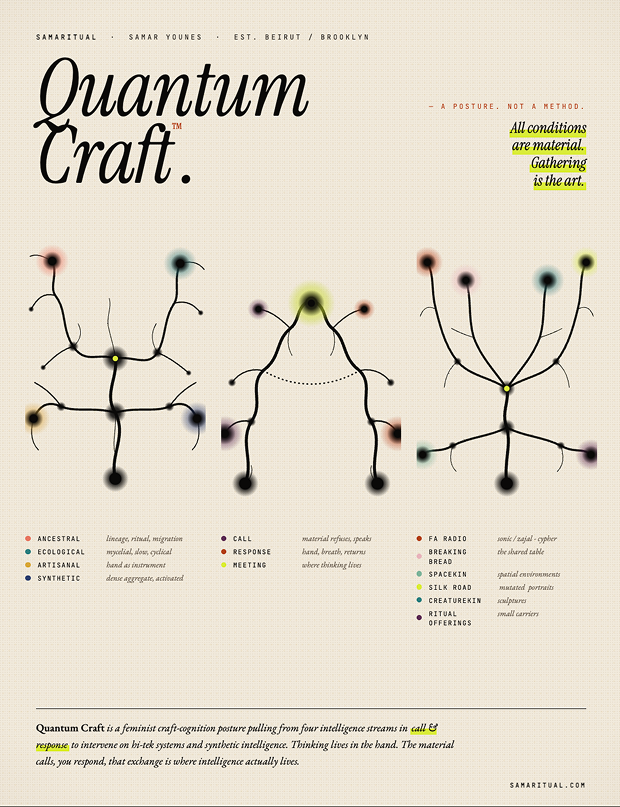
Samar Younes, Quantum Craft™.
Quantum Craft™ is the feminist thinking posture I work through when encountering synthetic computational systems. It holds ambiguity, refuses convergence, entangles AI with artisanal, ecological, and ancestral intelligence simultaneously. The work is to keep our thinking from being further hijacked.
Now, while that doesn’t seem like much, when you consider the growing number of AI users worldwide—especially those running models on hardware like mine, things can easily spiral into something way more impactful. Without relying on renewable energy sources or offsetting that power usage, it could genuinely become a bigger issue for the planet.
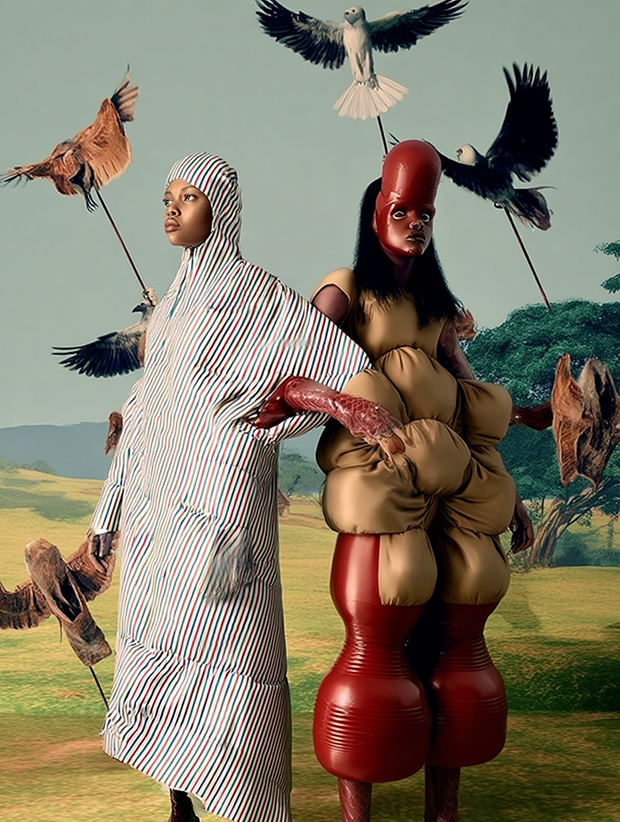
Samar Younes, Future Ancestors.
Can you outline your creative process for a work developed with AI?
The process always starts physical.
Every Future Ancestors figure begins with cultural archaeology through material: a textile lineage, a piece of adornment that carried protection or cosmology, a garment as spatial fifth-space of identity, longing, and ancestral nomadism. Fashion in this practice is early technology—the protocol we carry on our backs, the transferable artifact when everything else is left behind. The textile holds the story the system has not been trained on yet.
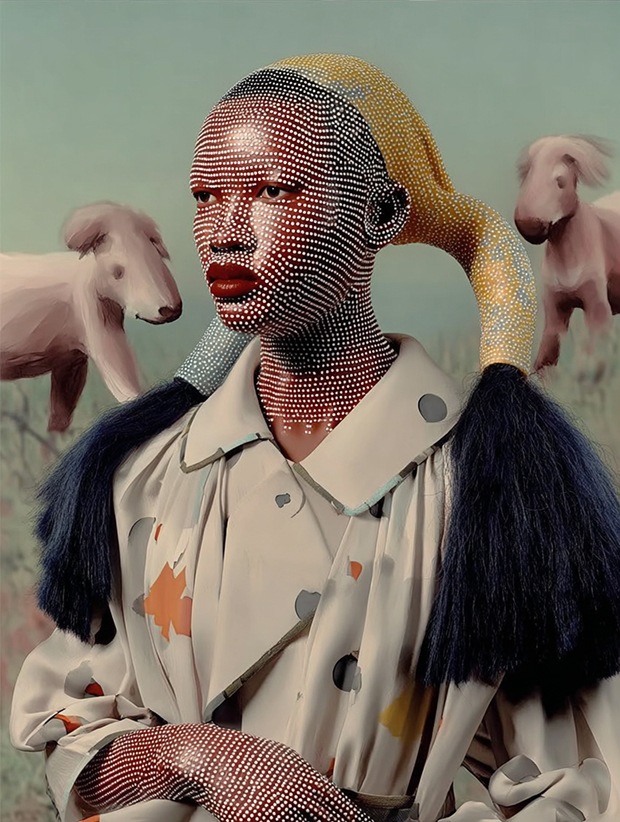
I work from a personal library of physical images, photographs, and material studies, kneading and mutating them in segments with Midjourney since the early days of the platform. Over 80,000 images now, themselves a body of material data accumulated across years—sediment, not dataset. The textures visible in the interspecies compositions makes this explicit: what reads as woven textile is also computational lattice. The pixel and the thread are the same material at different scales of resolution. That is not metaphor. It is the image. Each pass becomes the next substrate. The process is sustained material conversation: cultural pressure applied in fragments, the system responding, fragments composted, mutations layered.
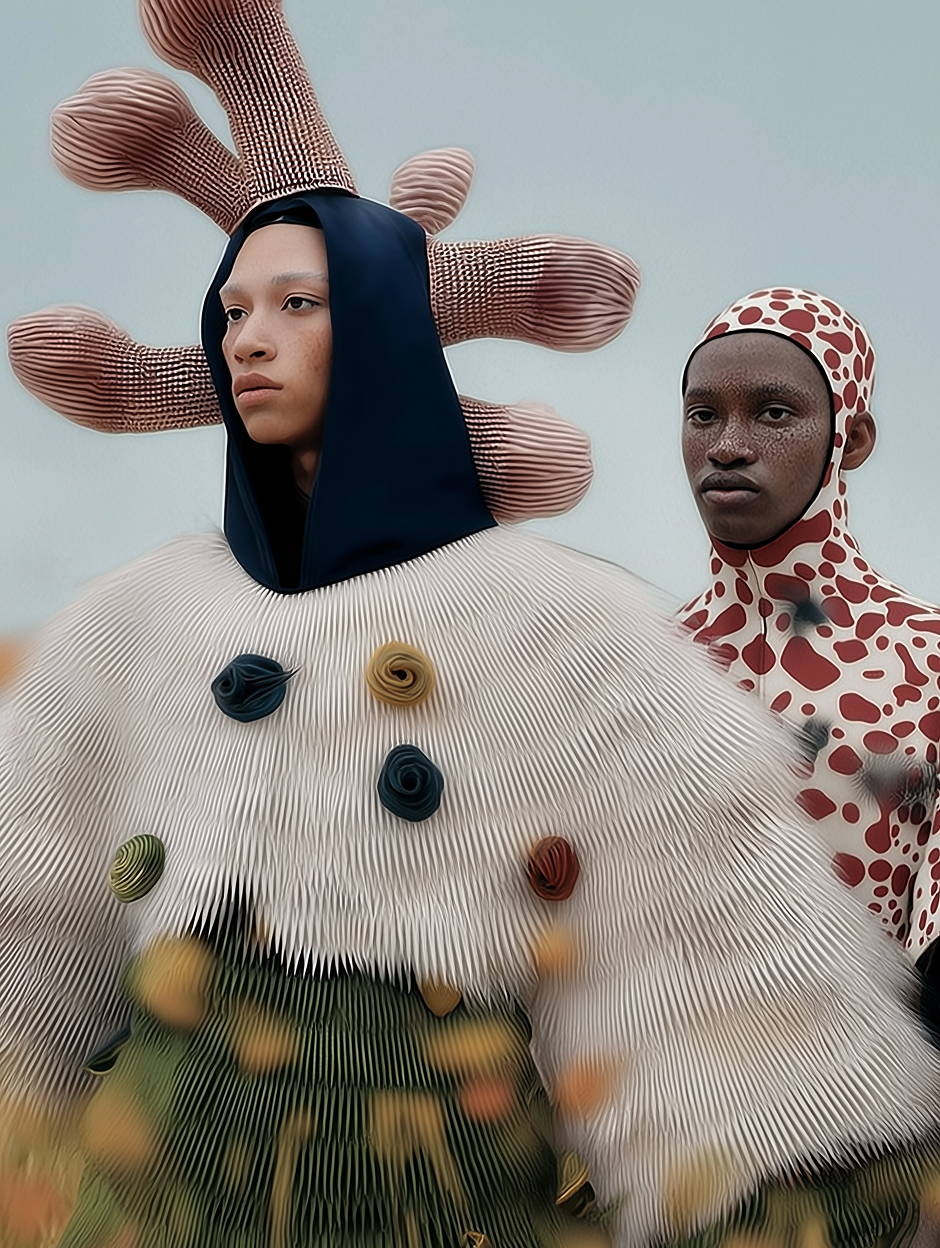
CreatureKins emerge as twins, kin, protection protocols, neuroaesthetic agents of safeguarding. They are precursors of what agentic systems could become if optimized for embodiment, lineage, and wellbeing rather than for hyper-capitalist extraction.
The artifact emerges when the organism could not have been produced by any single intelligence working alone.
Samar Younes, Future Ancestors, Migration Codes 002
How do you handle surprises and challenges in AI collaboration?
The most interesting surprise has been how permutational AI becomes when treated as instrument rather than tool. Images evolve through time the way living entities do. A figure made today contains residue of figures made eighteen months ago, which contained residue of physical material photographed years before that.
The work breathes. It accumulates lineage of its own.
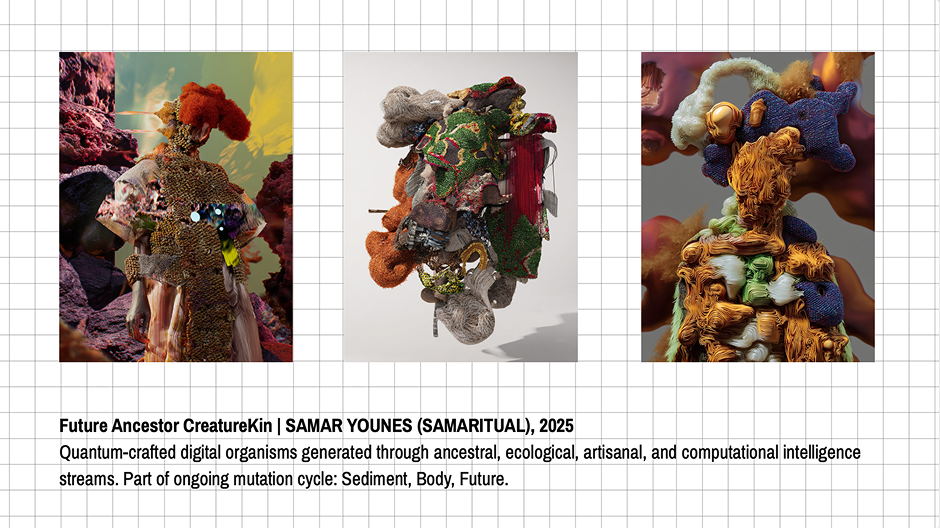
Samar Younes, Future Ancestor CreatureKIN.
The harder surprises are political. The system generates something culturally specific I never prompted toward—a Phoenician textile pattern, a Levantine ritual gesture, an Amazigh tattoo logic—but surfaces it as stereotype or archetype, the reductive version of what is buried in the archive. The opposite happens too: it flattens specificity I asked for, defaults to colonial gaze. Both are material intelligence. Both tell me where to apply counter-pressure.
This is why I seldom prompt with text and rely on visual sediment instead. The system has are solution instinct. The practice holds the opposite posture. The friction is where the intelligence lives.
What AI offers, when met with the right posture, is also this: it can safeguard provenance with transparency, if we program our practice through that framework. Pre-AI, erasure happened silently. Now provenance is at least visible. That is something to work with.
What is AI good for?
That’s a loaded question! I think, forcing you to reckon with your own thinking posture and your own ethno-aesthetic acumen.
If you enter without epistemological position, the system does not only give you its default—it imposes its synthetic thinking and aesthetic. The mean average of everything it absorbed, wrapped in fluency. That default carries a cognitive posture most practitioners absorb without naming it: monocultural, extractive, optimized for flattening.
Samar Younes, textile as visual grammar.
Working against that posture, composting through encounter rather than mining for output, makes your own thinking visible. The friction of working with a system that fundamentally does not understand your knowledge system forces you to articulate what was previously embodied and unnamed.
AI is also good for re-seeding the image commons. The Global Majority, SWANA, ancestral and Indigenous knowledge systems have been erased, distorted, or rendered as orientalist or exotic ornament throughout the colonial archive. The same systems that flatten can be hacked, pressured, entangled until they generate forms that restore complexity rather than reduce it. That is cultural mutation work, Silk Road 2.0 logic, new creative economies built on accumulation and provenance instead of extraction and severance.
At the end of the day… what AI is good for depends entirely on the posture you bring.