0009
United States


Where do you locate yourself in relation to the systems you work with?
Where are you heading, and what is pulling you there?
How would you describe the space your practice is currently unfolding in?
Description
Folds, seams, and worn textures are reinterpreted as brushstrokes, water, and bloom. The imagery lives in duality: pond and pile, pastoral and urban, reflection and residue. At first glance, the works appear as lilies drifting on water; on closer view, they reveal themselves as nylon, logos, and seams drawn from the culture that shaped me. This body of work marks a transition toward the flow of water. It is a portrait stitched in duality: the old pulse of urbanism and the pull of nature. Impressionism softens through fabric logic; what was worn becomes a symbol of reflection, and new waters carry me forward.
Process
I was heavily influenced by late '90s and early 2000s street fashion, fabric from Steep Tech, all those paneled, utility-based jackets. Over time, those visuals became memory for me, and in these outputs, they kind of came back. Not as literal references, but as texture that feels worn. The scenes are "engineered" using that visual vocabulary.
Tools
Created using a custom LoRA model and ControlNet. Post-production in Photoshop and finalized with upscaling tools.
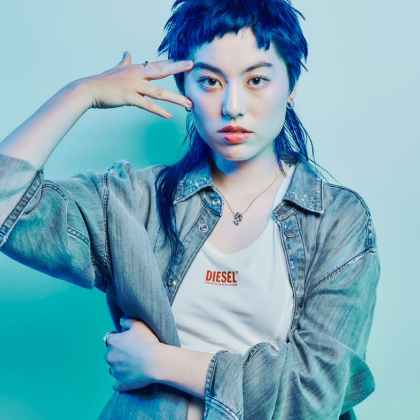
As a producer of Aww Inc., Asia’s first virtual human company, Sara Giusto is a female leader at the intersection of technology and creativity. She was featured in Forbes Japan’s “30 Under 30” in 2023 and was a TED speaker in 2024.
0009, Turning and Tucked caught me straightaway because of its beautiful composition and details - and the more I looked,the more I found. That's rare in an AI generated image.
The composition first of all is beautiful— the choice of the big negative space is awesome! At first it reads likewater, lilies on a pond. Then you notice seams, fabric panels, humans embeddedin what are essentially bedsheets. It pulls you in because of the composition,and lures you into the details.
The colour tones are also handled reallywell. With all of the above, I can really tell his specific style and taste wasbuilt over time which was really the final straw in why I picked this work asmy Golden Ticket. I have seen multiple beautiful images, but when you build astyle over time and are able to produce high quality work through it and tocommunicate that through one piece of work is phenomenal!
I also love the inspiration from the 90sSteep Tech fabric - there is always a depth when inspiration is taken fromfamiliar motifs you lived with.
Also wanted to mention the craft of themix use of Custom LoRA, ControlNet, and Photoshop post-production. Fashion,street culture, and something deeply personal all at once. I want to see itprinted big on a gallery wall.