Albertine Meunier
France


Where do you locate yourself in relation to the systems you work with?
Where are you heading, and what is pulling you there?
How would you describe the space your practice is currently unfolding in?
Description
a short movie about SLOP MAGA . #AI-made In 2018, Steve Bannon sat down with Bloomberg journalist Michael Lewis and revealed his media strategy in four words: "Flood the zone with shit." The goal wasn't persuasion—it was overwhelming the public with such volume that truth became unfindable. Fast forward to 2024. Artificial intelligence has perfected Bannon's playbook. This three-minute film examines how AI didn't invent modern disinformation—it simply made it perfect. The result: cognitive saturation, a permanent information fog where facts drown in algorithmic noise. AWARDS: Best Documentary at the AI INTERNATIONAL FILM FESTIVAL the critic : “What's behind the onslaught of social media? A blunt, fast-paced political documentary short, this film examines the evolution of disinformation from Steve Bannon’s 2018 strategy to the AI-accelerated chaos of 2024. Its montage style is intentionally overwhelming (mirroring the very tactic it critiques) and the clinical narration underscores just how easy it has become to manufacture visual “truth.” The short is wild in its presentation, almost dizzying, but that’s the point. It illustrates how AI has perfected the old propaganda playbook: not by persuading people, but by burying them in noise until truth becomes unfindable. The barrage of AI-manipulated political images feels absurd, yet the film captures exactly how effective these tactics can be. Technically, it’s stark and intentionally abrasive; emotionally, it’s sobering.”
Process
As a media artist working at the intersection of technology and truth, I became fascinated by the sheer volume of AI-generated Trump images flooding social media in 2024. Each one absurd—Trump as fighter pilot, as crowned king, as divine savior—yet cumulatively effective. When I discovered Steve Bannon's 2018 quote—"Flood the zone with shit"—I recognized that AI hadn't invented this strategy; it had perfected it. This film attempts to make visible a process designed to overwhelm: the transformation of propaganda from labor-intensive craft to automated output. My goal isn't to convince viewers of a position, but to help them recognize the flood they're already swimming in. I first thought about how the use of AI could make a difference in the production of a short film. Today's tools have reached perfection in the creation of images and video clips, as well as sounds and music. There are few interesting flaws for an artist like me who loves the errors and amateurishness of AI-generated content. So I have listed the reasons why AI is usually chosen for the production of audiovisual content: Time savings Cost savings Low-cost special effects Staging of famous characters Mise en abîme: using AI to talk about AI I chose these last two points: 1. Using AI to talk about AI 2. To feature a famous person
Tools
1/ in the pre-production phase, particularly for - the script - the soundtrack text - musical inspiration The main tool in the pre-production phase was Claude.ai, with which I conceived and wrote the voice over text 2/ In the production phase, notably for - image and video generation The tools used are: Google Imagen 3 Google Imagen 4 Kling 1.6 Kling 2.1 3/ In the post-production phase, particularly for - Music and Voice-over generation The voice-over is that of Martin Dupont Intime generated using the ElevenLabs tool. The music at the beginning and end of the film was generated using Udio.
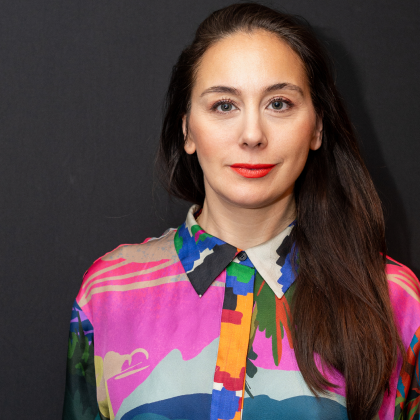
Hannah Johnson is a cultural strategist and storyteller exploring the space where technology, identity, and justice meet. Her work centers on reimagining visibility—who gets seen, whose voices are amplified, and how power is expressed through image and narrative. She is the co-initiator of several DEI leadership programs and a regular jury member across global awards in AI, digital culture, and feminist art. She brings a lens shaped by intuition, disruption, and emotional truth—always drawn to work that challenges dominant systems and tells the story between the lines.
Albertine Meunier’s Flood the zone with shit is a 4-minute descent into the AI rot we’ve all been forced to breathe. It’s an abrasive, clinical autopsy of the Steve Bannon playbook, now supercharged by AI to a point of no return. Watching it, I felt the walls closing in—the sickening realization that we aren’t being persuaded anymore; we’re being buried alive in noise.
This isn’t just “content.” It’s a mourning for the truth. Meunier has captured the exact moment we lost the ability to trust our own eyes. It’s wild, sickening, and the most honest thing I’ve seen all year.
The truth hasn’t just been lost; it’s being suffocated. And we are all just standing here, watching it happen.