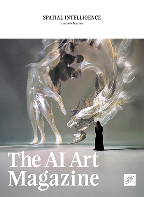
Bonnyvue
Germany


Where do you locate yourself in relation to the systems you work with?
I work as an artist at the intersection of design culture and generative image-making.
My position is grounded in the belief that art does not lose autonomy when it enters relation with design. Choosing proximity to design is not submission, but a cultural correction to an art logic that equates distance with value.
I treat design objects as authored cultural bodies: they carry history, intention, and visual intelligence. My images do not depict these objects. They emerge from their material and formal memory. In this sense, the design language of an object becomes the prompt.
Where are you heading, and what is pulling you there?
I move from representation toward material translation.
From object toward image-memory.
My practice investigates what happens when iconic design language becomes fluid when material, construction principles, and formal gestures dissolve into generative variation and re-form as abstract visual matter.
I am interested in authorship after the object:
when design no longer appears primarily as furniture, but as a circulating image logic embedded in datasets, archives, and collective visual culture.
How would you describe the space your practice is currently unfolding in?
My practice unfolds on the wall, in direct relation to the design objects it corresponds with.
I respond to classic furniture Design. They are part of a collective visual memory and likely part of the training material of generative models.
I work inside this condition.
AI becomes a medium in which design history is already sedimented.
The artwork reclaims specificity through curation and restraint, turning collective memory into an authored, situated image.
Artist Statement
AI Is Liberation
For me, personal AI is liberation in three different aspects.
1. Creative Liberation
Trained in photography and design, I often felt the weight of unrealized ideas. Concepts came quickly but realizing them always meant dealing with limitations: of time, of budget, of possibilities.
AI changed that. Suddenly, nothing is too elaborate. I can shape the image directly from thought and follow the momentum of inspiration. Not even gravity can hold me back!
2. Curatorial Liberation
In recent years, I worked as an art consultant in galleries helping people find artworks that truly reflect their personality, their values, their sense of style. Often, we simply didn’t have the right piece.
Here, too, AI feels like liberation: now it’s truly an option to create personal, meaningful works of art — for anyone.
3. Professional Liberation
I left the gallery world and founded my own studio to close that gap: to create artworks that don’t follow trends but follow the person.
I use AI as a medium for translation: translating memory, mood, and style into a unique visual language.