DIEGO MARTINS
Brazil


Where do you locate yourself in relation to the systems you work with?
Where are you heading, and what is pulling you there?
How would you describe the space your practice is currently unfolding in?
AI Art experience
Personal experience
Unexpected thought
Description
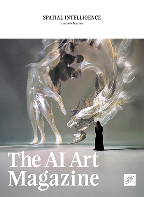
Sopro is a speculative work situated between dream and afterlife. It imagines space not as a backdrop, but as a living system that breathes, remembers, and transforms those who move through it. Architecture, coral-like organisms, fog, and light merge into a continuous field where organic and constructed forms lose their boundaries. The work proposes space as an active intelligence. It listens, absorbs, and responds. Rather than guiding the viewer through a linear narrative, Sopro invites a state of suspension, a passage through a threshold where time dissolves and perception becomes fluid. Movement is slow, atmospheric, and internal, closer to a dream-state than to physical travel. Rooted in personal experiences of illness, fragility, and the proximity of loss, Sopro reflects on transition as a spatial condition. It explores the idea of afterlife not as a place, but as an environment that reshapes presence and identity. The viewer does not observe this space from the outside, but inhabits it, becoming part of a system that continuously reorganizes itself.
Process
SOPRO was born from a question that has accompanied me since a very young age: what exists after life. For many years, I developed the habit of recording my dreams immediately upon waking. Within them, persistent images repeatedly returned: coral forests, suspended landscapes, bodies dissolving into luminous mist. This intimate archive of dreams became my first visual catalogue, and even before the film existed, an entire symbolic universe was already taking shape. When I began experimenting with these images through artificial intelligence tools, I realized something profound was being revealed. The emerging forms resembled alveoli, membranes, vapors that seemed to breathe. This process gained another layer when my father was diagnosed with lung cancer. From that moment on, the worlds I was creating and the reality I was living ceased to be parallel and began to intersect. The film emerges from this convergence. I did not want to create a traditional narrative. I wanted to create a passage. SOPRO is a sensory journey, a limbo between presence and absence. An invitation to traverse a post-life territory where each image functions as breath, and each breath functions as memory.
Tools
Sopro was developed through a hybrid AI-based pipeline structured across pre-production, production, and post-production. During pre-production, language models such as ChatGPT, Claude, and Gemini were used to organize personal dream notes, structure a sensory script, and develop a symbolic vocabulary related to breath, transition, and the afterlife. These tools functioned as conceptual organization systems. Visual development involved generating over four thousand images using Midjourney and Krea. From this volume, a strict curatorial selection was made, and each frame was manually refined in terms of color and texture, with final processing carried out in Magnific to ensure aesthetic unity and atmospheric consistency. As visual continuity tools were not available at the time, each image was treated individually. Video production employed Runway, Kling, and Luma as complementary systems. Runway was used for organic motion and atmospheric dissolves; Kling for bodily transformations and emotionally weighted camera movement; and Luma for spatial depth and volumetric fog. In post-production, editing was carried out in CapCut with AI-assisted rhythm and flow support. The soundscape was developed using Suno, Sono, and CapCut, exploring breath, wind, and low-frequency vibrations as extensions of space and respiration.