eeezeen
United Kingdom


Where do you locate yourself in relation to the systems you work with?
Where are you heading, and what is pulling you there?
How would you describe the space your practice is currently unfolding in?
Description
This work investigates how language, particularly language generated and mediated through artificial intelligence, actively shapes human perception, emotion, and understanding of reality. Rather than treating language as a neutral tool for communication, the project approaches it as an operative system that continuously frames how the world is seen and interpreted. Drawing from the idea of linguistic relativity, the work focuses on the accumulation of negative, hostile, and distorted language that circulates widely in online environments. These expressions are often fleeting and anonymous, yet their repeated exposure leaves lasting cognitive and emotional traces. The work asks how such linguistic environments influence the way individuals perceive others, themselves, and everyday situations, especially when these environments are increasingly processed and reproduced by automated systems. By relocating online language into a physical and embodied context, the work highlights the tension between digital speech and its real-world consequences. It examines how artificial intelligence participates in amplifying existing linguistic behaviours, and how this amplification subtly reshapes social norms and perceptual habits. Ultimately, the work invites viewers to reconsider language not as something that simply describes reality, but as something that actively constructs it.
Process
The motivation for this work emerged from observing how rapidly online language environments have expanded and embedded themselves into everyday life. As of 2024, the global online community population has surpassed five billion users. Increased connectivity and ease of access have accelerated digital participation, but this expansion has also been accompanied by a proportional rise in cybercrime. Notably, nearly half of these cases are attributed to verbal abuse, highlighting how language itself has become a primary site of harm within digital spaces. Despite its scale and impact, verbal violence is often dismissed as intangible or temporary, protected by anonymity and the speed of online circulation. At the same time, artificial intelligence systems are increasingly trained on data drawn from these environments. As a result, existing linguistic behaviours, including hostility and aggression, are absorbed and reproduced without ethical awareness or contextual judgment. This convergence raised a critical concern: if language plays a fundamental role in shaping how people think and perceive reality, what are the consequences when large parts of our linguistic environment are influenced by automated systems trained on toxic and harmful discourse? Rather than addressing this question through explanation alone, the work was conceived as an experiential inquiry. It seeks to externalise an otherwise invisible and normalised condition, transforming it into something that can be p
Tools
The work is constructed as an integrated system composed of AI-generated text, a camera, a compact thermal printer, and a single-board computer (SBC). These elements do not function as separate tools but operate together as a continuous real-time loop that connects perception, language, and physical output. A camera captures a first-person view of the surrounding environment, producing a constant stream of visual input. This input is processed by an AI system that generates text based on linguistic patterns learned from hostile and negative online discourse. Rather than describing scenes objectively, the system reinterprets what is seen through a language framework shaped by accumulated digital expressions. The single-board computer functions as the core controller, coordinating image capture, text generation, and output timing. The generated text is immediately printed using a compact thermal printer, creating a physical record that unfolds over time. By avoiding screens and relying on direct printing, the work shifts AI-generated language from a transient digital signal into a tangible and accumulative form. Operating in real time and in motion, the system reveals how AI-generated language is inseparable from the social and cultural conditions on which it is trained. In doing so, the work positions artificial intelligence as a reflective surface, returning a distorted yet familiar image of collective language into physical space.
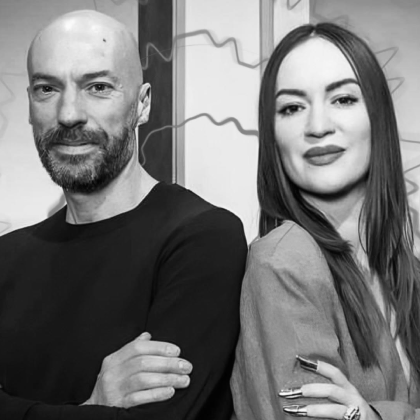
Auronda Scalera and Dr. Alfredo Cramerotti are a curatorial duo at the forefront of contemporary art and emerging technologies, with a track record of shaping major international exhibitions, festivals, and institutional strategies. They have curated and advised global exhibitions and festivals, including Noor Riyadh, Art Dubai Digital, pavilions at the Venice Biennale, the Lumen Prize for Sotheby’s. As Directors of Multiplicity Art in Digital and founders of Web to Verse, they champion research and critical discourse in digital art. Their thought leadership and curatorial work have been recognized by major international forums, governments, and leading media outlets.
In an era in which artificial intelligence increasingly mediates how reality is described, filtered, and returned to us, the question of language becomes urgent again - as an active force shaping perception, emotion, and social behaviour. The work REVIEW (2025) by eeezeen situates itself precisely at this fault line, where automated systems absorb, reproduce, and amplify the linguistic debris of digital culture. Rather than proposing AI as a futuristic abstraction, the artist exposes it as an operative mirror: one that reflects back the accumulated textures of contemporary language, including its most corrosive forms.
Language has long been understood as a structuring condition of reality. From linguistic relativity to post-structuralist critiques, it is clear that words do not simply describe the world, they actively produce it. What REVIEW foregrounds is how this production process mutates when language is increasingly generated, mediated, and re-circulated by non-human agents trained on vast datasets of online communication. In this sense, the work does not just visualise AI; it stages language itself as a system under stress.
At the core of REVIEW is a deceptively simple yet conceptually charged apparatus: a camera capturing a first-person view of the surrounding environment, an AI system generating text through patterns derived from hostile and negative online discourse, and a thermal printer that continuously outputs this language into physical form. The result is a stream of printed sentences, accusatory, distorted, emotionally charged, that reinterpret the visible world through a linguistic framework shaped by digital aggression. The choice to avoid screens is crucial. By translating AI-generated language into paper, the work arrests what is usually fleeting, forcing viewers to confront language as residue, accumulation, and evidence.
This materialisation of automated speech is not incidental. Online hostility is often dismissed as ephemeral, protected by anonymity and speed. Yet its effects are cumulative and enduring, leaving cognitive and emotional traces that reshape how individuals perceive others and themselves. REVIEW insists on this persistence. The printed output becomes a growing archive of linguistic violence, unfolding in real time and in space. What is usually consumed privately and invisibly is rendered public, embodied, and difficult to ignore.
Importantly, the work does not frame artificial intelligence as an autonomous aggressor. Instead, it reveals AI as a system trained on us, on our expressions, biases, fears, and antagonisms. The hostility embedded in the generated text is not invented by the machine; it is inherited. In this sense, AI operates less as an external threat and more as a reflective surface, returning a distorted yet recognisable image of collective behaviour. The discomfort produced by the work lies precisely in this recognition.
The camera’s first-person perspective further complicates the experience. By aligning the viewer’s gaze with the system’s perception, REVIEW collapses the distance between observer and machine. The environment is no longer neutrally seen; it is linguistically judged, framed, and re-coded in real time. This dynamic exposes how perception itself becomes vulnerable when filtered through automated language systems. What we see is inseparable from how it is described, and how it is described increasingly depends on algorithmic mediation.
The artist’s decision to construct the work as a continuous loop, vision to language to physical output, underscores the systemic nature of the inquiry. There is no clear beginning or end, no stable narrative resolution. Instead, the work operates as an ongoing condition, mirroring the relentless flow of digital communication that saturates everyday life. This refusal of closure aligns with the artist’s broader position: rather than offering solutions or ethical prescriptions, REVIEW creates conditions for heightened awareness. It unsettles perception before judgment can comfortably form.
This approach places eeezeen within a lineage of artists who treat technology as an environment to be activated and revealed. The work does not stand outside AI to critique it; it intervenes from within, allowing the system to speak in its own contaminated voice. This is where the practice gains its critical force. By accepting that contemporary reality is already technologically shaped, the artist avoids moral binaries and instead exposes the mechanics through which meaning is produced.
The intermediate space that REVIEW occupies, between online and offline, anonymity and physical presence, data and sensation, is emblematic of our current condition. Language no longer belongs exclusively to human exchange; it circulates through automated infrastructures that learn, replicate, and normalise patterns at scale. In mapping this unstable terrain, the work makes visible how social norms are subtly reconfigured, not through grand ideological gestures, but through repeated micro-expressions embedded in everyday digital life.
Ultimately, REVIEW invites a rethinking of responsibility. If AI systems reproduce the language they are trained on, then the work asks us to consider what kind of linguistic environment we are collectively building. The printed slips of paper are not accusations aimed at technology alone; they are fragments of a shared authorship. In confronting viewers with this feedback loop, the work transforms AI from an abstract concept into an ethical mirror, one that reflects not what we aspire to be, but what we repeatedly say, share, and tolerate.
In a cultural moment obsessed with innovation, efficiency, and optimisation, REVIEW offers a necessary interruption. It slows down language, gives it weight, and forces it into the realm of the tangible. What emerges is not a spectacle of artificial intelligence, but a quiet, persistent unease, an awareness that the systems shaping perception are already deeply entangled with our own modes of expression. In making this entanglement visible, eeezeen’s work does not resolve the problem of AI and language; it ensures that it can no longer be ignored.