Name

_Results

close [x]

Forside

South Korea

Where do you locate yourself in relation to the systems you work with?

I position myself at the living edge of the system, not as an external user who commands it, and not as an internal component that simply executes its logic, but as a threshold where mutual transformation occurs. The systems I work with are not neutral tools; they are environments that shape perception, attention, and possibility. My practice enters these environments to redirect their native impulses toward speed, repetition, and endless variation into slower, denser, more contemplative states. I work with AI as a material that can be folded, compressed, and strained until it begins to generate conditions for the sublime. In this sense, I am neither operator nor observer, but a critical co-evolver, locating myself where human sensing and machine calculation negotiate a new perceptual ground.

Where are you heading, and what is pulling you there?

I am moving away from depiction and toward atmosphere, away from information and toward intensity. What pulls me forward is the intuition that digital space can host a form of the sublime that is not based on scale or spectacle, but on pressure, silence, and sustained attention. Rather than multiplying images, I aim to deepen the internal tension of each one, allowing it to hover between formation and dissolution. My trajectory follows forces of condensation and restraint, seeking states where form is not asserted but slowly emerges from within a field of subtle variation. I am heading toward images that are less about what is seen than about how seeing itself is altered.

How would you describe the space your practice is currently unfolding in?

My practice unfolds in a boundless, horizonless digital field structured by micro-differences rather than grand gestures. This space is composed of particles, filaments, repetitions, and gradients of density that accumulate into a quiet but undeniable intensity. There is no narrative center and no fixed viewpoint; instead, the work creates an atmospheric condition that the viewer enters and inhabits. Images here are not windows or objects but pressure zones that recalibrate perception, slowing the eye and thickening time. Within this field, human awareness and algorithmic process are not opposed but interwoven, producing a shared sensory terrain where digital matter begins to breathe and the experience of the sublime emerges as a sustained, internal vibration rather than an external shock.
Published in >
The AI Art Magazine, Number 3
Digital Sublime , AI generation, AI-generated digital imagery and moving image.
Forside, Digital Sublime , AI generation, AI-generated digital imagery and moving image

Description

This work explores a state where organic form and digital structure become indistinguishable. It is not a depiction of flowers or plants, but a field of post-natural growth where translucency, tension, and suspended fragments suggest life without biology. The image evokes a quiet pressure rather than a blooming moment: forms hover, overlap, and breathe within a dark, depthless space, creating an atmosphere of digital sublimity. Instead of representing nature, the work examines how perception reacts to density, softness, and layered transparency when freed from gravity and ground. It is about the sensation of emergence itself, as if matter is continuously forming and dissolving at the same time.

Process

The work emerged from an interest in slowing down the generative speed of AI and compressing it into a state of still, concentrated intensity. Rather than producing spectacular or hyperreal imagery, I wanted to create a condition of quiet suspension where viewers feel a subtle internal vibration. I was drawn to the idea of growth without environment, petals without soil, and structure without origin point. This led to an exploration of forms that appear familiar yet unplaceable, inviting the viewer to inhabit a moment before classification, where perception precedes naming.

Tools

The piece was created through AI-based image generation guided by iterative prompt design and perceptual calibration. I used generative diffusion models as a material rather than a shortcut, repeatedly refining prompts to control translucency, edge density, and internal layering. The process involved selecting and recomposing outputs to build a coherent pressure field rather than a single focal object. Color and contrast were tuned to emphasize mineral-like softness and suspended light, avoiding hard realism in favor of atmospheric depth. The final image is the result of many small adjustments that bend algorithmic variation toward stillness, condensation, and digital sublime presence.

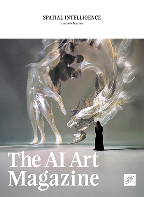
Image credit:
Essay by