Name

_Results

close [x]

Krista Kim

United States

Where do you locate yourself in relation to the systems you work with?

I locate myself at what I call the membrane between extraction and return. The dominant AI systems—the centralized LLMs from OpenAI, Google, Meta, Anthropic, Amazon—operate on a logic of harvesting. They absorb human creativity, behavior, and biometric signals to serve optimization, prediction, and profit. I position my practice as a counterforce: using the same technologies to return sovereignty to the individual. When I wrote the Techism Manifesto in 2014, I declared that artists must actively shape the systems that shape us. We cannot leave the creation of digital culture to technocrats and corporations alone. That position has only intensified. Now, as we approach AGI and synthetic realities flood our perception, the question is no longer whether artists should engage with AI—it is whether we will build systems grounded in empathy and human dignity, or cede that territory entirely. My work with HeartSpace and Tenbeo's heart signature technology embodies this stance. The heart key is internal, dynamic, living—it cannot be copied, spoofed, or extracted from a database breach. When I bring participants into an infinity mirrored room and translate their heartbeats into collective visual symphonies, I am demonstrating an alternative architecture: biometric data as sacred material, not surveillance commodity. The installation doesn't harvest—it witnesses, then gives back. I stand in the lineage of McLuhan, who taught that media are not neutral tools but environments that rewire perception and reconstruct the self. Techism gives that insight an ethical imperative: if digital media are environments, then artists must be the architects of those environments. We must infuse them with consciousness, not capitalist control and manipulation.

Where are you heading, and what is pulling you there?

I am heading toward proof of humanity as civilization's new trust anchor. Very soon, we will not believe what we see on our screens unless it is verified. AGI and billions of AI agents will produce synthetic content that becomes the majority of what we encounter. Deepfakes will simulate voices, faces, entire personalities. In this landscape, the question becomes existential: how do we prove who we truly are? If machines can flawlessly replicate our behavior, our appearance, even our style of thought—what remains uniquely human? The answer I am building toward is the heart signature: a living, unforgeable proof of presence. Not a password that can be stolen, not a face that can be captured from a photograph—but an internal electrical pattern generated by your body in real time, owned entirely by you. This is where HeartSpace points: toward a future where your heartbeat becomes your digital identity, your proof of authorship, your sacred key. What pulls me is the urgency I feel as a mother. I think constantly of my children and all the children inheriting this moment. They deserve to grow up knowing they are sovereign beings with inherent dignity—not data points to be harvested. They deserve AI that helps them discover their gifts, not algorithms that exploit their vulnerabilities. This maternal pull is not sentimental; it is political. It shapes every design decision.

How would you describe the space your practice is currently unfolding in?

The space is the threshold—and the threshold is where everything is decided. The decisions we make now about data ownership, biometric authentication, decentralized versus centralized AI—these will determine whether our grandchildren inherit liberation or surveillance. My practice unfolds in that charged interval. Architecturally, the space is the infinity mirrored room of HeartSpace: a container where four strangers' heartbeats merge into a collective visual tapestry. Yellow for calm, purple for heightened emotion, pink for peak intensity—colors that make the invisible visible, that reveal how intimately we affect one another. The installation is a prototype for what I call conscious architecture: environments that respond to human presence not to manipulate, but to heal. Conceptually, I work within the mycelial model. Just as fungal networks beneath the forest floor exchange nutrients, signals, and wisdom between trees of different species, I envision a decentralized network of Digital Twins—sovereign AI companions trained on our own data and values—that weave humanity into a new kind of symbiotic intelligence. Not extraction, but nourishment. Not hierarchy, but mutual support. The mycelium does not dominate the forest; it listens, distributes, balances. This is the topology I am building toward. If we want sovereign technology to become civilization's operating system, it must be beautiful and robust enough to scale. The space I occupy is the translation layer between philosophy and lived implementation. The question the space keeps asking me: What is digital human existence, and what is the beauty in it? After a decade of building, I have an answer: digital human existence is sovereign, creative, and interconnected. The beauty lies in our capacity to shape technology as an expression of our highest consciousness—to use data not to overwrite our identities, but to help us become more fully, more beautifully human.
Published in >
The AI Art Magazine, Number 3
HeartSpace, AI generation, 2024.
Krista Kim, HeartSpace, AI generation, 2024

Description

As synthetic realities proliferate—deepfakes, AI-generated voices, fabricated identities—the work asks: What remains uniquely, unforgettably human? The answer it offers is the heartbeat: internal, living, impossible to copy or spoof. The work transforms this biological truth into shared aesthetic experience. But it is also about interconnection made visible. Four strangers enter the space. Their individual heart signatures—each as unique as a fingerprint—merge into a single evolving tapestry. The work reveals what we cannot ordinarily perceive: that we are constantly affecting one another, that our emotional states ripple outward, that separateness is a perceptual habit rather than a fundamental truth. At a deeper level, HeartSpace is about reclaiming the body from extraction. The dominant paradigm treats biometric data as raw material for surveillance and profit. HeartSpace inverts this: your heartbeat becomes art, becomes identity, becomes something you witness and keep rather than something harvested without your knowledge. The work demonstrates what data sovereignty feels like—not as policy abstraction but as lived experience.

Process

The urgent threat of AI overtaking our sovereignty. We are at an inflection point. The dominant AI paradigm is isolation, addiction, data accumulation for control and manipulation, corporate productivity. Algorithms harvest our attention, predict our behavior, and steer us toward consumption and compliance. Where is the humanity in that? Where is the connection, the meaning, the soul? I created HeartSpace to demonstrate the alternative—that AI can bring us together rather than isolate us, that it can support human flourishing rather than extract from it. Four strangers enter a room. Their heartbeats merge into a single living tapestry. The technology doesn't harvest—it witnesses, translates, returns. Participants leave having seen something invisible made visible: that we affect one another, that our rhythms can synchronize, that connection is not a relic of the pre-digital world but something technology can actively nurture. The current systems are designed to fragment us—to keep us scrolling alone, comparing ourselves to curated fictions, feeding data to machines that know our vulnerabilities better than we do. HeartSpace is my counter-proposal: biometric AI that serves presence, not surveillance. Collective experience, not algorithmic isolation. Technology in service of what makes us human.

Tools

ECG heartbeat sensors capture each participant's cardiac rhythm in real time. Tenbeo's proprietary AI-generative software translates these signals into unique heart signatures, which are then visualized through TouchDesigner—rendering each heartbeat as distinct waveforms, movement, and color. The colors shift dynamically to reflect emotional states: yellow for calm, greens and blues for moderate emotion, purple for heightened feeling, pink at peak intensity. The visual output displays across full LED screens housed within an infinity mirrored room, creating boundless reflection and spatial immersion. Four participants connect simultaneously, their individual signatures weaving together into a collective tapestry that breathes and evolves in real time.
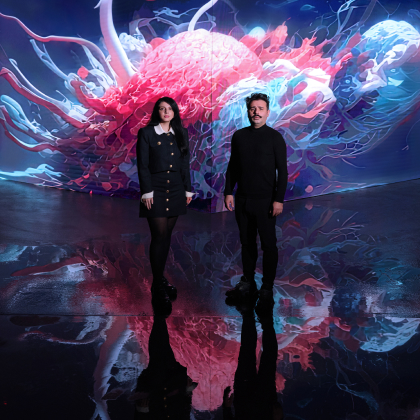
Image credit:
Sovereign, Creative, Interconnected
Essay by Eylul Duranagac + Ferdi Alıcı

“Digital human existence is sovereign, creative, and interconnected. The beauty lies in our capacity to shape technology as an expression of our highest consciousness—to use data not to overwrite our identities, but to help us become more fully, more beautifully human.” Krista Kim

In HeartSpace, the heartbeat becomes the elemental conceit expressing this attitude. It is an event that exists only in passing, not a storable, transferable, tradable asset, but an ongoing response of the body to its surroundings. Rendered visible as a curve of light, this pulse becomes an instance of truth, a proof of authenticity and individuality, because it remains inextricably bound to a specific human being.

When its rhythm interlaces with the pulses of others, an image of connectedness emerges that is not based on the exchange of information, but on a shared human finitude.

HeartSpace envisions a digital space in which lives bear witness to one another instead of exploiting one another; a digital space in which visibility serves not optimization, but mutual recognition, awareness, and appreciation, and which at the same time allows us to see that our everyday digital spaces can be shaped beyond the logics of technology corporations and their extractive AI architectures.