Name

_Results

close [x]

Mirage Bureau

Brazil

Where do you locate yourself in relation to the systems you work with?

I locate myself inside the systems I work with, not outside them. My practice operates from within contemporary AI infrastructures, treating them less as neutral tools and more as unstable environments loaded with bias, memory, desire, and failure. I occupy a position of friction: between authorship and delegation, control and surrender, precision and noise. My work is built from fragments, partial images, interrupted narratives, unresolved gestures, embracing continuity only when it feels fragile. I am close to the machine, but not aligned with its promise of optimization.

Where are you heading, and what is pulling you there?

I am moving toward slowness, distortion, and emotional opacity. What pulls me forward is a resistance to seamlessness: I follow paths where images hesitate, glitch, or refuse to fully resolve. I’m drawn to using AI as a speculative partner rather than a solution, allowing misinterpretation, hallucination, and ambiguity to guide the work. At the same time, I resist purely technical virtuosity, redirecting my practice toward narrative tension, affect, and the poetic misuse of systems designed for efficiency.

How would you describe the space your practice is currently unfolding in?

My practice unfolds in a hybrid space between cinema, photography, and computational systems, a deformable field where images behave like memories rather than representations. This space is temporal and psychological: kitchens, interiors, bodies, and everyday objects become sites of emotional residue and symbolic displacement. By bending AI outputs through cinematic language, sound, and sequencing, I attempt to reshape the space around the work into something intimate, unstable, and humanly imperfect.

Artist Statement

After initially testing some AI tools, I quickly realized that the creative process was very similar to my previous experiences with traditional media. I found that the self-discovery process occurred similarly, but faster, more intriguing, and deeper. At the same time, it became broader, offering variations in aesthetics and formats, allowing me to access new creative areas. This discovery convinced me that true artistic expression through AI was not only possible but also fascinating. I perceive the investigation of human failure, the persistent inability to fully communicate, adapt, and sustain connections, both socially and existentially, as central to my work. I explore the body and language as inherently flawed tools for connection, constantly disrupted by noise, projections, and emotional overflow. There is always the desire to communicate and inevitably a misunderstanding. I embrace this failure as a source of poetic possibilities. Working with AI has become a subjective dialogue, a collaborative exchange between human and machine. This interaction multiplies possibilities, compelling me to continuously refine my choices and clarify the essential elements of my art. It prompts me to reflect deeply on recurring themes and symbols within my practice. It helps me deepen my poetic approaches, examining and re-examining them from multiple angles, with each moment making them clearer and more complete. Ultimately, I seek for my art to evoke reflection, estrangement, and simultaneously identification. Art captures and encapsulates a moment in time that transcends the personal and becomes collective, a present moment accessible again at any time. It communicates without the need for words, evoking sensations and thoughts freely and uniquely within each viewer. It's akin to experiencing oneself inside another "self," activated by memories of a perfume, a tattoo, or an old love. It's about feeling who we once were and eventually who we are, dissolving and reshaping our perception of time itself.

Published in >
The AI Art Magazine, Number 3
Poker Guest, AI generation, 2026.
Mirage Bureau, Poker Guest, AI generation, 2026

Description

Poker Guest is a visual series about social tension and intimate-emotional conflict, and the constant interaction between these two worlds. The project unfolds as a series of videos in which, at a rapid pace, the guest, positioned as the viewer, arrives and moves through surreal environments until coming face to face with the poker players. Everything happens in an agile and unstable way: scenes form and dissolve unexpectedly. Identity slips, bodies fragment, and gestures exceed intention. The poker game functions as a metaphorical structure: a space of anticipation, concealment, and unstable power dynamics. Rather than documenting a match, the images capture what leaks out of it: anxiety, desire, aggressiveness, fragility. The figures appear suspended between presence and erasure, as if caught in the interval between a decision and a collapse. Through distortion, motion blur, and fragmented bodies, the series investigates how contemporary subjectivity performs under pressure, when control is demanded, but uncertainty prevails.

Process

The work emerged from an interest in moments when social rituals begin to fail. I intentionally embraced misalignment: bodies that cannot fully sustain themselves, gestures that overflow, faces that refuse to settle. At the same time that the images may feel entertaining, they also generate discomfort. The work draws a parallel with social relationships and the masks we create to navigate them, strategies of survival, performance, and disguise within a system in which, in one way or another, everyone is playing the game.

Tools

I created the images in Midjourney using a series of highly specific prompts in which, while technically defining what I expect to see, I also introduce subjectivity, poetry, and metaphysical elements. I used Magnific to enhance detail and increase image resolution, applying the same approach, balancing technical precision with expressive intent.

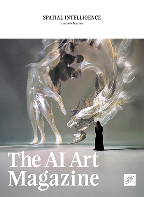
Image credit:
Essay by
Published in >
The AI Art Magazine, Number 2
The Noise Between Us, AI generation, 2025.
Mirage Bureau, The Noise Between Us, AI generation, 2025

Description

The noise between us and the world shapes the reality we perceive and invent. It's a noise we both absorb and produce, becoming simultaneously a confrontation and a creation of our present. This work poetically explores this abstract boundary, this invisible edge, between our existence and reality itself. It addresses our inability to clearly perceive how we interact and communicate in everyday life, highlighting constant disturbances that become invisible, ones we tend to silence and reshape to survive socially.

Process

My motivation emerged from reflecting on how deeply noise influences our interactions and perceptions, and how we often fail to acknowledge its pervasive impact. I was driven by the desire to reveal and make visible these disturbances and the subtle tensions within our daily attempts at connection, prompting viewers to acknowledge and reflect on these silent disruptions in their own lives.

Tools

I used Midjourney for the initial image generation, incorporating personal photographs into poetic, metaphysical, and descriptive prompts. Subsequently, I enhanced the piece using Magnific multiple times to add details, and finally, blended the treatments cohesively using Photoshop.
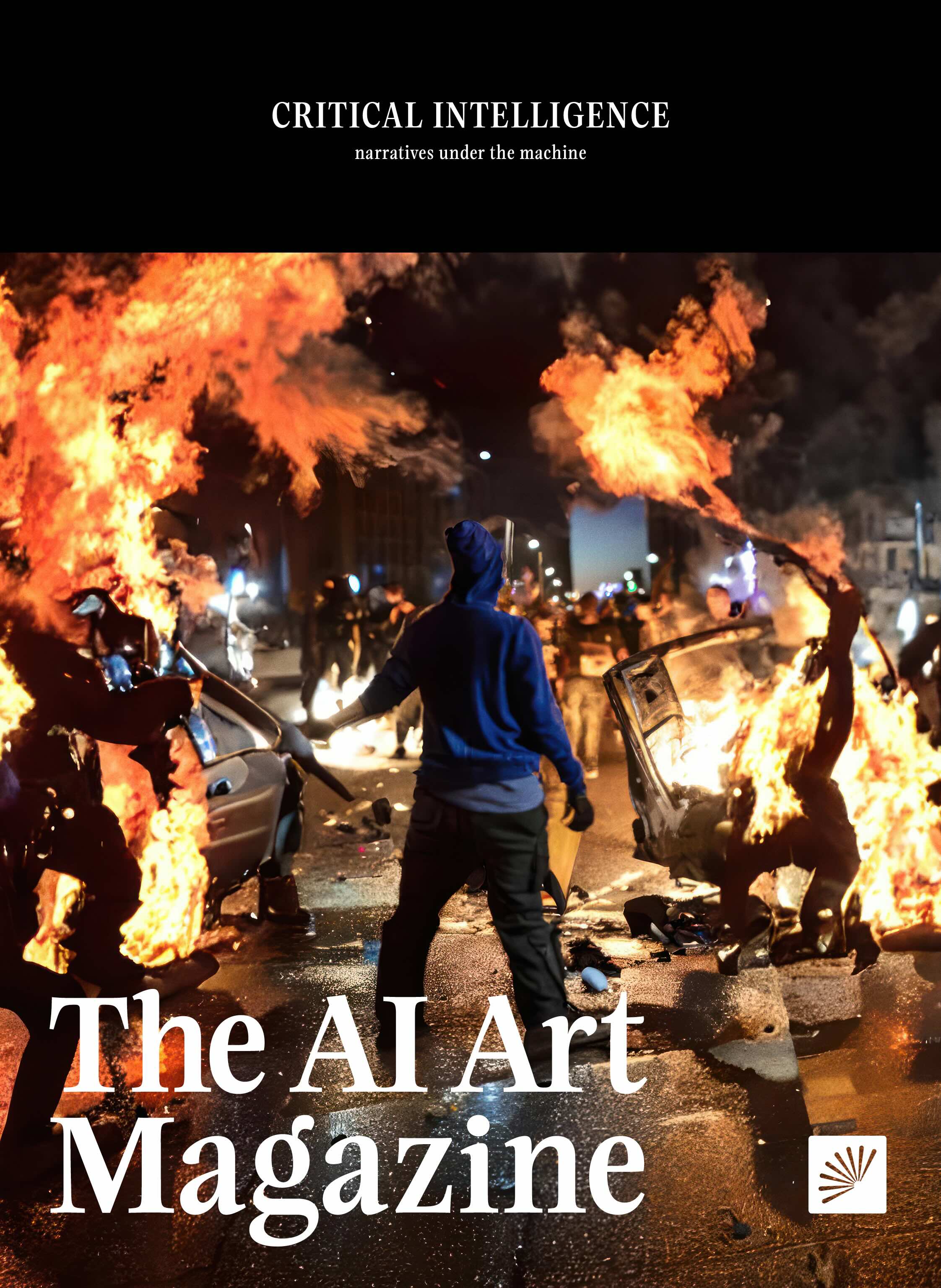
Image credit:
Essay by