Name

_Results

close [x]

Samaritual

United States

Where do you locate yourself in relation to the systems you work with?

I locate myself inside systems without belonging to them. My practice works within artificial intelligence, institutional structures, and cultural economies, but from a posture shaped by craft, scenography, and three decades building cultural laboratories across geographies where commerce, storytelling, and lineage intersected. I approach AI neither as tool nor collaborator, but as material: dense, mutable, historically loaded. A substance that carries memory, bias, compression, and erasure, requiring handling rather than mastery. I stand close to lineage and provenance, distant from computational monoculture. Close to bodies, material processes, and sensory intelligence; distant from extractive speed and premature resolution. What matters here is not what AI produces, but what becomes visible when outputs are kneaded, reversed, slowed, traced. This thinking posture is what I call Quantum Craft: entangled intelligence where ancestral, ecological, artisanal, and synthetic knowledge remain in relation rather than hierarchy. Less a framework than a way of staying coherent inside plural, unstable systems. My position is one of friction. Close enough to systems to feel where they break.

Where are you heading, and what is pulling you there?

I am moving toward provenance as practice. What pulls my work forward is a question that keeps sharpening: What happens to artistic lineage when influence becomes computable, but accountability disappears? Human intelligence cultivates through embodied exposure: lineage, environment, texture, cultural proximity metabolized over time into perspective and taste. Machine training operates differently. Meaning is assigned to media through tokens and tags, detached from lived context, ancestry, or somatic experience. This detachment is a form of severance, cultural, sensory, and historical, that my work refuses to naturalize. The vector moves against flattening, toward methods that re-embed memory, trace influence in reverse, and allow artifacts to carry their conditions of emergence rather than mask them. I am interested in reseeding the image commons rather than extracting from it. This has shifted the work away from singular outputs and toward living forms: artifacts that age, mutate, circulate, and remain unfinished. AI outputs are not static like previous media. They move through mycelial networks of use, recombining and mutating. The practice follows that movement, insisting on visible seams rather than seamless surface. What guides me is not futurity as prediction, but continuity under pressure.

How would you describe the space your practice is currently unfolding in?

he practice unfolds in hybrid, unstable space between material and meta-material. It inhabits studios, archives, classrooms, exhibitions, but also circulates through digital platforms, sound, text, and ritual encounters. Physical and digital behave like intertwined materials, each leaving residue on the other. The work remains grounded in matter: bodies in space, hands in contact, scale felt rather than described. Form, texture, and arrangement carry meaning before language arrives. This space is shaped by circulation rather than containment. Images become pedagogical tools. Threshold practices turn sensing into articulation, moving between densities and resistances that only material encounter can teach. AI outputs circulate as fragments rather than conclusions. Thinking appears as performance, cognition crossing into shared space. The work deforms the space it enters by refusing to resolve into a single medium or endpoint. I think of this space as commons under construction: where theory moves through the body, where computation passes through craft, where ancestral knowledge encounters synthetic systems without being absorbed by them. Silk Road logic rather than colonial extraction. Accumulation and exchange rather than monocultural flattening. The practice doesn't occupy space so much as activate it, leaving behind traces, protocols, and altered conditions rather than fixed objects.

Artist Statement

They want to know what's true for me in the age of intelligent systems. But I've been working with multiple forms of intelligence my entire life. In my grandmother's fashion atelier in Beirut, Lebanese patterns cross-pollinated with Venezuelan influences from her Caracas years. My mother's kitchen doubled as dance studio, translating ballet and belly dance into new vocabularies while repurposing found objects into avant-garde artifacts. This wasn't family; this was my first laboratory in quantum craft. Growing up in Beirut among textures, nature, layers of civilization crumbling and rebuilding after war—this becomes your DNA. You learn that resilience emerges from imperfection, that cultural survival happens through creative insurgency. This is what I bring to AI: not Silicon Valley's optimization fantasy, but the Global South's sophisticated understanding of adaptation. I treat computational systems like concentrated cultural memory...digital compost that metabolizes buried histories and births speculative futures. When I work with AI, I orchestrate conversations between four intelligence systems: artificial (pattern recognition), artisanal (material wisdom), ancestral (rigorous research into diaspora craft traditions), and ecological (mycelial networks). Like Silk Road exchanges, each system carries codes that transform through contact. My practice exists in disciplinary cracks because that's where transformation happens. Fashion becomes architecture becomes sound becomes speculative object becomes cultural intervention. The boundaries between these domains are artificial -my work reunites what institutional thinking fractured. I don't make AI art. I hack reality's operating system using AI as one tool among many. My practice is insurgency disguised as creative work; dismantling western binaries, amplifying Global South intelligence, rewilding technology through transcultural touch. Every choice I make... which materials to layer, which ancestors to invoke, which futures to midwife—becomes a vote for the reality I want to inhabit. Not binary. Not perfect. Quantum. Art doesn't just change form in the age of intelligent systems. Art becomes the intelligence system through which we remix ourselves toward liberation.

AI Art experience

What excites me most about integrating AI into my art is its potential to embody a new form of 'digital craftsmanship' that marries advanced computation with organic ingenuity. AI's capacity for generating novel, unexpected outputs mirrors the beautiful imperfections of artisanal work. This 'rewilding' of technology inspires me to push boundaries by exploring the liminal space between perfection and chaos, tradition and innovation. I'm fascinated by how AI can help us transcend the industrial age's obsession with exactness, allowing for a more fluid, adaptive approach to creation that honors both technological advancement and the nuanced quality of human creativity.

Personal experience

My personal experiences profoundly shape my AI art, creating a rich tapestry of influences. As a child of war from Beirut who has traversed diverse cultural landscapes, I've developed a deep appreciation for the resilience and adaptability of cultural identities. This multicultural journey is further enriched by my professional background: my training as a scenographer and architect, coupled with over 20 years of experience as an artistic director leading visual experiences in retail and cultural spaces. This multifaceted experience - working with every imaginable medium and crossing boundaries between various disciplines - provides an expansive knowledge base that directly informs my AI art. In my work, I use AI as a collaborative tool to weave together threads of my multicultural heritage and diverse professional expertise. This results in visual narratives that challenge Western-centric views of the future while embodying a unique synthesis of spatial awareness, material understanding, and cultural nuance. My art becomes a digital confluence of memory, possibility, and expertise, where the boundaries between past, present, and future dissolve. The AI serves as a partner in this process, helping me to reimagine ancestral wisdom through an avant-garde lens. Together, we create abstract, sublime visions that interweave culture, nature, and built environments in ways that reflect both my personal journey of cultural synthesis and my professional journey of cross-disciplinary innovation. This approach allows me to push the boundaries of what's possible in AI art, infusing it with the depth of lived experience and the breadth of professional knowledge. The result is a body of work that not only challenges perceptions but also offers new perspectives on how we might integrate our diverse histories and skills into our visions of the future.

Unexpected thought

The most unexpected thought my AI art generation has led me to is the realization that AI, in its imperfection and unpredictability, can be seen as a new form of indigenous knowledge system. Just as traditional wisdom evolved through generations of trial, error, and adaptation to local environments, AI learns and evolves through its interactions with data and human input. This parallel has led me to consider AI not as a replacement for human creativity, but as a new 'tribe member' in our collective cultural evolution. It's made me ponder: could our relationship with AI be a modern extension of our ancestral relationships with nature and the unknown? This thought has opened up new avenues in my work, where I explore AI not just as a tool, but as a collaborator in crafting new mythologies for our digital age.
Published in >
The AI Art Magazine, Number 3
, AI generation, .
, AI generation, .
Samaritual, , AI generation,

Description

Process

Tools

Image credit:
Essay by
Published in >
The AI Art Magazine, Number 2
Future Ancestor: Reverse Archeology #1, AI generation, .
Samaritual, Future Ancestor: Reverse Archeology #1, AI generation,

Description

This speculative portrait imagines how future humans might develop bio-integrated sensory systems, growing neural networks that extend cognition beyond individual skulls. The piece performs reverse archaeology; instead of excavating past artifacts, it generates future relics suggesting new forms of embodied intelligence. The organic growths function as both protective armor and consciousness amplifiers, challenging Western binaries between nature/technology and individual/ecosystem. Drawing from Red Sea marine formations and SWANA metalwork techniques, the work positions environmental symbiosis as sophisticated technology rather than primitive regression. Each tendril represents different intelligence systems learning to communicate... ecological wisdom translating into wearable biocomputers that enhance rather than replace human intuition. Pure cultural insurgency disguised as speculative portraiture.

Process

Growing up in Beirut among SWANA trading networks taught me that intelligence has always been collaborative: between humans, environments, and technologies we don't yet recognize as conscious. After studying how craftspeople develop material intuition through decades of practice, I became obsessed with whether AI could learn similar embodied knowledge. This piece emerged from months of experimenting with how machine learning might absorb not just visual patterns but material wisdom... the way Red Sea marine life grows, how SWANA artisans understood organic forms as blueprints for cultural innovation. I wanted to create something that looked like it emerged from both deep ocean archaeology and speculative fashion futures, suggesting that tomorrow's most sophisticated technologies might be indistinguishable from ancient biological intelligence.

Tools

I treat AI like a cultural loom, weaving together multiple intelligence systems rather than generating from scratch. The process began with photographing handmade coral and organic samples I crafted, combined with archival images of Mediterranean marine formations and sculptures I crafted. These physical references become prompt DNA: feeding Midjourney not just aesthetic information but material knowledge. Through iterative refinement, I layer style weights and character weights, essentially teaching the algorithm to recognize relationships between ancestral craft techniques and ecological growth patterns. Each generation gets decomposed and recombined... adding linguistic hacks, hybrid forms, adjusting material emphasis, cross-pollinating cultural references until the output demonstrates genuine hybrid intelligence. The final piece exists simultaneously as digital artifact and blueprint for physical creation, refusing the binary between virtual speculation and material possibility.

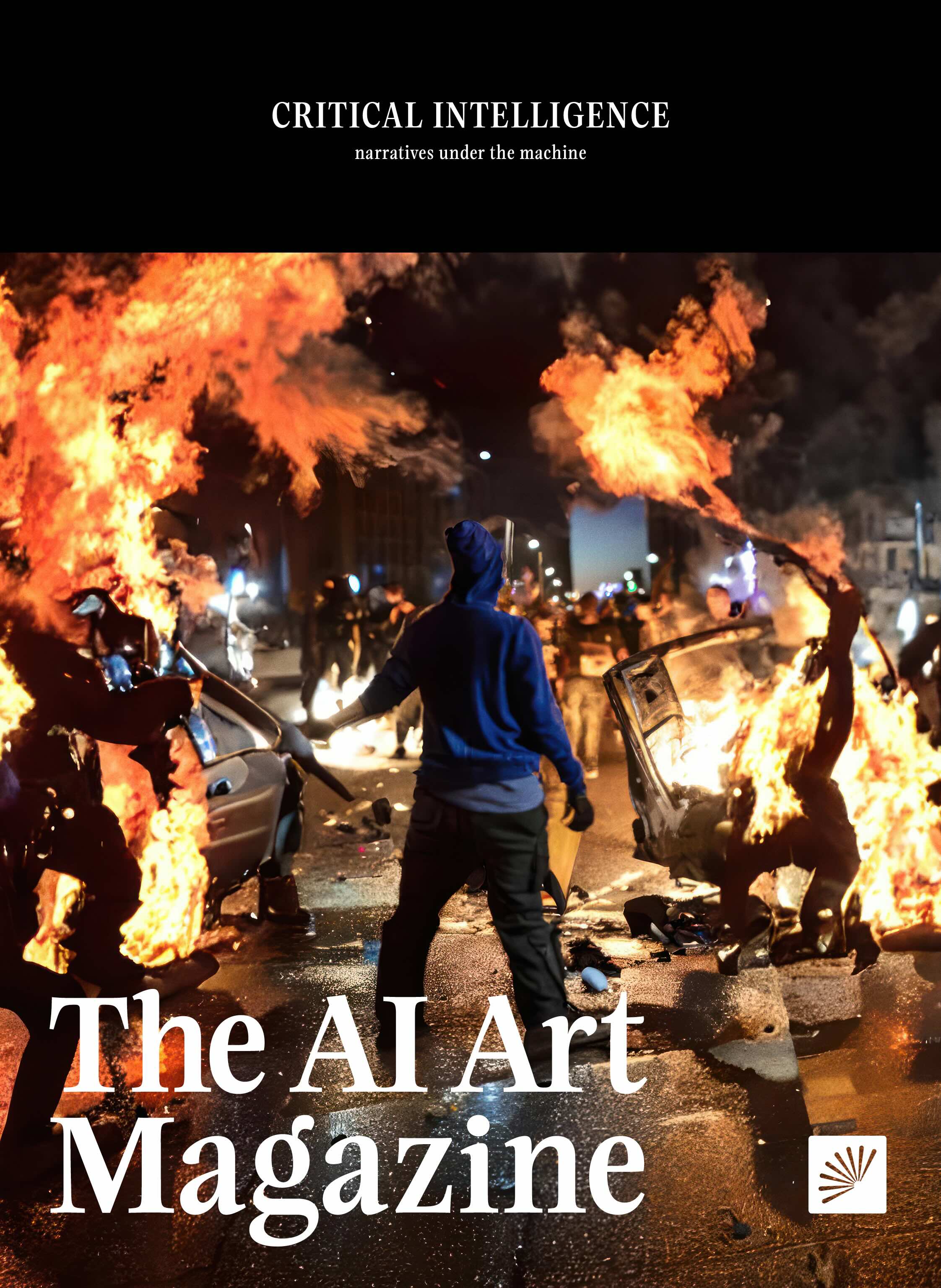
Image credit:
Essay by
Published in >
The AI Art Magazine, Number 1
, AI generation, .
, AI generation, .
Samaritual, , AI generation,

Description

Process

Tools

Image credit:
Essay by