Voigt
Switzerland


Where do you locate yourself in relation to the systems you work with?
Where are you heading, and what is pulling you there?
How would you describe the space your practice is currently unfolding in?
Description
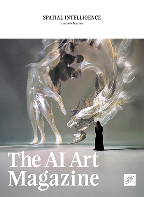
Over the past three years, I have developed a cycle of immersive installations examining three cultural spheres: painting, theatre practice, and natural history. The trilogy investigates how latent visual and narrative potentials embedded in artistic, performative, and ecological archives can be reimagined through a collaborative process between myself and AI-based image and language models specifically trained and adapted for each project. This process opens new perspectives on art, body, and nature. Developed in collaboration with data scientist Tobias Wursthorn, the work brings artistic and scientific perspectives into dialogue. The generated materials are subsequently shaped through my artistic processes of montage, composition, and spatial staging, forming immersive environments that negotiate the relationship between human and machine imagination and open a contemporary discourse on art, body, and nature. A central structural element of the works is that AI not only contributes to visual material but also comments on it acoustically. A synthetic voice describes, classifies, or interprets the images, creating a second observational layer in which machine and audience become viewers simultaneously, reflecting on and critically engaging with the same evolving visual worlds.
Process
The trilogy emerged from my ongoing interest in how perception and cultural memory are shaped by images and archives, and how these structures are changing through new technologies. I was particularly drawn to the idea that vast visual and scientific collections — paintings, stage documentation, botanical archives — contain countless unrealized narratives and perspectives that can be reactivated through contemporary tools. At the same time, I was interested in the growing presence of machine systems that increasingly observe, classify, and interpret the world alongside us. This led to the question of what happens when machine imagination intersects with human artistic authorship, and how these encounters reshape our understanding of nature, bodies, and cultural heritage. The project therefore follows both a curiosity and a concern: curiosity about new forms of image production and perception, and concern about how ecological and cultural memory can be preserved and reinterpreted in a time of environmental and technological transformation. The installations aim to create spaces where audiences can experience this shifting relationship between archive, machine, and human imagination firsthand.
Tools
The project combines AI-based image and language models with cinematic and spatial installation practices. Historical image collections, stage documentation, and scientific archives are processed using generative and analytical AI systems that were trained and adapted specifically for the project in collaboration with data scientist Tobias Wursthorn. Custom datasets derived from paintings, theatre archives, and botanical collections were used to develop models capable of generating and interpreting visual and textual material within each thematic context. The resulting outputs serve as the starting point for an artistic process involving editing, montage, animation, and compositional restructuring. Machine-generated descriptions and classifications are integrated as synthetic voice elements, creating an additional narrative and observational layer. The final works take the form of multi-channel video installations and immersive environments in which moving images, sound design, spatial composition, and scenographic strategies merge. The production process combines digital image synthesis, cinematic editing, sound composition, and installation design, resulting in spatial works where AI-based processes and artistic authorship remain visibly intertwined.