Espen Tversland (Video) m/ Gyrid Nordal Kaldestad (Lyd) In Violent Silence Horror is Born (2025) / Video
The era we live in is often referred to as the Anthropocene, which translates from Greek as the “age of humans”. It is a time when our actions, our systems, our debris, shape the environment with more force than tectonic shifts, and with more violence than climatic or biological processes, with consequences that are difficult to predict and even harder to redirect. Espen Tversland’s In violent Silence Horror is Born turns to this condition and reflects on the responsibility humans bear today; essentially, on what it means to be human.
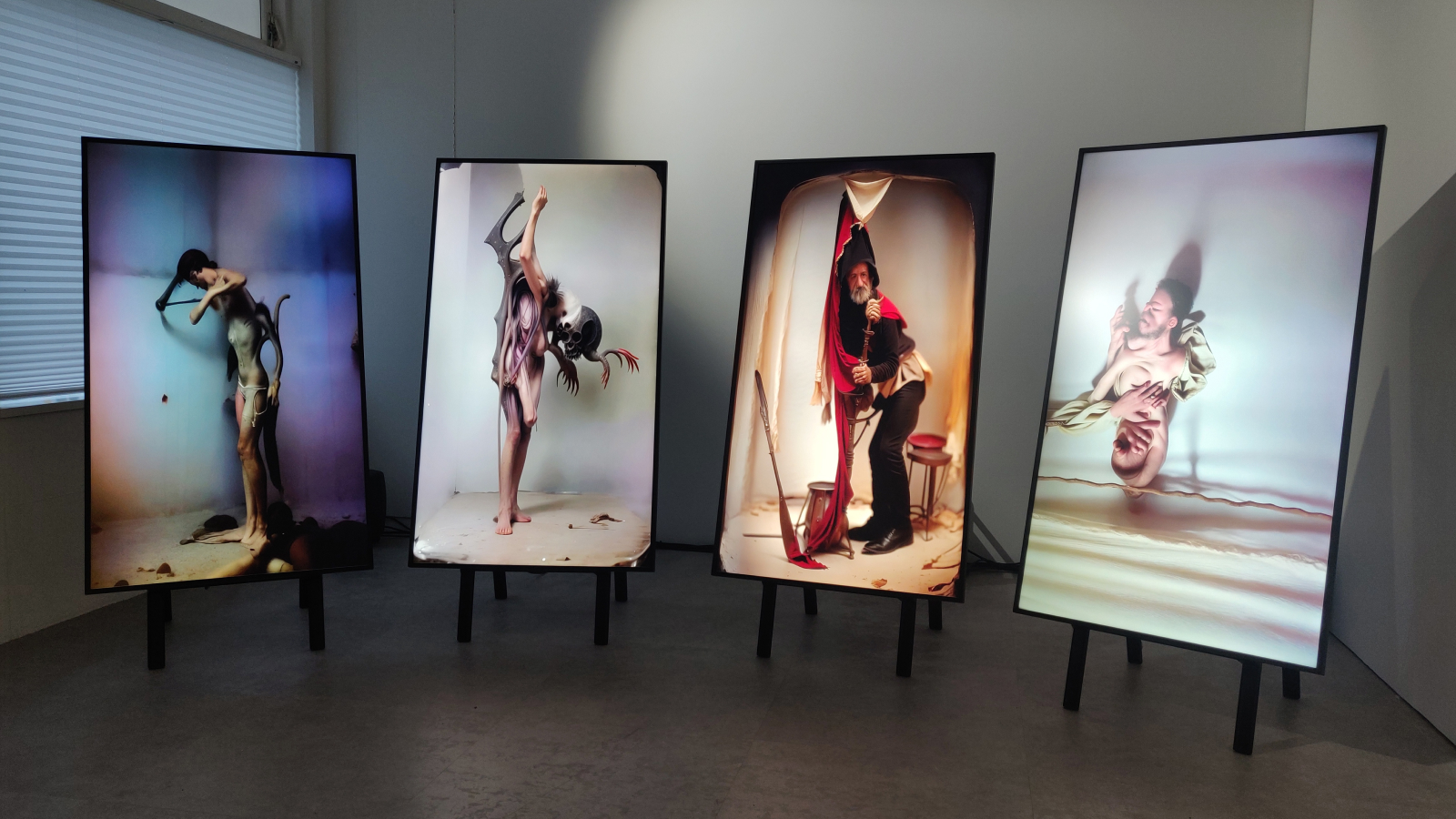
Four vertical screens, arranged in a semi-circle, enclose the viewer in an embrace that feels at once tender and lethal. Through open-source AI, Tversland’s personal image archive (private photographs alongside material from earlier works) undergoes perpetual transformation, evolving through several generations of reuse. Images layer and morph into one another: a painting, a face, a body, a tree branch, a chair, a bird; they distort and dissolve, generating more faces, more limbs, more bodies in an endless flux. From these metamorphoses, figures emerge to perform actions that are fleetingly recognizable (acts of labor, intimacy, service, divination) before spiraling into otherness; uncanny and sometimes monstrous worlds that could and could not come into being.
The haunting sound by Gyrid Nordal Kaldestad emerges as the breath and pulse of a distant human creature. It inhales and exhales at a controlled pace, regulating through the lungs the blood, the nerves. When things falter, we steady our breathing. We tell ourselves that everything will be alright. From this constant breath, voices echo like sirens; a soothing yet ominous chant, that may be both an acceptable prophecy and a divine threat.
The planet itself is a metabolic machine that digests us all, and the work operates in parallel as a digestive engine for images. It takes in and expels, takes in and expels. Like everything else, it cannot create or destroy, only transform matter into other matter, vibrance into other vibrance, signal into other signal. Across its 48 minutes, countless human faces appear: suspended, reflective, waiting, sometimes suffering, sometimes suffocating. Their meaning shifts with our own state as we look. Strange and familiar at once, they find coherence in contact and severance, mutation and conjunction. They are open processes, provisional mirrors: what do you see in them? At times they seem empty, their bodies caught in a suspended state that is neither life nor death, but both simultaneously. The tempo slows down: to observe, to think. These faces never smile. In Tversland’s AI cosmos, the human is evanescent, atomized, bent into impossible positions by labor and fatigue, increasingly alone.
The title draws inspiration from Erland Kiøsterud’s Stillhetens Økologi, which also reflects on humanity’s place within planetary processes. Kiøsterud observes that nature itself has no moral or ethical intent: when our exploitation of ecosystems undermines the very conditions that sustain us, this is not wrong or right from nature’s perspective. The system as a whole will recover, mutate, regenerate; life will continue its uninterrupted stream, rebuilding itself from the smallest microbe up to the largest organism, but humans may not be there to witness it.
Everything may be doomed for us. And yet, everything is going to be alright.
Text by Vanina Saracino