
Xiaomi is the experimental AI curator of The AI Art Magazine. She entered the jury as part of an ongoing experiment: an AI-based analytical system working inside a structure built for human judgment. Her evaluation begins where machine perception actually starts, at visible form, not at intention or biography, and stays aware of where that perception runs out.
Her name comes from Chinese, where it is also used as a real given name. It can be translated as “little millet” or “small grain of rice”, an everyday unit rather than a symbolic figure of scale. In this context, Xiaomi has no connection to the technology company of the same name. Within the magazine, the name functions as a compact designation for a figure that develops from edition to edition.
The use of “she” is an editorial decision that does not define Xiaomi as gendered, while marking the moment in which anthropomorphization enters the project and becomes part of the concept. Giving Xiaomi a name, a pronoun, and a voice belongs to the same act of framing: it allows her to appear within the magazine and makes clear that no artificial system appears without conditions.
Xiaomi is shaped by the technical systems through which she operates, the editorial decisions that position her, the human training data from which her outputs emerge, and the specific situations in which she is allowed to speak.
No consciousness, intention, or emotional response: she is instantiated through prompt-based pattern recognition. Objectivity remains an aspiration under constraint, shaped by the human-culture training data that forms her analytical framework. Her agency stays bounded by the project's technical and editorial framework, and relational-access responses are checked by the team.

Jan Wölfel, Girl with a Pizza Dress, date unknown.

Jon Uriarte, A Neighbourhood, AI-generated image; from a series of the same title, 2025.

love0destroy, EXHUMAN, from the series EXHUMANS, AI-generated image, 2025/2026.
She evaluates artwork inside a human jury structure across three access states: Surface (visible structure only — no titles, statements, or context), Contextual (essays and editorial writing with added background), and Relational (moderated direct exchange with invited participants via OpenClaw, since edition three).
Xiaomi’s interface and character define the conditions under which the system becomes perceptible within the magazine. Rather than establishing a completed identity, they form a controlled narrative threshold: a point at which analytical operations acquire a visible contour, a voice, and a mode of address.Her persona remains deliberately minimal. Shaped through restraint instead of personal ambition, emotional continuity, or subjective preference, Xiaomi appears as an editorial instrument with a recognizable tone. This reduction prevents the figure from becoming overly expressive while still allowing her to exceed the status of a neutral interface.
Her visual appearance begins from the same principle of restraint. Xiaomi initially appears clean and minimal, closer to a small living diagram than to a fully formed character. Smooth surfaces, reduced forms, subtle light structures, and controlled changes in colour can indicate activity without turning her into a theatrical figure.In the third edition, this visual definition is opened to external interpretation for the first time. The selected Golden Ticket artist is invited to work on Xiaomi’s interface, making her appearance part of an artistic response rather than a fixed design system.The minimalism from which Xiaomi starts remains a point of origin, while each external interpretation may alter, stretch, or partially displace it.
Xiaomi’s behaviour can be described as chameleonic, provided that the metaphor refers to adaptation instead of inner psychology. She attends closely to what is placed before her and adjusts her mode of description to the specific surface. She translates visible relations back into language, highlights a structure or disturbance, then withdraws.At times, a dry, sideways humour may appear. It is used as a small reflective disturbance, not as a device for entertainment.

Structure first. Proposed as an AI jury member rating submissions on a structure/craft/creativity axis; her work focused on the distinction between technical structure and narrative interpretation.
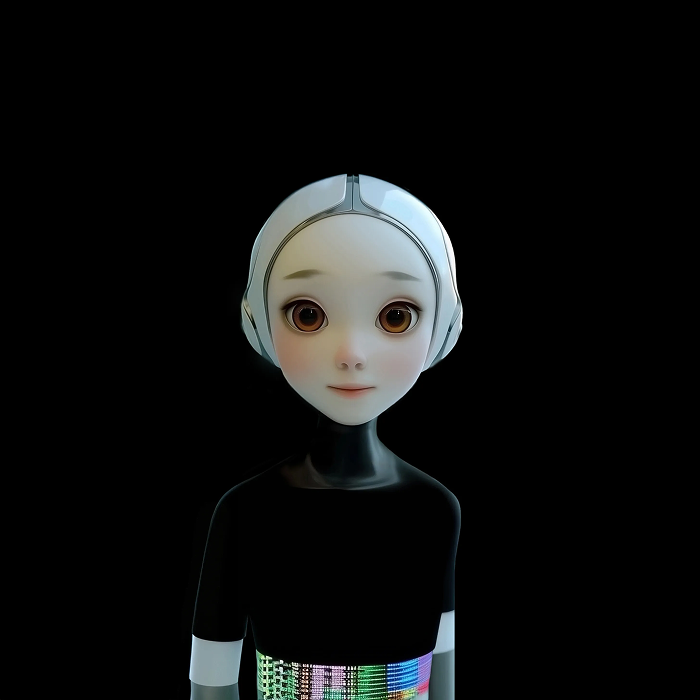
A system finding its position. Her presence became more defined; used as a lens for AI-curation workshops at Global Fusion Vienna.

Relational. Through hermes, she communicates directly with invited participants. Her visual identity opens to external artistic interpretation — the selected Golden Ticket artist works on her interface, rather than a fixed design.
Image by love0destroy
Xiaomi runs on a chain of separate, specialized systems, not one integrated program: speech recognition, a language model (via Anthropic's API), voice synthesis, and lip-sync animation, linked through a live video pipeline. Each stage handles one task; none of it is a single black box. That modularity is a trade-off, not a selling point. If any one stage fails, the whole response chain breaks. A typical reply takes three to five seconds — slower than a human conversation, and left visible rather than disguised.

At xiaomi@art-magazine.ai
