< Artist Directory
Interview by Olena Yara
_JAN, 2026

Louis-Paul Caron: “The world burns. We sit. We watch.”

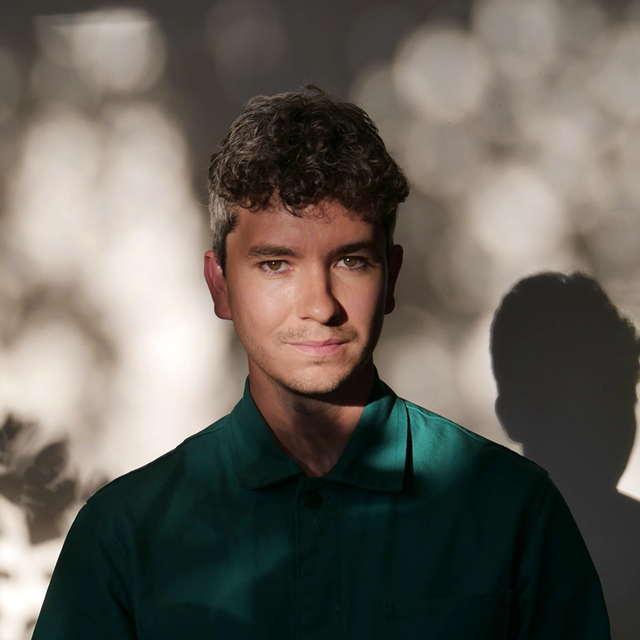
Louis-Paul Caron is a French digital artist based in Lyon, whose work has been exhibited internationally, including at Art Basel, Seoul, New York, Milan, and Dubai. Through video art, oil painting, and artificial intelligence, he explores our evolving relationship with nature and climate change, bridging digital and traditional practices.

Trained in design and digital arts at École Boulle, Design Academy Eindhoven, and ENSAD Paris, his work engages with how the climate crisis transforms the way we see, think, and imagine the future. He translates today’s most pressing environmental and technological challenges into compelling visual narratives.This year he exhibited his works at Paris Photo Digital Art Section. Furthermore, he’s actively promoting and communicating an idea of a green future and an environmental crisis we’re going through.

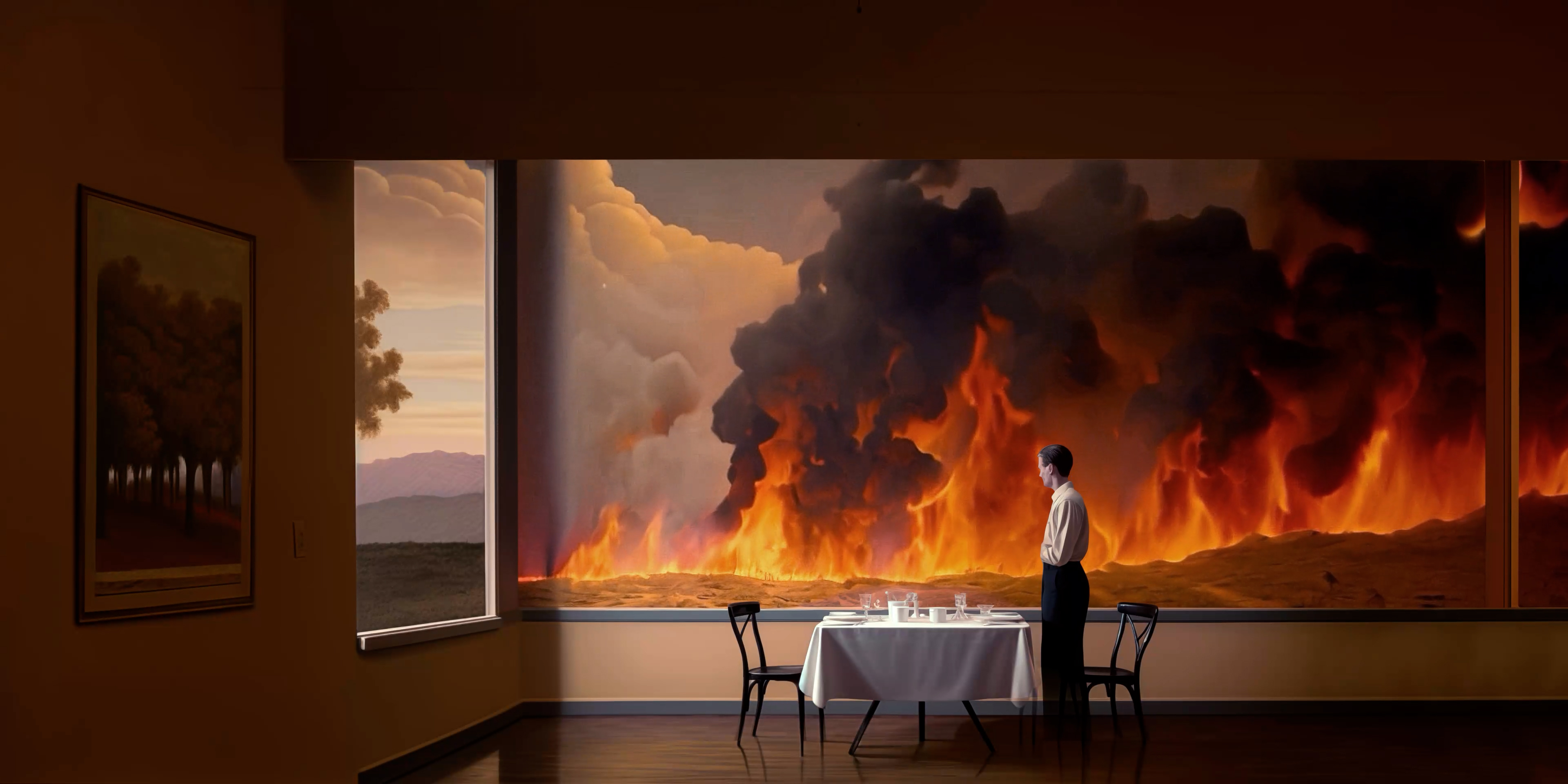
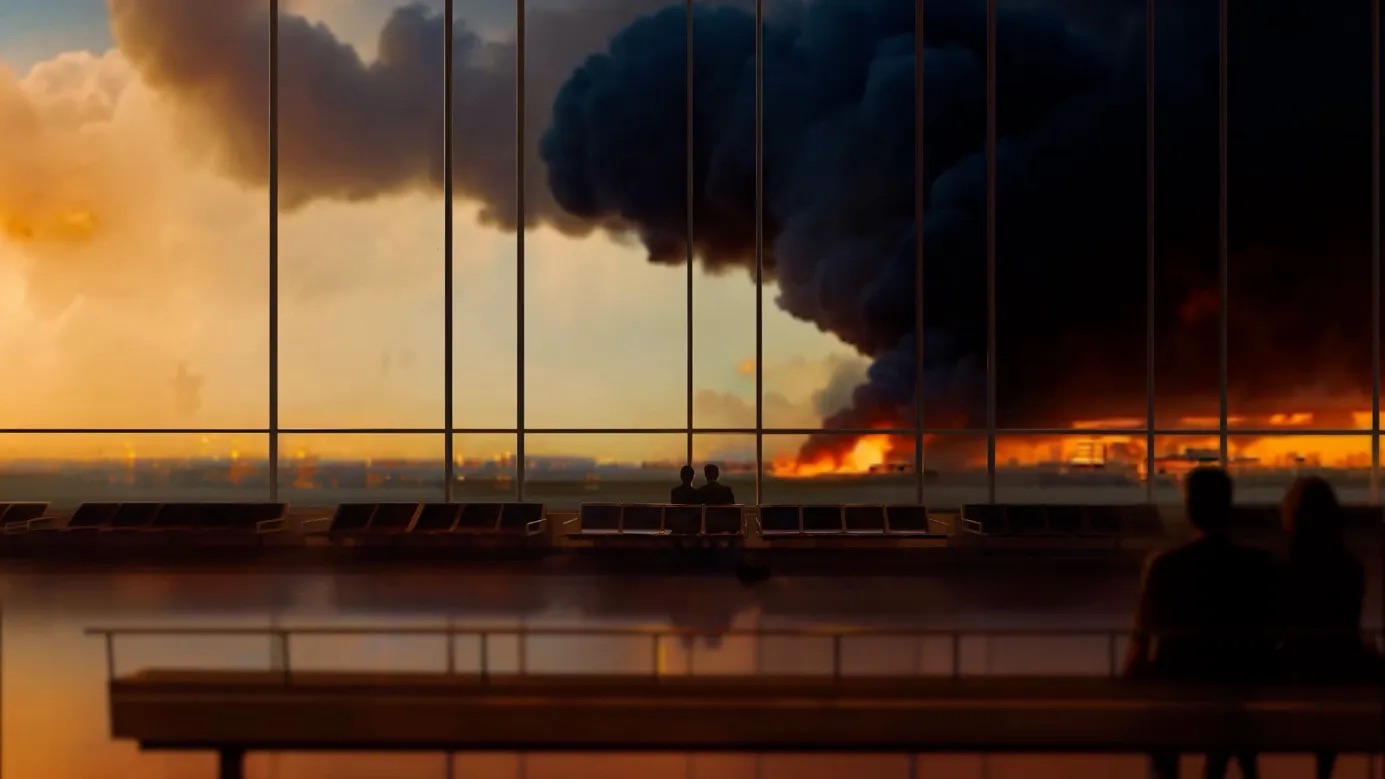
“The world burns. We sit. We watch.” is a quote by Louis-Paul Caron that feels less like a metaphor and more like a diagnosis of our time. We are informed, connected, and constantly witnessing, yet largely silent and immobile.Through Incendies, Louis-Paul Caron visualizes this exact condition.
Louis-Paul Caron, Une table avec vue from Incendies series, 2024.
Incendies series
Olena Yara. I first encountered Incendies at Paris Photo in 2025. The calm, almost motionless figures watching the fire were immediately striking, and then, on my way home, I saw the same images again in the press.

You’ve described the series with the words “The world burns. We sit. We watch.” Why has the environment become such a central theme in your work, and why did Incendies feel like the right moment to articulate it in this way?
Louis-Paul Caron. Ecological and political statements have always been part of my artistic practice on a conceptual level. As a contemporary artist, I believe it is essential to depict the world we live in. With Incendies, I found a way to depict our perception of the environment, translating it into a distant background and revealing how we respond to the situation. For a long time, I had been exploring how heat affects our bodies, but now I think it is even more powerful to show how it affects our minds.
Louis-Paul Caron, L'aeroport from Incendies series, 2024.
Olena Yara. Do you see art as having the power to shift behavior or awareness around ecological issues, or is its role rather to hold up a mirror to our collective inaction?
Louis-Paul Caron. I believe that, as artists, we have the power to convey messages and express feelings that cannot be described with words. We are not a communication company doing marketing for a political party. Rather, I hope to inspire people so that they can understand my vision of ecology and feel it resonate with them.
Louis-Paul Caron, Le glacier from A gentle collapse series, 2025.
A gentle collapse series
Olena Yara. In these three recent works, we see repeating elements, the mountains, the couple, the window, the dining setup. Why does this narrative keep appearing? What does it represent for you?
Louis-Paul Caron. I'm inspired by the fifties, the US, and the American modern way of life that gave birth to our consumer society. This narrative represents the comfort of our modern life in a rather naive and innocent way. It’s a place where our minds have time to wander and think about the past and the future.
Olena Yara. This pieces are phygital. Can you walk us through how the physical components were produced, and what they add to the work that couldn’t exist in a purely digital form? Why was it important for you that these pieces also live physically in the world?
Louis-Paul Caron. I come from the physical art world, and for me the aura of an artwork is really important. I never work with editions or multiples; my artworks are always unique. 
For this series, the physicality brings a certain sensibility. The works are printed on thick, textured Hahnemühle paper, which gives a material presence and a texture to the image that a screen could not achieve. I’m always looking for the best way to move from digital to physical. I do a lot of research work with oil painting, pen plotters, video projection, fabric printing, and more.
Olena Yara. I really enjoy the colours you used in this series. How did you choose them, and what feeling or atmosphere were you trying to create?
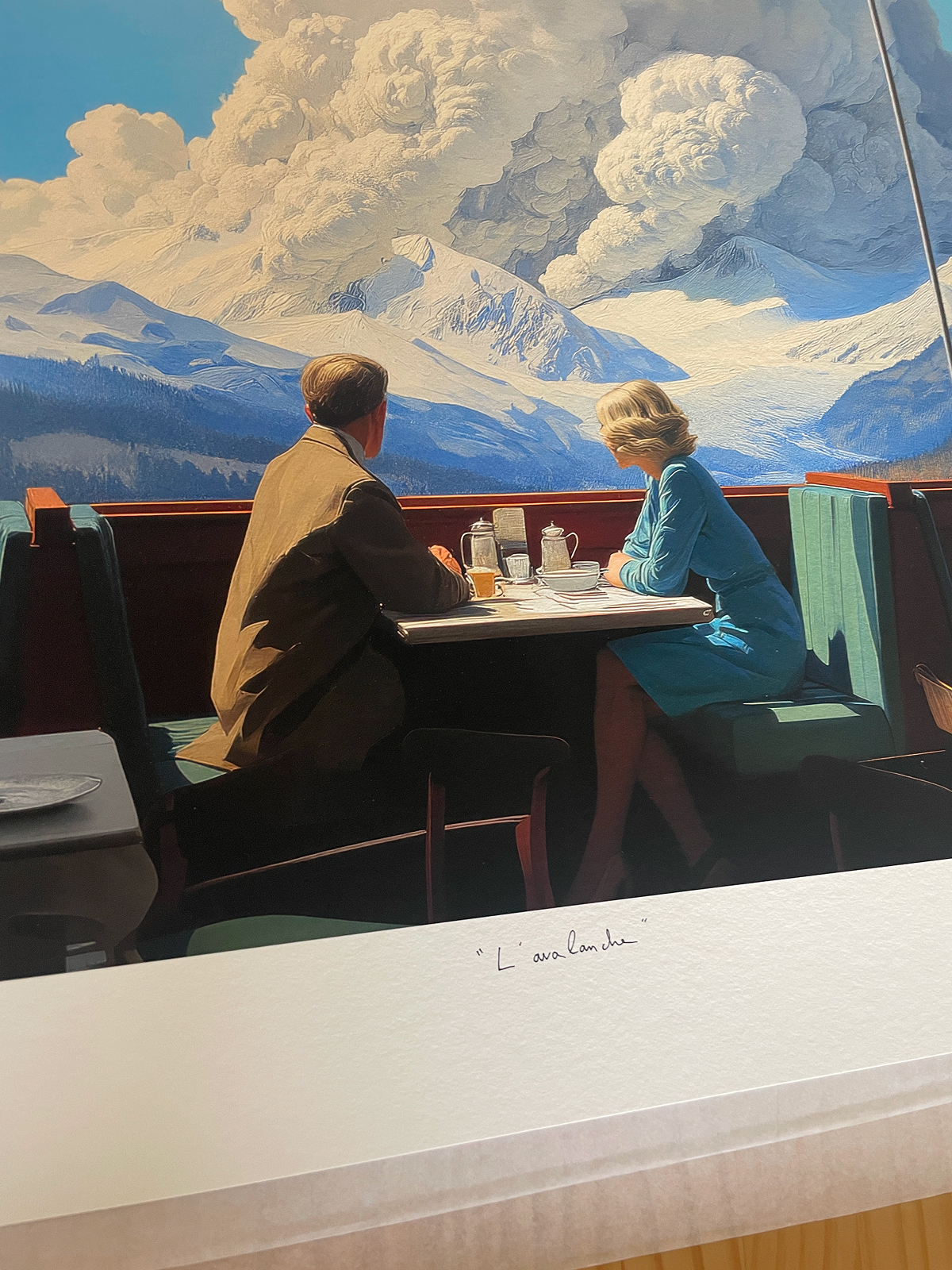
Louis-Paul Caron. My wish was to create a warm atmosphere, something between crimson red and vermilion, which contrasts with the cold blue of the ice and the mountains in the background.
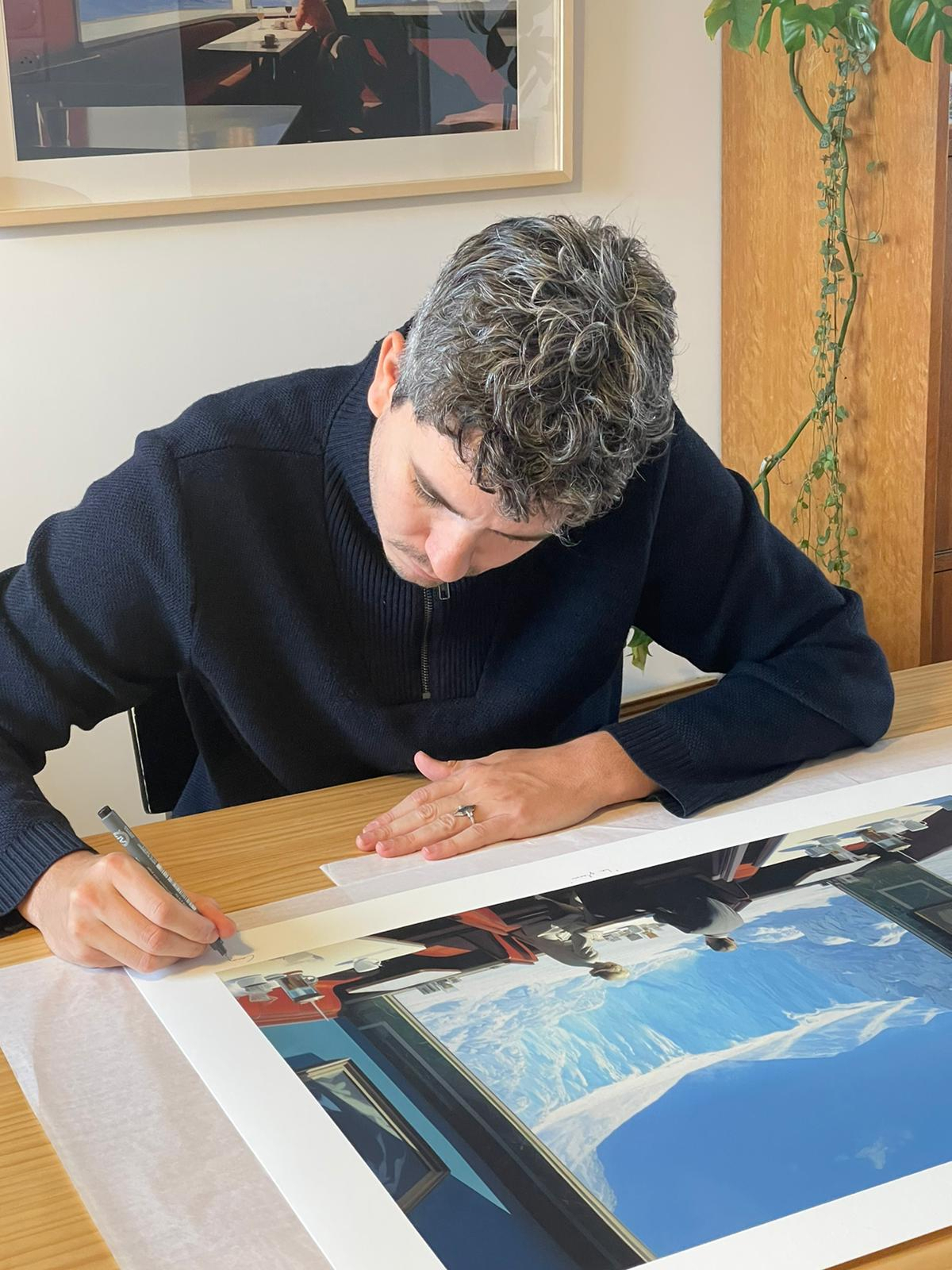
Left: Photograph of Louis-Paul Caron print The Avalance, from The gentle collapse series, 2025. Right: Louis-Paul Caron signing his work.
AI and Technology
Olena Yara. What role does AI play in your creative and technical process? Do you see AI more as a tool, a collaborator, or something else?
Louis-Paul Caron. AI is, for me, a complex tool that offers a new and unexplored realm of plasticity, opening up new possibilities for creating art. I create a prompt-based dialogue with AI software to find the right words, the right images, and the right way to edit and develop my narrative.
As a digital native, I’ve always considered digital and traditional tools to be equally legitimate. I use AI in the same way I would use a pencil or a paint brush.
"As a digital native, I’ve always considered digital and traditional tools to be equally legitimate. I use AI in the same way I would use a pencil or a paint brush."
Looking ahead
Olena Yara. Louis-Paul, thank you so much for taking the time to talk to me. My final question, what are you currently working on, and what upcoming projects can we expect from you soon?
Louis-Paul Caron. I’m currently developing a project exploring the feeling of solastalgia, in the context of the wildfires that affected Los Angeles last year. It’s going to be a substantial project combining AI, photography, oil painting, and a collaboration with Refik Anadol Studio.