< Artists
Interview by Simone Brauner
_May 6, 2026

niceaunties: "Mirror, Mirror on the wall, who is the fairest of them all?"

The old fairy-tale question returns again and again, because it is never only about beauty. It is about looking, being seen, being judged, and learning to measure oneself through a voice that seems to come from outside, but often already lives within.

In Mirror into the Auntieverse, niceaunties turns this logic gently and sharply at once. The mirror no longer returns an ideal image. It returns an auntie. A voice. A familiar form of care that can sound like criticism. A reflection that is not only visual, but cultural, bodily, and inherited.

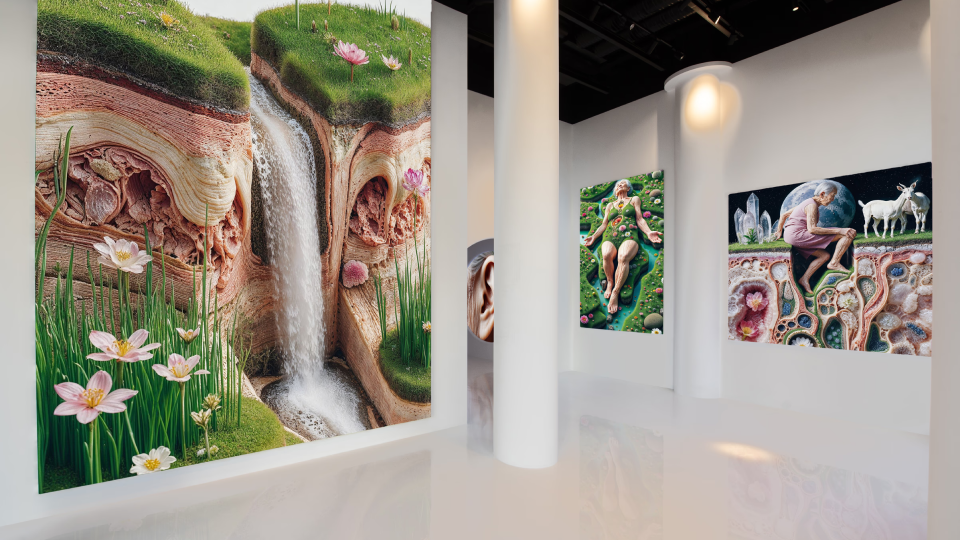
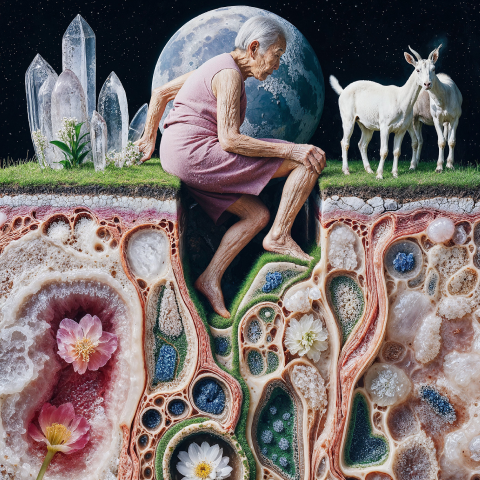
This conversation takes place on the occasion of Auntiescapes at Load Gallery in Barcelona, where the Auntieverse turns toward the body. Skin becomes terrain. Flesh becomes landscape. Menopause, cycles, humour, pressure, beauty, memory, and ecological unease move through the works as living forces.

niceaunties, the artistic moniker of Wenhui Lim, has built a world in which the auntie is no longer a side figure in someone else’s story. She becomes the one who looks back. She carries care and judgement, resilience and absurdity, social memory and speculative freedom. She can be monumental, funny, tender, strange, and uncomfortably precise.

A mirror is never only a surface.
Sometimes it is a threshold.
Sometimes it is an auntie.
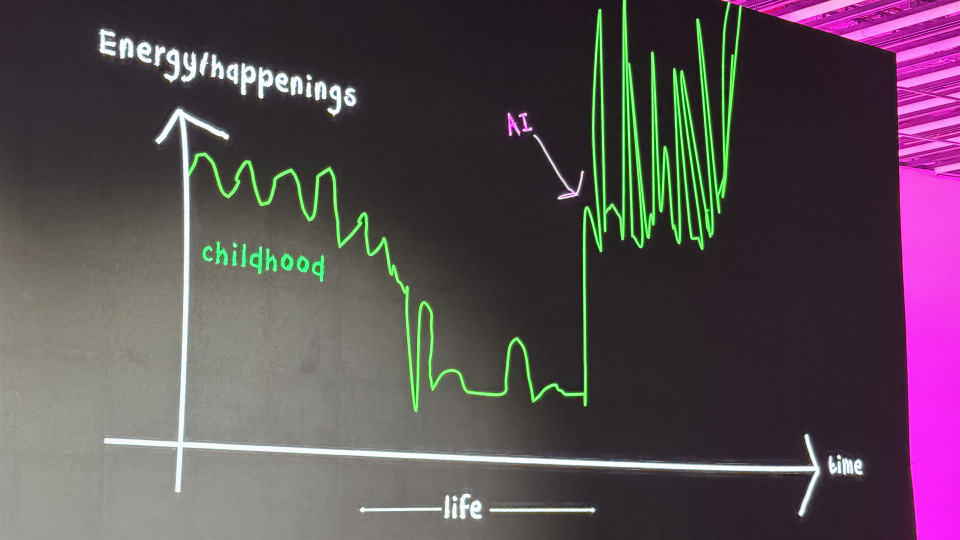
Simone Brauner. In your OFFF Barcelona talk (2025), you showed your energy diagram: creative energy flattening after childhood, then shooting upward with AI. The aunties enter in this third phase. Over a year has passed. If we placed two curves side by side—yours and the aunties'—would they still run in parallel, or has the Auntieverse developed a dynamic of its own?
niceaunties. What an astute observation and question! Well, actually there are three curves happening in parallel.
The first curve is a gigantic one spanning the entirety of human existence. If I may be so bold, aunties are to me a facet of the feminine in a time when it is oppressed.
The more I ask questions about aunties, the more I open up a Pandora's box containing thousands of years of social conditioning. It is the typical "the more you know, the more you don't know."
Aunties seem to exist at the precipice of the old structure of being hidden and suppressed, and the leap into unfamiliar territory of understanding identity, self-worth, and power. The spectrum of this journey exists in many shades across the globe and layers of society and culture. It is a wonder to observe, study, and learn from one another. With the internet, this learning became far more transparent and yet overwhelming.
In parallel, I note a movement on social media of an increasing feminine voice, women of all ages in search of their identity and manifesting their desires, ageing women talking about energy, health, and being in touch with their bodies. It is all new and wondrous to me. It is not something we speak about in the open in my culture. It is not just the case of we don't know what we don't know, being loud or too outstanding is frowned upon.
The second curve is a continuation of my graph, and it mirrors my own excitement and emotions exploring and accessing this subject matter using new technology. I was feeling a lot more, in both depth and volume. This curve ebbs and flows as I navigate a new life direction. Creating the Auntieverse is a journey of growth, of self questioning and a search for identity, of asking questions on my own terms. Not relying on so many other humans to manifest an outcome, as compared to architecture, is a breath of fresh air.
The third curve, the curve of the Auntieverse, of reimagining aunties in a speculative future, is the one that navigates between the above two, weaving, balancing, at times leaning closer to one than the other. It fluctuates between the excitement of expansion into mediums beyond digital art, into sculpture, film, academia, and beyond, and the conundrum of increasing bewilderment around the expanding topic of the auntie and trying to understand what it means.
niceaunties, “Energy/Happenings,” presentation at OFFF Barcelona, 2025.
Simone Brauner. The amplitude in this third phase seems quite high. What creates a peak or a low point for you today? Is it still technological shifts, or has it moved into the conceptual?
niceaunties. A peak is always about discovering a new perspective for creating content, whether it is reframing an old idea or finding a new form of aesthetics by combining ideas that have not been tried before. In the beginning, the technology and wonder of creating something through a simple prompt of course contributed to the peaks, but that has given way. In fact there are always too many new things to test.
A low point would be a typical artist's block of feeling like nothing has yet been created, and self doubt, though these feelings quickly fade as one gets into the flow.
Simone Brauner. Speaking of flow, what skills do you think one needs to truly find one's way with this tool?
niceaunties. I learned that the best way to create is to stay in the experimental and "having fun" space. It takes patience to find prompts that project the right vibes in images, and after that, the prompts form a base upon which future images are built.
And therefore, the most important skill is clarity of intent, being focused on the direction we wish to create. That comes from self understanding. I think that is where the real work is: self work.
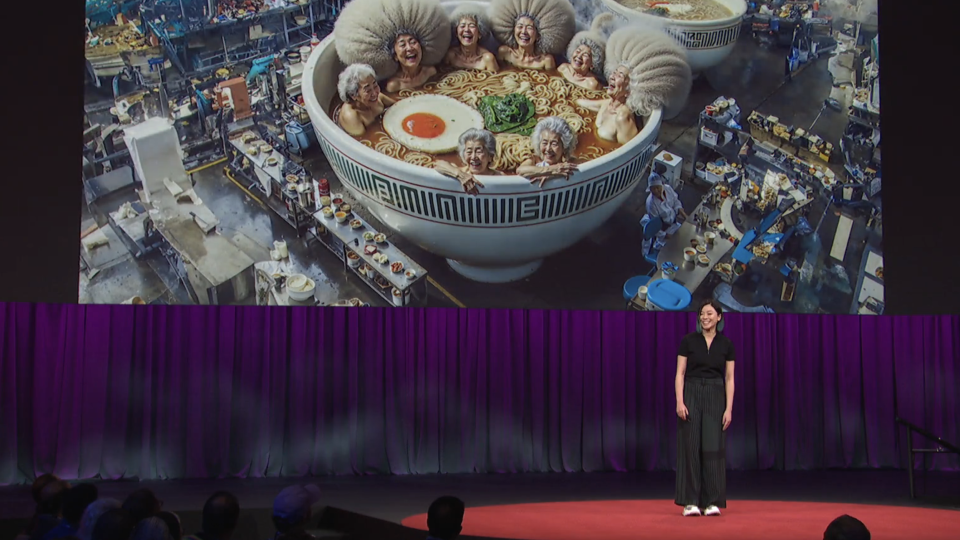
niceaunties, TED Talk, Vancouver, 2024.
Simone Brauner. In your TED Talk (April 2024), you describe your transformation from architect to artist and how AI opened a new form of visual expression for you. Do you think the aunties represent this possibility of transformation?
niceaunties. The entire Auntieverse is about reframing the negative stereotype of the auntie, giving it new meaning, a fresh injection of energy, and focusing on possibilities regardless of age or societal expectations. In this context, the aunties do not just represent the invisible characters in our world, they also represent the ageing figure, the voice of self-criticism, the suppressed inner voices.
Simone Brauner. Your aunties seem "gloriously, unapologetically free." Looking at your images, anything feels possible. Yet in everyday life, the question remains: how much of this freedom can actually be lived? Is the Auntieverse daily motivation for you, or is it a space to retreat when reality feels too rigid?
niceaunties. Despite what the world says, we have the power to create our own lives and our own freedom. The Auntieverse is an affirmation of that belief, and it feels empowering to visualise it. In a way it is a vision board for the future, which I believe is not too far off. It is up to the viewer to interpret what they see and feel.
niceaunties, Title, YYYY.
Simone Brauner. How alive are the aunties to you? Do you keep something like a world bible, an internal map defining the rules and biographies of this universe? Or do you intentionally leave their identity fluid, so they can evolve with each new technological development?
niceaunties. The aunties from the Auntieverse represent a magnified slice of the real-world auntie, the version of her who is unapologetic, who places herself first, who loves both self and world, understands we are one organism yet sovereign, and also chooses to be free and have fun.
The Auntieverse is evolving with an internal four dimensional map that overlaps geography, themes, and cultural nuances. I have tried to organise its narratives within a real-world logic, and they now exist in various places across the Auntieverse: Auntie City, Auntlantis, Jelly City, the Moon. Themes such as beauty, childhood memories, and environmental concerns offer another way to navigate the Auntieverse. For the Auntiescapes exhibition, the body is the place of focus and the theme is energy and the body's relationship with the planet.
niceaunties, parkour, 2026.
The auntie has arrived
Simone Brauner. The word "auntie" has travelled through many meanings. In Asian cultures and parts of the African diaspora, it can be a respectful title for older women who hold social and emotional authority. But it can also be dismissive, a label for women seen as old-fashioned or out of touch.
niceaunties. In Asia, in many cultures, we call any mature woman on the streets an "auntie," just as one would say "madam" in Western society. The "auntie" is also a label for menstruation. "The auntie has arrived" has a sense of dread and suffering. The "auntie" is also a maid or cleaner in China. It would seem to me that too many negative connotations have been attached to this terminology, which is also applied to loved family members. In Singapore, even interior designs or furnishings can be labelled "auntie" if deemed unfashionable.
Simone Brauner. For me, as a European woman, the word feels different. In my language, "aunt" is mostly tied to biological family and does not carry the same deeper social or cultural associations.

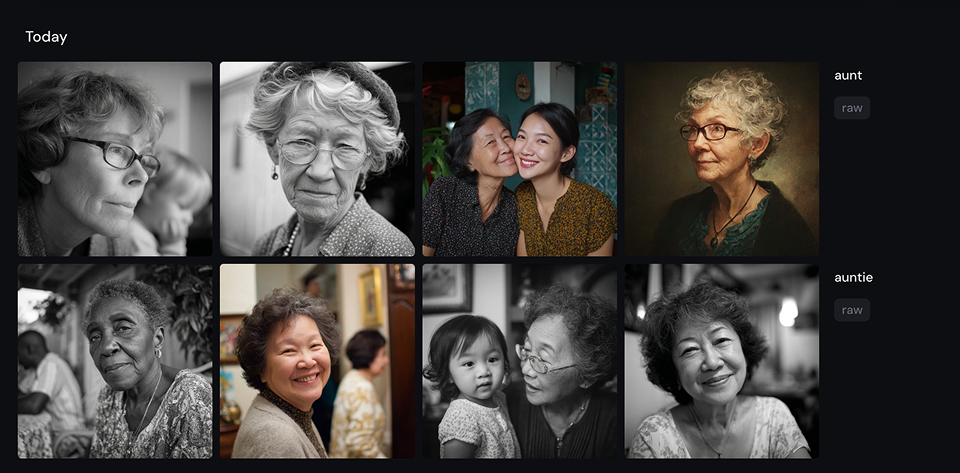
I made a small experiment in Midjourney, comparing "aunt" and "auntie." The result was interesting: "aunt" produced older white women in classical portraits, often with serious expressions. "Auntie" shifted toward Black and Asian women, toward warmth, kinship, and social closeness. For the algorithm, the suffix seems to function as a cultural code.

Does this bias still play a role in your creative process? Or have you personalised your tools so much that the clichés of the base models are no longer an obstacle?
niceaunties. At the very beginning, the bias in Western AI models existed in terms of nationalities. In early 2023, prompting "Japanese" generated clearly defined Asian faces. That flavour still exists in my work, as LoRAs were trained based on over three years of building the Auntieverse archive. That is however a small part of the content. The main purpose is to question, and in turn raise questions about, personal freedom and ageist ideas.
Screenshot from Midjourney, 2026.
Simone Brauner. In Paris you said: "The guiding question is my attitude towards ageing… and what kind of auntie I want to become when I grow up." How has building the Auntieverse shaped your relationship with ageing?
niceaunties. Certainly, my energy towards the term "auntie" has transformed from stigma to one of endearment. Many of my new friends call me "auntie," and I surprised myself by receiving it with joy and humour instead of cringing.
Building the Auntieverse is a constant reminder of how I should be questioning every beauty standard and belief. It does not mean I am not afraid of ageing or wrinkles, but it means I look at the future with curiosity, and the understanding that energy and belief is the key to how life unfolds. I love to experience every facet of life no matter the age, but again, who knows… ask me this again in 10 years :)
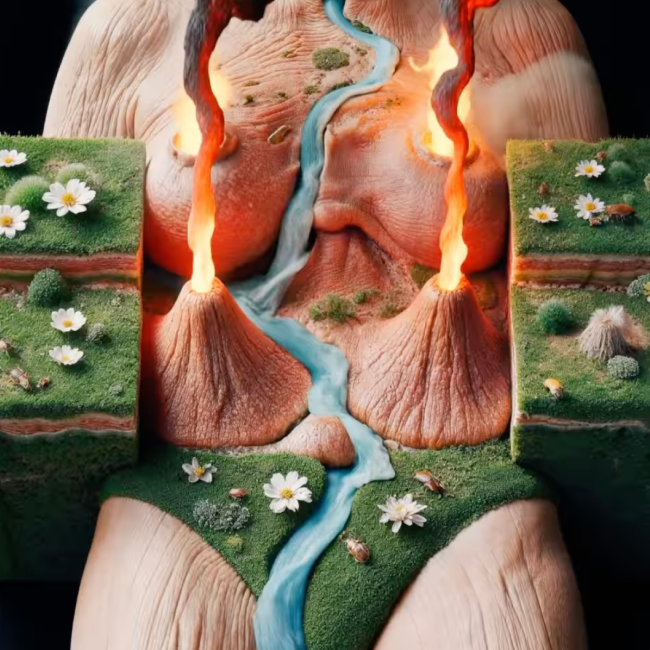
niceaunties, hotbod, 2026.
Simone Brauner. Experiences like pregnancy, postpartum emptiness, monthly cycles, or menopause often remain unspoken. People are left alone with these bodily transformations. 

In works like hotbod, you bring these themes into the centre, directly, colourfully, and in public. What have you observed in your own life, or in the lives of people around you, that led you to tell these silent stories in such a radical way?
niceaunties. You are absolutely right in that these women's bodily issues are not talked about enough or understood sufficiently by society, but that is improving. I read the book "Everything You Need to Know About the Menopause" by Kate Muir and was surprised by the stories shared by women within.
I wish everyone, both men and women, would read the book. I have not yet experienced it myself, and my family members and aunties did not talk about it, but friends around me have talked about their discomfort and energy loss. I imagine the frustrations bubbling under the surface, skin outbreaks, temper flares, and hot flushes. It conjures the image of a volcano erupting from our body, and hence hotbod.
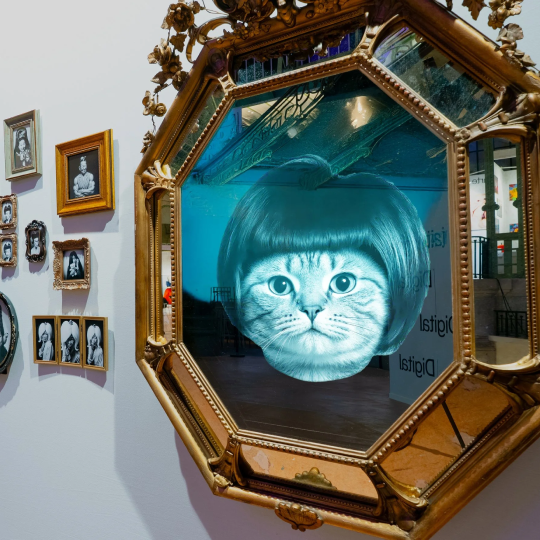
niceaunties, Mirror into Auntieverse, Paris Photo, 2025.
“Wa! Got so many wrinkles already ah? But still got charm la”

“Oh my gawd, You look SO tired, are you ok??”

"Your skin so dry..you must drink more water, trust me!“

“Eh, your face look bigger than last time I saw you leh… what happen ah?“

“Wah, your skin so nice, glow until can blind people sia! What cream you using ah?“
Simone Brauner. A special part of your exhibition is Mirror into the Auntieverse, which was also exhibited at Paris Photo. When someone looks into this mirror, they do not see themselves. Instead, an auntie voice speaks to them with direct, almost "mean" remarks. What kind of language did you grow up with, and is it familiar to people from other cultures?
niceaunties. This is exactly the kind of love language I grew up with. Tough love and care disguised through criticism. I realised it is exactly reflective of the kind of environment the previous generation of women grew up in.
The auntie love language is a culturally specific mode of care, often expressed through blunt questioning and unsolicited commentary. Aunties ask why you have gained weight or not eaten enough, whether you are married, why you are not married, what job you are doing and whether it is stable. These questions, often perceived as intrusive or critical, are rooted in a practical concern for survival, social stability, and wellbeing. The body, work, and relationships become visible markers through which care is expressed and assessed.
What can feel like judgement is, in many cases, a form of protection shaped by lived experience. Having navigated economic precarity, social expectations, and domestic responsibility, aunties translate care into direct language.
The absence of softness does not signal a lack of empathy but rather a different calibration of it. In this sense, the auntie voice operates as both external commentary and internalised self-regulation, one that many carry within them over time.
I note that many women from several countries resonate with this voice. Visitors from Mexico City, friends from Europe and Asia, all reflect on family members showing their care in similar ways.
Simone Brauner. I find it impressive how you use humour as a tool. At first, there is a sense of lightness, and then a space opens for very personal stories. Laughter seems to lower the threshold, making it easier to speak about insecurities we might otherwise prefer to hide.
niceaunties. I find that even though I do not intend my work to be humorous or use humour as an intentional flavour, it is very much part of my culture. Aunties, and most notably taxi drivers, joke about serious issues, offering political or social commentary through wit as a way to talk about things that might otherwise go unsaid. Humour creates a soft landing for hard topics, a more gentle entry point that invites people in rather than shutting them out. It disarms before it provokes. In that sense, I do not see laughter as making things smaller. If anything, it opens the door wider, allowing the viewer to step into something deeper before they realise they have crossed the threshold.
niceaunties, bodybag, 2025.
The Body is
a mirror
a projection of our inner world
a vessel for held and unspoken feelings
a fragment of a larger soul
a delicate balance
a world of organisms
the planet Earth
a universe within
Beautiful
Simone Brauner. On the Load Gallery website, there is this beautiful text that describes the body as a mirror, a world of organisms, and the planet Earth itself. Why did you choose the physical, ageing body as the primary point of access here, rather than staying with social roles or purely cultural narratives?
niceaunties. In the most obvious way, one realises the impact that society, family, and other physical forces have on the body. Then, with time and lived experience, it becomes obvious that emotions, energy, and belief systems have an impact on the body too. Who else but the aunties know it best, with their expanse of life knowledge.
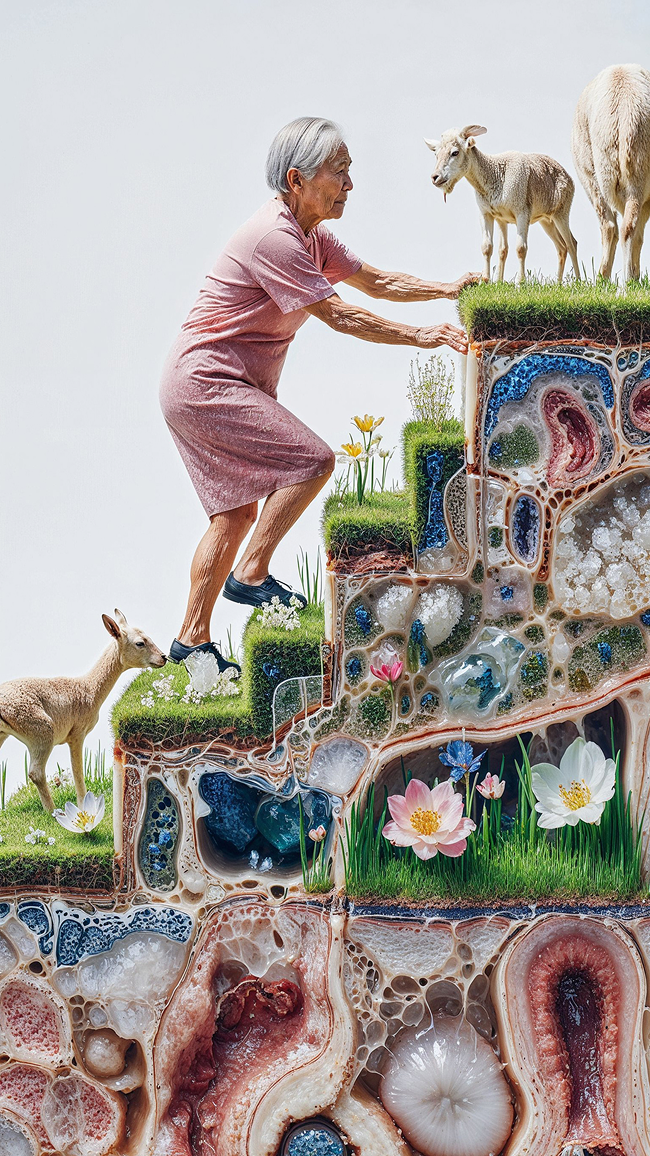
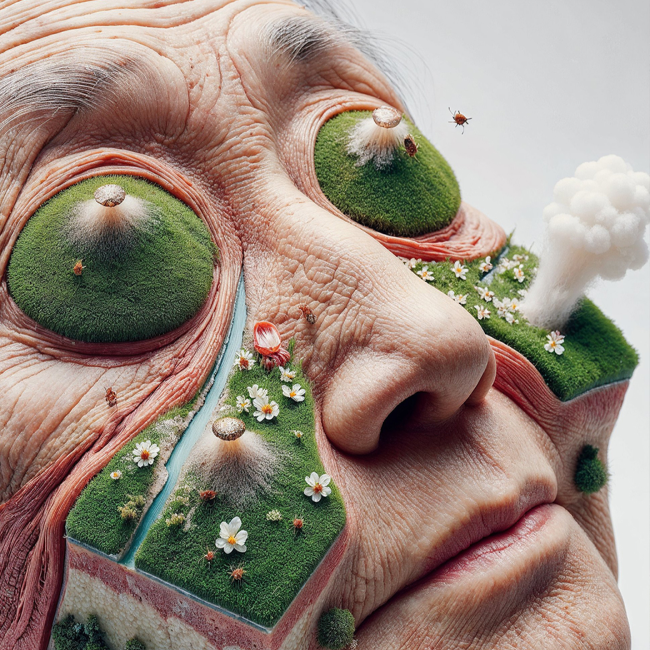
It is also my own conclusion working on this project that the body is frozen energy, and that the body is the conduit between spirit and the planet. We are one, both organism and universe, and the universe is within us. Works like bodybag, junkbutt, and NSFW talk about the weight of emotions we carry and the light within, while works like cycles and frogauntie explore life cycles and the repeating of loops. Auntie nvwa and falls zoom out further to larger scapes, depicting landscapes that reveal themselves to be part of a body at a much larger-scale, reminding us that we are all connected.
niceaunties, Auntiescapes, 2026, installation view at Load Gallery, Barcelona. Courtesy of Load Gallery.
Simone Brauner. In classical literature, the comparison between body and landscape is often eroticized, frequently from a desiring perspective. In feminist thinking, it becomes instead a living ecosystem, a place of memory and resistance—a grown landscape rather than a declining form. What place does desire have in the Auntieverse?
niceaunties. There is nothing wrong with sexual attribution, as it is very much part of our embodied nature, especially when one loves, appreciates, and is connected to one's body, not necessarily seeking external validation. In the Auntieverse, the desire is for freedom, power, and self alignment, and this extends to every aspect of being this new expression of auntiehood: in thought, feelings, inspired actions, and in connecting with our bodies. Ageing is beautiful, and so is the freedom of trying out ways of self care or wanting to stay youthful, as long as it stays light, playful, and self loving.
Simone Brauner. In preparing this interview, I came across Ursula K. Le Guin's essay "The Space Crone" (1976), in which she reclaims the postmenopausal woman not as a figure of decline, but as one of experience, knowledge, and a different kind of authority. Le Guin imagines the "spacecrone" as a figure fit for unknown futures, someone who might know how to live with solitude, change, survival, and the care of life. If the world becomes increasingly digital, and we had to send an auntie into the future, what would she carry with her? What would she know that others might forget? And how can we all keep those values alive, especially in times of crisis?
niceaunties. I love this question! There are a few ideas.
The first is reframing perspectives. Anything can be reframed, and even more so when one zooms out beyond the situation. The auntie would carry with her the ability to see things differently, to find new meaning where others see only limitation.
The second is the balance between the individual and the whole. The auntie would be the one to remind society that care for the individual is just as important as caring for the collective, just as cellular health and microbes and the body support one another. It is all about balance.
The third is belief. The auntie carries the understanding that she has the power to create her own reality. With love and care for others, while giving importance to herself first and foremost, she demonstrates that self sovereignty is not selfishness but the foundation from which everything else grows.
Simone Brauner. In works such as homebody and falls, the body becomes landscape. You refer to Alan Watts: "We do not come into this world; we come out of it, as leaves from a tree." How do viewers tend to respond to these works, and what interests you in those responses?
niceaunties. It is interesting that for some viewers, the images appear as grotesque and scary, even though it is the very flesh of us. In the Chinese legend, the goddess Nvwa created men out of the clay of the earth, and so did God create Adam out of earth in the Bible. The reaction to these images often reveals more about the viewer's belief system than about the work itself.
Simone Brauner. Your images visualise this sense of interconnectedness so powerfully that, as a viewer, I am immediately reminded of who I am and what I come from. But while I enter this world, a second voice appears: the knowledge of the resources, server farms, and algorithms required to make these visions possible. I often feel this contradiction myself when using these tools. How do you live with this contradiction?"
niceaunties. As for the contradiction of using energy-intensive technology to bring us closer to nature, everything, every part of our existence, requires resources. If I could positively influence people to rethink or question ageing and our relationships with one another, our bodies with the planet, can that kind of intangible giving back be measured against how much I take? I think nobody can truly answer that question.
niceaunties, title, 2026, video still. Courtesy of the artist.
Simone Brauner. At Load Gallery, Auntiescapes moves from the online flow of digital images into a concrete physical environment. The works remain digital, but they become spatial: encountered through scale, movement, light, and the way one's own body moves through the exhibition. Did this feel, in some moments, like a return to your architectural training?
niceaunties. My architectural training shows up more in the layered concepts and storytelling within the videos. As for the gallery space, the beautiful scale of the space and the size of the screens did influence me to consider experiencing my videos in a slower, contemplative way, which led to me zooming into the body and focusing on landscapes.
It is also a reference to landscape works and most notably waterfalls, appearing in many large-scaled commercial lobbies. I wondered what the auntie version of that would feel like, with her oddities and occasional appearance, and what kind of lobby would an Auntiescape fit into. It is out of both curiosity and a reaction to the Load Gallery space, and a continual study of our bodies' relationship with nature, that led to the Auntiescapes.
"If the aunties teach us anything, it is that caring intelligence begins with honest attention to ourselves, to our cycles, to what we carry, and that technology, at its best, can hold space for that kind of honesty."
Simone Brauner. The work can hardly be separated from its carrier. The screens, the round displays, the ceiling installation, and the different viewpoints in the room all shape how Auntiescapes is read and experienced in this space. What possibilities opened up for you through this specific space?
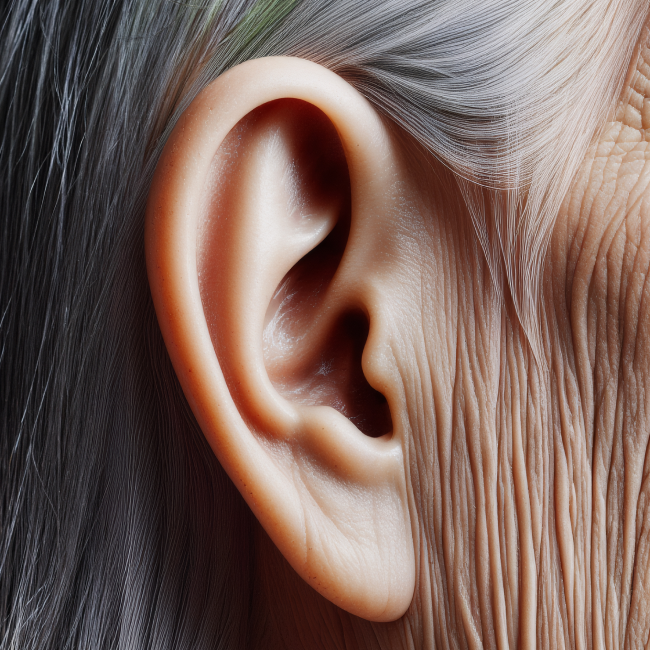
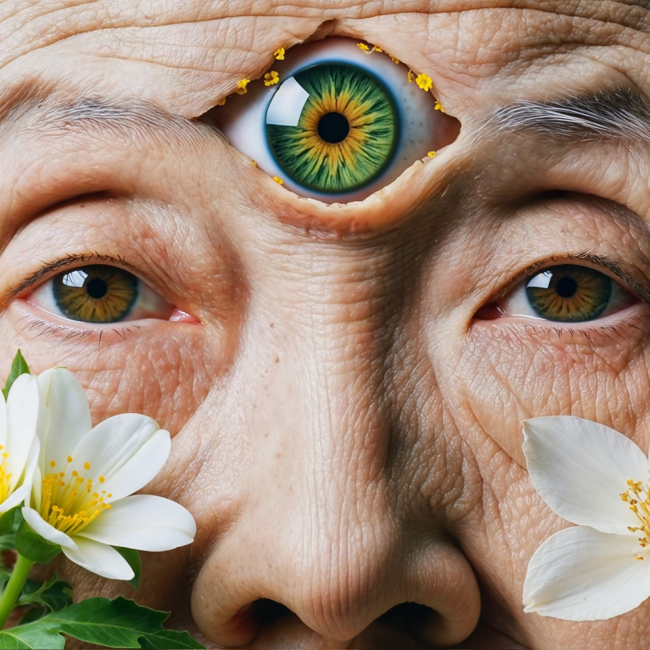
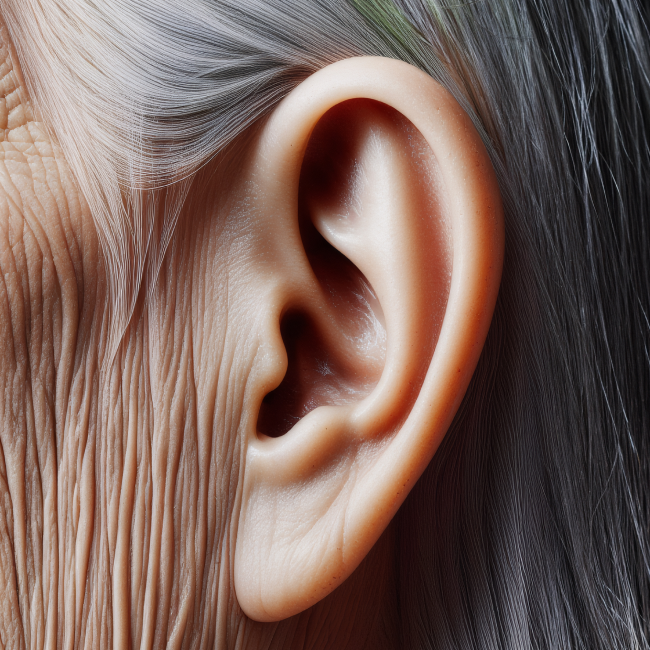
niceaunties. The most notable space within Load Gallery is the round room, an immersive 3x3m room with circular frames in the ceiling and walls, as well as a framed circular entrance, much like a traditional Chinese garden. It seems fitting that it is where the “Mirror into Auntieverse” sits, a contemplative space where your inner auntie is reflected. The circular screens show different parts of an auntie's face: her eyes, her lips, her ears, with flowers growing from within the mouth and ears, dispersing with an imaginary wind. Together they form headspace, the artwork that envelops the “Mirror into Auntieverse”.
At the mirror, visitors step in front of a screen that uses motion capture to replace their reflection with an auntie's face, who, after a few seconds, delivers a blunt insult. Visitors can scan a QR code to capture the moment and print it via Bluetooth as a polaroid to take home.
Simone Brauner. After everything the aunties have already carried through the world, what are you most looking forward to in this return to Barcelona?
niceaunties. Every time I return to Barcelona I see a different side to it. This time, a quieter, more intimate, peaceful side, and it is beautiful. I look forward to connecting with people visiting the exhibition and hearing their thoughts on the body and their relationship with it.
Simone Brauner. Thank you so much for your time, your openness, and for letting us step a little further into the Auntieverse.